Discussion forums bringing together NGOs and startups working in the field of sustainable development will precede the international conference.






In 2015, as Lebanon was experiencing multiple crises, a bold idea emerged at Saint Joseph University of Beirut. Diana Fadel, president and founder of the Diane Foundation, believed that the country's future depended on education in eco-citizenship and sustainable development.
She then proposed to the rector of USJ the creation of a university chair dedicated to these themes. This led to the establishment of the Diane Foundation Chair for Education in Eco-citizenship and Sustainable Development, CEEDD, which has been entrusted for 10 years to Prof. Fady al-Hage, the rector's delegate for continuing education and holder of this chair.
From its inception, the CEEDD made it its mission to work on the seventeen sustainable development goals (SDGs), as the country faces a double emergency: Environmental, with the waste crisis, water and air pollution, and social, with poverty, inequalities, and institutional fragility.
To address these challenges, the chair has developed four areas of action. The first is awareness-raising, aimed at fostering civic consciousness and encouraging new practices within communities, municipalities, schools, and universities.
The second area is training, in the form of specialized modules, continuing education cycles, and academic programs, such as the "Sustainable Businesses Leading to Economic Growth" certificate. The third area is research, through the award of a doctoral scholarship every three years, allowing young researchers to explore scientific or social topics related to sustainable development. Finally, the fourth area is partnership and networking, making the chair a meeting point for NGOs, public institutions, startups, and civic initiatives.
In a decade, the chair has launched numerous projects, often under difficult conditions, but with unwavering determination, says Hage. Among the most notable awareness initiatives are the Citizen Cafés, friendly meetings bringing together citizens and experts around specific sustainable development topics. Another flagship initiative: the "Green USJ" project, which has brought sorting bins to campuses, recycled waste, and implemented upcycling actions.
The chair has also led major projects, notably funded by USAID, on water management. In the Bekaa, in the south and north of the country, awareness and training campaigns were organized for municipalities, schools, and communities. "We worked with a very large number of municipalities to support them in water management and to raise students' awareness about the importance of this vital resource," Hage emphasized. Academically, the chair is now on its third doctoral scholarship. It has also provided continuing education sessions for NGOs and institutions, and organized conferences open to youth and the general public.
Students at the heart of the mission
While the chair operates on a national scale, its heart beats to the rhythm of USJ students. For ten years, the "Green USJ" project has reached the 12,000 students spread across USJ's various campuses in Beirut, the south, and the Bekaa, the rector's delegate continues. Awareness about waste, energy, and water management: every student cohort is introduced to these essential issues.
A student club, the "Green USJ Club," was created to extend this momentum, he notes. About twenty young people from various fields — engineering, geography, science — are already campaigning to make university spaces greener and spread an ecological culture. "The ambition now is to grow this club and open it to all disciplines and all campuses," he added.
The chair has also engaged on gender equality, leading pilot projects in three schools to raise awareness among students about stereotypes. "These workshops showed just how necessary it is to act early on perceptions, and the success of the project led partners to extend it to other schools," said the chair's holder.
A scientific and festive celebration for the 10th anniversary
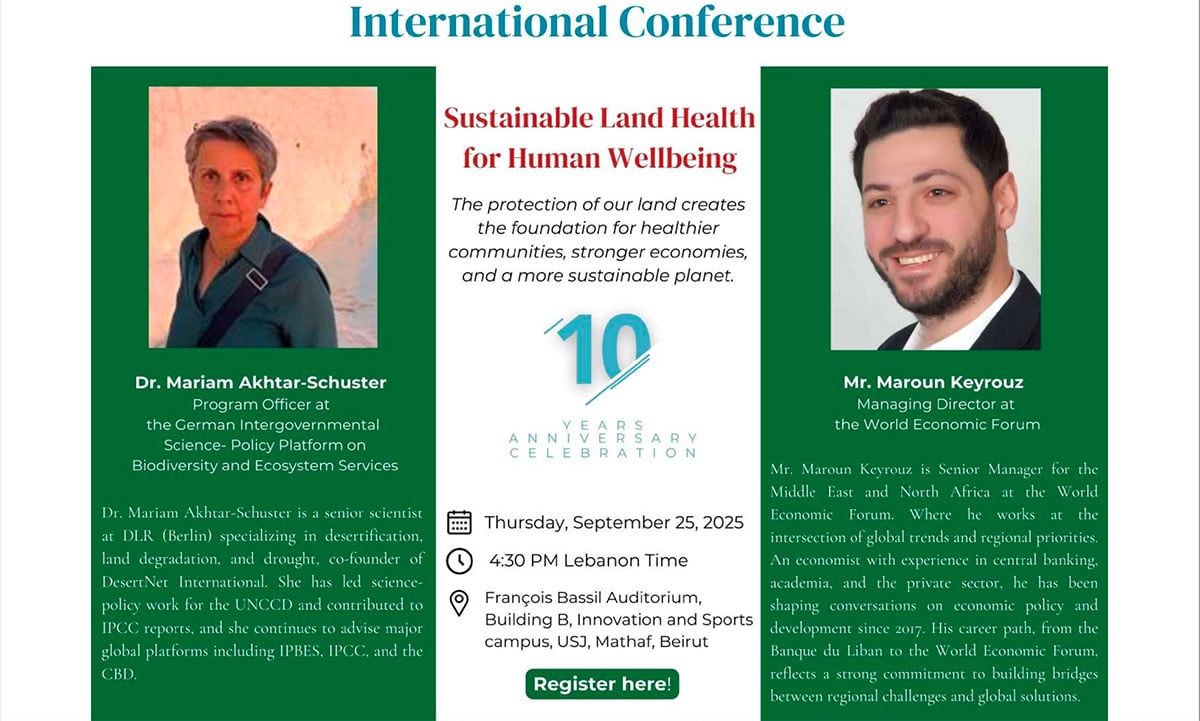
On Sept. 25, 2025, the chair will celebrate its ten years with a scientific and festive event. The afternoon will be devoted to discussion forums bringing together NGOs and startups working in sustainable development.

Four themes will guide the discussions: Humanitarian affairs, health and well-being, sustainable development, and green entrepreneurship. "The goal is to create links, encourage networking, and help these actors find funding to pursue their projects," says Hage.
At the end of the day, an international conference will conclude the event. European researcher Dr. Mariam Akhtar-Schuster will speak on the link between land, well-being, and health, followed by a presentation from Maroun Keyrouz, executive director at the World Economic Forum.
Ten years after its creation, how does Hage view the journey so far? "My outlook is fairly positive, despite all the crises Lebanon has gone through. We managed to stay active on the ground, sometimes online when necessary, and to reach a wider and wider audience."
For him, the challenge is not just technical, but above all cultural and mental. "I think the Lebanese hold a certain resentment toward their environment — that is, after all these crises and wars, there is a rift between Lebanese people and their environment," he noted. "Lebanese take care of their immediate environment — their homes, their cars, their work — but are indifferent to what’s happening outside. There is no empathy for the environment, no sense of care, and we've worked on that during these ten years."
According to him, it is necessary to change this relationship with the environment, to reconcile citizens with their territory. This work on perceptions is essential: "You don't change your behavior without first changing your outlook."
Through its projects, publications, training sessions, and conferences, the chair has helped initiate this change. The story continues: New initiatives are being prepared, new generations of students are getting involved, and a lasting dialogue is being built among researchers, institutions, and citizens.