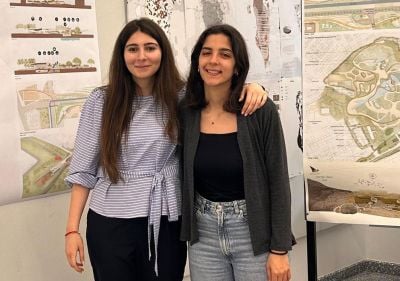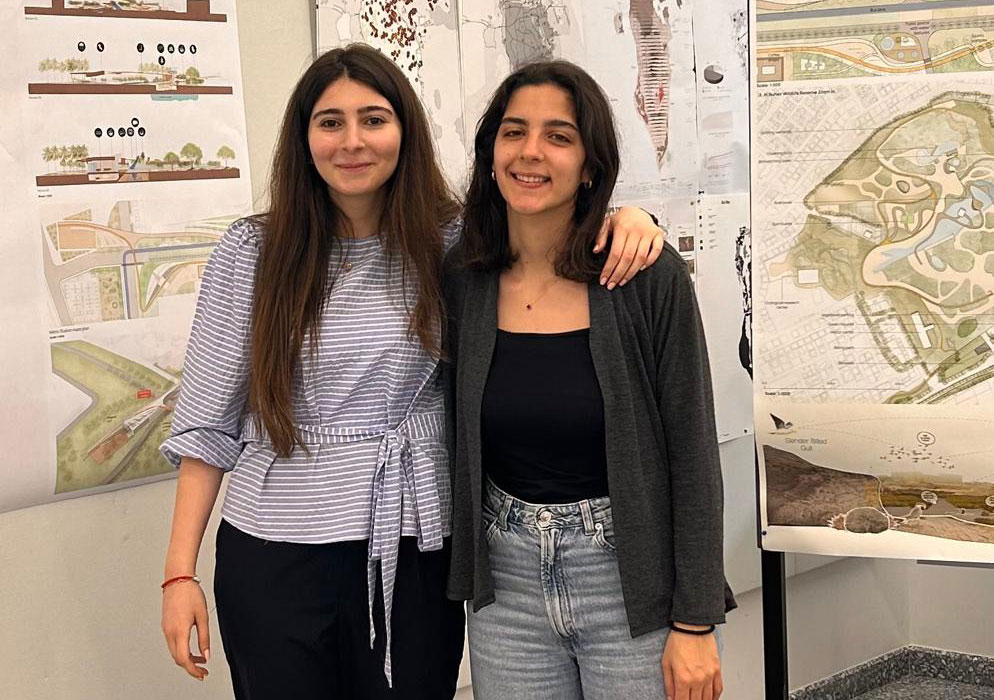
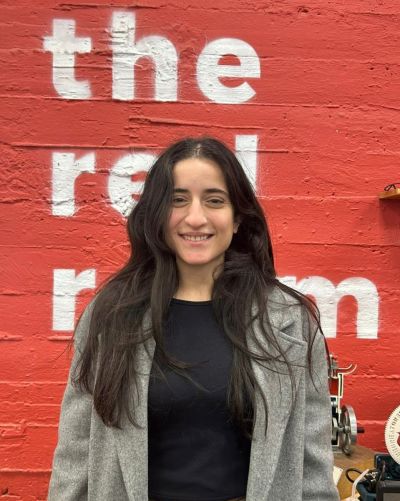
Maya Haïdar (on the left) and Clara Saliba. (Credit: Jana Karnib)






Selected from among 130 applications from universities around the world, Eco Commons is one of 30 projects showcased since Sept. 18 at the Oca Pavilion in Ibirapuera Park, São Paulo.
The exhibition highlights the winners of the International Schools of Architecture and Urbanism Competition at the 14th International Architecture Biennale, launched this year under the theme Extremos/Extremes: Architectures for an Overheated Planet.
Graduate students in urban planning at the School of Architecture and Design (SoAD) at the American University of Beirut (AUB), Maya Haïdar and Clara Saliba presented their project Eco Commons: Seeding urban biodiversity for climate and social resilience in Tubli Bay.
The aim of their project is to rehabilitate the Tubli Bay ecosystem in Bahrain by establishing green infrastructure while empowering local communities. The AUB students developed this project within the framework of the Urban Design Studio and the Territorial Imaginaries research and teaching lab, with support from a grant by the University Research Board of the Maroun Semaan Faculty of Engineering and Architecture.
For the two 24-year-old Lebanese women, this international recognition represents "every urbanist’s dream" and confirms their belief that "another world is possible, one where economic interests do not take precedence over nature and where design benefits not only people but also the environment." They are interested in integrating ecology into urban planning and, passionate about this project, they see this distinction as a validation of their work.
Saliba notes: "This achievement has transformed my outlook on our role as urban planners... Ecology is an indispensable component of our cities, and integrating it into social infrastructure advances climate justice while creating new livelihood opportunities."
According to Professor Sandra Frem, who leads the Urban Design Studio and co-directs the research and teaching lab with Professor Carla Aramouny, Eco Commons stood out because it addresses climate change, biodiversity loss and social inequalities through an integrated vision.
"Rather than seeing ecology and economy as opposed, it proposes a transition toward ecotourism, fair fishing, and renewable energy. This combination of caring for the environment and creating social opportunities, even in the face of climate challenges, is what makes the project so powerful, fostering its selection at the São Paulo Biennale, which focuses on interconnected themes," says Sandra Frem.
The bay as a connected landscape
Once known as a vast refuge for many terrestrial and marine ecosystems, such as mangroves and mudflats, and a diversity of species including migratory birds, today Tubli Bay has been severely impacted by pollution, climate change, and government policies favoring oil-based economies.
Struck by this situation, Haïdar and Saliba saw in it "the urgency to act," but also a "potential for regeneration." Choosing to work on this site became a way for them "to be engaged with a fragile ecosystem whose future depends on new forms of care, responsibility and creativity in design," aligning with the national economic diversification plan for 2030 through the creation of new emerging economies.
To address these challenges, the young urban planners envisioned the bay as a connected landscape, bringing together nature, water and social life. Ecologically, the project aims to restore marine and coastal biodiversity, but also to integrate it into dense urban spaces through a network of continuous habitats for migratory birds and wildlife.
At the same time, Eco Commons establishes water collection, storage, and treatment systems to manage drought, flooding, and water quality. These multifunctional facilities "promote biodiversity" and "strengthen climate resilience."
Socially, facilities such as bird observatories and environmental education centers engage and empower communities. "One of the design interventions we are most proud of is the creation of eco-corridors that reconnect coastal and terrestrial habitats.
Four major corridors, supported by a secondary network, transform the main roads of Tubli Bay into a true ecological web," says Saliba. Including pedestrian walkways, bike lanes, metro lines, and bus corridors, the green eco-corridors as well as shaded public spaces facilitate access to the coast and improve the quality of urban life.
Urban planners of tomorrow: Territory actors
For Haïdar, the restoration of the al-Buhair wetlands as a nature reserve, expanded to its historical size and hydrologically connected to Tubli Bay, is one of the flagship interventions the winners can be proud of.
"There, we designed a multi-purpose pedestrian bridge linking the eco-corridors to the reserve. This elevated structure transitions from a pathway for pedestrians and bikes to a metro station with a public stepped terrace. Below, the metro line is accompanied by seating and an exhibition space," she explains. For the honorees, it was equally essential that the proposed systems "strengthen the existing social infrastructure, allowing citizens to discover existing species and play a central role in environmental protection."
In a world facing climate change, working on Tubli Bay has shaped the students’ vision of the role and mission of tomorrow’s urban planners. "Our responsibility is not limited to creating aesthetic spaces. It also includes the preservation of biodiversity, reestablishing the connection between residents and nature, and designing cities capable of withstanding climate change," says Haïdar.
Saliba describes their role as "mediators between ecology, the economy, and residents." It is mainly "about fostering climate justice and equity by actively involving communities," she continues.
Ultimately, the recognition of Eco Commons at the São Paulo Biennale confirms that "urban planning can and must address major global challenges. For students, it reinforces the belief that their systemic, climate-focused approach has impact beyond the classroom and contributes to ongoing climate action," says Sandra Frem.
The professor in charge of the Urban Design Studio also believes this distinction will guide the careers of future urban planners, "encouraging them to see themselves not only as building designers but as territory actors capable of connecting ecology, politics and society. This mindset is increasingly sought after and allows them to become leaders in climate-responsive and regenerative urban planning."