





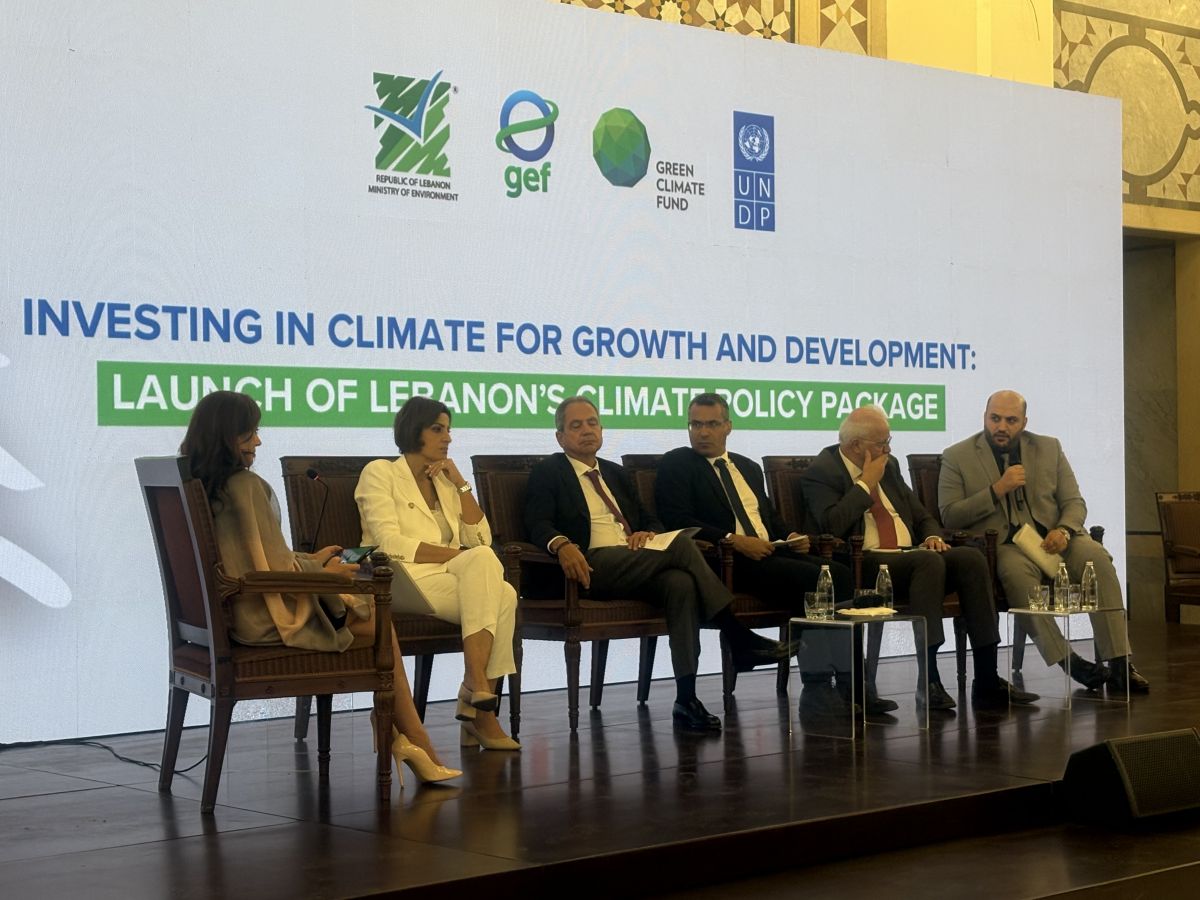
The first round table brought together the ministers of environment, energy, agriculture, justice, and health. (Credit: Suzanne Baaklini/L'Orient Today)






The climate crisis is not the responsibility of the Environment Ministry alone. That was made clear Tuesday at an unprecedented joint ministerial conference at the Grand Serail, organized by the ministry under the patronage of Prime Minister Nawaf Salam, who said climate change “is not secondary but central.”
It was an occasion for Environment Minister Tamara Elzein to launch a “climate policy package” that, she said, “directly addresses the challenges, turning climate risk into an opportunity for resilience and development.”
Noting that climate change already costs Lebanon the equivalent of five percent of its GDP, she announced the creation of a climate change directorate within her ministry.
The package consists of three complementary strategies, explained Lea Kai, climate change adviser to the U.N. Development Program and the Environment Ministry.
The first is Lebanon’s Nationally Determined Contribution, or NDC, which sets out its commitment to reduce greenhouse gas emissions under the 2015 Paris Agreement and the U.N. Framework Convention on Climate Change and is set to be submitted before Sept. 30, according to Kai.
The NDC “shows that despite all the crises, our greenhouse gas emissions are falling and that we are committed to reducing them further, by 22 to 33 percent by 2035,” Kai said, noting that the lower end of the range corresponds to action without international support and the higher end with such support.
The main contribution to meeting these targets will come from the Energy Ministry, accounting for 70, if not 80 percent, she added.
The second strategy is the National Adaptation Plan, Lebanon’s first. “It is a roadmap explaining how the country will adapt to climate change, focusing on eight economic sectors,” Kai said. The third is Vision 2050, a strategy for low-emission economic development.
“The three documents are required by the U.N. Framework Convention on Climate Change, but we will use them for coordinated action among ministries,” she emphasized.

From energy to agriculture ministries, to health and justice ministries
During Tuesday’s roundtables, each represented ministry outlined its challenges. Energy and Water Minister Joe Saddi said he is revising the water strategy and working to address leakage in the pipelines.
To combat drought, he spoke of creating hillside lakes and other ecological storage systems, introducing water reuse systems and improving data collection.
On the energy front, Saddi said work is underway on several tracks, including the construction of new power plants, which requires at least three years, the conversion of existing plants to natural gas, the rehabilitation of the country’s hydroelectric plants with U.N. Development Program support and an increase in the share of renewables.
The issue of private generators was discussed extensively, as recent measures have been introduced to curb pollution and the exploitation of consumers through the installation of filters and meters.
Agriculture Minister Nizar Hani detailed the “increasingly evident” impacts of climate change on farming and forests, while Health Minister Rakan Nassereddine pointed to the “alarming” rise in pollution-related diseases.
Justice Minister Adel Nassar highlighted the shortage of judges handling environmental cases and lamented that “the level of fines is not dissuasive.”
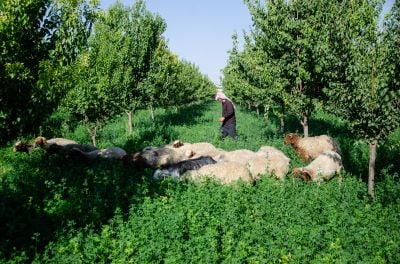
Economic repercussions
Another panel focused on expanding investment in renewable energy, sustainable transport and green infrastructure.
Economy Minister Amer Bisat said climate-related threats have also become “economic,” estimating that “climate change has cost Lebanon about $40 billion over the past 30 years.”
The challenges extend beyond the domestic market. “A large share of our exports goes to Europe, where new regulations are being introduced. We are not adapting quickly enough, and this undermines our competitiveness and export capacity,” he said.
Industry Minister Joe Issa al-Khoury outlined measures taken to reduce emissions from factories. Asked about cement plants, Lebanon’s heaviest industry, he said a plan to cut their emissions is in preparation.
Blerta Aliko, the resident representative of the U.N. Development Program, said that without action, Lebanon’s climate-related losses could rise to 32 percent by 2080. “In 2023 alone, heat stress caused $1.3 billion in productivity losses, affecting more than 110,000 jobs in agriculture, construction and services.”
She added that projections show one dollar invested in green solutions could generate more than five dollars in economic returns by creating jobs, boosting innovation and delivering tangible benefits to communities across Lebanon.

 7 p.m. recap: Iran warns Egypt, Israeli soldiers vote in south Lebanon, Haret Hreik responds to Kataeb