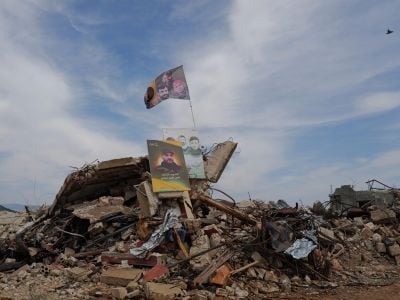
A portrait of Hezbollah fighters killed by Israel, on the rubble of the border village of Blida, in South Lebanon, April 16, 2025. (Credit: Matthieu Karam/L'Orient Today.)






BEIRUT — A year after the deadly war against Israel that decapitated its leadership, the powerful Hezbollah continues to pay its fighters and keep its network of institutions running in Lebanon, according to witnesses and experts.
Under intense pressure to lay down its arms, Hezbollah also faces a campaign aimed at suffocating its financial empire.
U.S. envoy Tom Barrack stated on Monday that the group receives "$60 million a month," without specifying the source. Several Hezbollah members and supporters interviewed by AFP, all speaking on condition of anonymity, insisted they continued to receive monthly cash payments.
Fighters receive between $500 and $700, according to two of them — more than Lebanon's minimum wage. The widow of a fighter said that families of Hezbollah "martyrs" still receive allowances, including for rent payment.
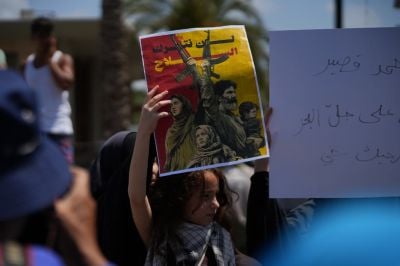
Hezbollah runs a wide network of schools, hospitals, and community organizations serving its supporters, making it "one of Lebanon's largest employers," according to Joseph Daher, a researcher and expert on the party's political economy.
One year after the death of its former chief, Hassan Nasrallah, killed in an Israeli airstrike on Sept. 27, 2024, the group is "under political and economic pressure," Daher acknowledges, but "it is very difficult to know" how much it is truly affected.
Increased surveillance
A Hezbollah official who requested anonymity said the movement had spent "$1 billion" to help about 50,000 families whose homes were destroyed or damaged during the war that ended in November 2024. AFP was unable to verify these figures. These aid packages cover rent, furniture, or repairs, according to several beneficiaries.
But unlike the previous war between Hezbollah and Israel in 2006, Hezbollah did not take charge of rebuilding completely destroyed homes. Its leader, Naim Qassem, said the reconstruction is up to the Lebanese government.
Since a government supported by the international community came to power, Lebanon — which has pledged to disarm Hezbollah despite its opposition — has stepped up monitoring of cash flows entering the country, particularly from Iran, the armed movement's main sponsor.
"There is an awareness," within the international community, that "Hezbollah thrives in a weak, unstable, and cash-based economy," says Sami Zoughaib, a researcher at the Policy Initiative, a Beirut-based think tank.
In July, the Central Bank banned all transactions with the financial company Al-Qard al-Hassan, tied to Hezbollah and sanctioned by the United States, which many Lebanese Shiites — who form the party's base — rely on.
But the institution, whose offices have been bombed by Israel, continues to operate, according to testimonies. Very popular since the collapse of the banking sector in 2019, it extends loans in dollars in exchange for gold deposits. One customer, who requested anonymity, said she "got scared" after the Central Bank's decision but was still able to repay her loan and recover her gold.
Money by plane
Hezbollah's economy relies largely on cash flows, sometimes brought in on commercial flights, according to experts.
Lebanon indefinitely suspended flights from Iran in February after threats from Israel. A Lebanese security source indicated that passengers arriving from countries where the party typically receives funds, including Iraq, now face tightened searches at Beirut airport.
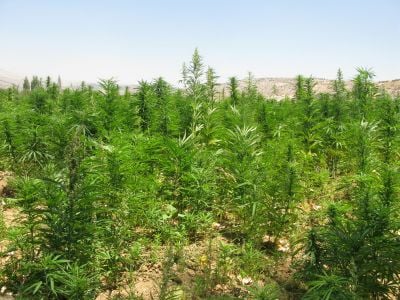
The United States, along with several Western and Gulf countries, accuses Hezbollah of financing its activities through trafficking, including the Captagon trade, an illegal synthetic amphetamine. Hezbollah rejects these accusations.
According to Daher, Hezbollah continues to generate revenue from "its own businesses," some "in Iraq," and affiliated businessmen elsewhere in the world.
A recent Canadian government report states that Hezbollah uses various means — businesses, cryptocurrencies, bank transfers, and charitable funds — to receive "funds leaving Canada."
Daher says the downfall of Syrian President Bashar al-Assad, its ally, in December was "the biggest setback." The party was getting "not only weapons, but also cash" through the porous border between Lebanon and Syria, he says.