






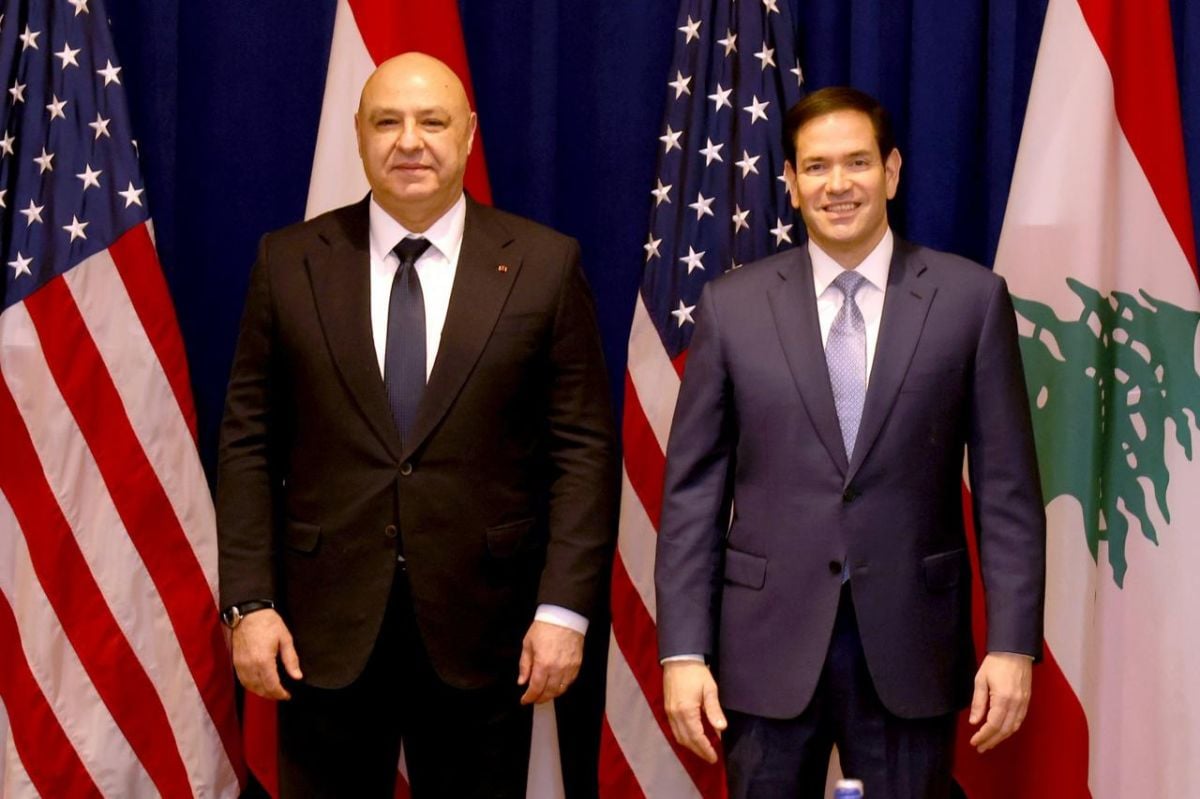
President Joseph Aoun with U.S. Secretary of State Marco Rubio on the sidelines of the United Nations General Assembly in New York, Sept. 22, 2025. (Photo courtesy of the Lebanese Presidency)






On the sidelines of the United Nation's 80th General Assembly, President Aoun has been busy rallying support for Lebanon in a string of meetings with foreign leaders and diplomats.
Possibly most notable among them was a meeting on Monday evening with U.S. Secretary of State Marco Rubio. Just the day before, U.S. envoy Tom Barrack had launched some harsh criticism against the Lebanese government, saying its efforts toward a state monopoly on arms was "nothing but words."
Rubio struck a different tone, praising the measures adopted by Beirut last month, which included approving a plan drawn up by Rubio for Hezbollah's disarmament and presented to Lebanon via Barrack over the summer.
According to a presidential statement, Aoun asked Rubio for American support in ensuring Israel abides by the Nov. 27, 2024, cease-fire agreement. Israel attacks Lebanon on a near daily basis, and has killed more than 300 people since agreeing to the supposed truce.
Aoun appealed to Rubio to hold his Israeli ally accountable, "especially since no violation of this agreement has taken place on the Lebanese side," he pointed out.
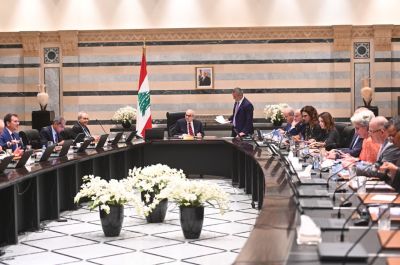
Aoun also requested that Washington "support the Lebanese Army with equipment and material so it can carry out its missions throughout all Lebanese regions," and for "support for efforts to hold a conference dedicated to Lebanon’s reconstruction."
He also reportedly asked for the necessary conditions "to achieve a just, comprehensive, and lasting peace in the Middle East," as Israel continues to bomb its neighboring countries with apparent impunity.
For his part, Rubio reportedly affirmed American support for Lebanon, and praised the country's strength. The U.S. is a traditional backer of the Lebanese Army and favored Aoun's election as president. Earlier this month, the U.S. Department of War (formerly the Department of Defense) announced the approval of aid worth $14.2 million for the Lebanese Army specifically to assist in its disarmament of Hezbollah.
Foreign Minister Joe Rajji, Aoun's political advisor Jean Aziz and Lebanese ambassador to Washington Nada Mouawad were all part of the Lebanese delegation at the meeting the Rubio, while on the American side, Barrack and envoy Morgan Ortagus were in attendance.
‘Suspicious timing’
Aoun also met with U.S. Senator Jeanne Shaheen on Monday and thanked her for her role in securing $193 million in support for the Lebanese Army and $40 million to the Internal Security Forces. Shaheen, whose husband is Lebanese-American, is a member of the U.S. Senate Foreign Relations Committee and was among an American delegation that included Barrack, Ortagus and Senator Lindsey Graham, which visited Lebanon in late August.

In her meeting with Aoun on Monday, also attended by Mouawad, Shaheen lauded the operational measures taken by the Lebanese Army, stressed that any positive development in Lebanon’s situation will serve to increase this aid.
Aoun mentioned that the Lebanese Army's efforts are not contained to southern Lebanon but also include security along the country's northern and eastern borders.
Aoun also noted the "suspicious timing" of the Israeli attack on southern Lebanon's town of Bint Jbeil during Ortagus' visit in the southern Lebanese city of Sour. An Israeli drone bombed a car carrying a family of six, killing all but the mother and one child, just hours after the cease-fire monitoring committee had met.
The uninterrupted stream of Israeli attacks on Lebanon raise questions, Aoun pointed out, about the ability of the international community, particularly the United States and France, which brokered last November’s cease-fire, "to put an end to these repeated aggressions, to secure the release of Lebanese prisoners, and to put a stop to the escalation that, if it continues, will nullify the efforts of those trying to restore stability in the South, primarily the United States."
Meetings, meetings, meetings
On Tuesday, Aoun addressed the General Assembly for the first time since coming into office in January. He also met with several leaders, including interim Syrian President Ahmad al-Sharaa, Iraqi President Abdellatif Rachid, Polish President Karol Nawrocki, Kuwaiti Crown Prince Sheikh Sabah Khaled al-Hamad al-Sabah, and Italian Prime Minister Giorgia Meloni.
He also held talks with Spanish Prime Minister Pedro Sanchez. The previous day, he met with his Slovak and Finnish counterparts, as well as the Irish and Luxembourgish prime ministers.
