


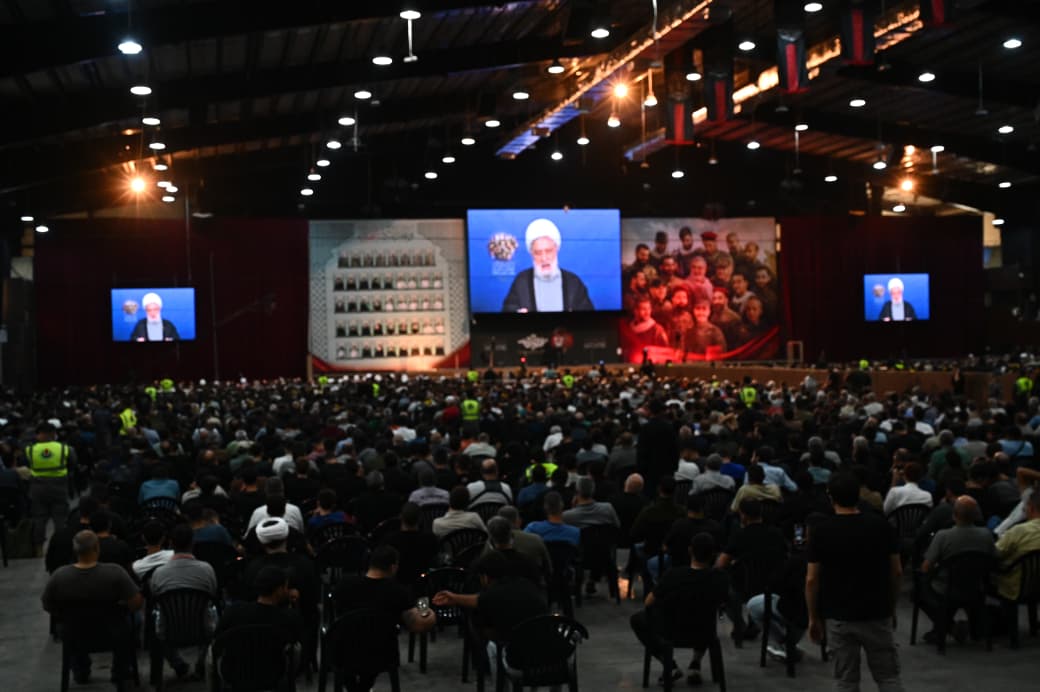
Hezbollah Secretary-General Naim Qassem gives a televised address screened for an audience in Beirut's southern suburbs, on Sept. 19, 2025. (Credit: Mohammad Yassin/L'Orient Today)






BEIRUT — During a speech given Friday marking the one-year anniversary of the assassination of senior party official Ibrahim Aqil, Hezbollah leader Naim Qassem made an unusual gesture toward Saudi Arabia, which had, in recent years, cut ties with Lebanon because of Hezbollah's influence in the country.
A large audience gathered in Beirut's southern suburbs to watch the televised address, including, for the first time since the Israel-Hezbollah war ended in November 2024, party fighters. Aqil, who was the leader of Hezbollah's elite al-Radwan unit, was one of 52 people killed by Israel in the bombardment of a residential building in Beirut's southern suburbs that subsequently caused its collapse.
Qassem spoke of extending an "outstretched hand" to Saudi Arabia, presenting his proposal as a "public suggestion" and a "practical measure."
"I call on Saudi Arabia to open a new page with 'the Resistance' based on a dialogue that would settle differences, that would be based on the principle that Israel is the enemy, and that would freeze disputes during this exceptional period our region is experiencing," he said. "We assure you that the weapons of 'the Resistance' are only aimed at Israel, not at Lebanon, not at Saudi Arabia, or anyone else. Pressuring 'the Resistance' is a gift to Israel."
Saudi Arabia pulled out its ambassadors and shut down economic routes in 2021 in response to the flow of illegal drugs between the two countries and Hezbollah's political influence. It reinstated its ambassadors in 2022 and then, following the November 2024 cease-fire in Lebanon and Hezbollah's weakening as a result of the war, Saudi Arabia stepped up its involvement in and support for Lebanon.

Qassem's comments come days after Qatar called an emergency summit that brought together leaders from dozens of Arab and Muslim countries to discuss a united response to Israel's recent bombardment of Doha, where Gaza cease-fire negotiations had been underway.
"At one point, they had convinced the Arabs that 'the Resistance' is the enemy and that Israel is the friend, but after the strike in Qatar, it is clear that all the countries in the region are being targeted, one after the other, until Israel reaches the expansion it desires," Qassem said of the Sept. 9 attack. Since Oct. 7, 2023, Israel has bombed seven of the region's countries. "We all must face this danger — it's not only the responsibility of 'the Resistance,' and we must unite against this common enemy," Qassem said.
During his speech, Qassem repeatedly used the phrase "let us unite," calling not only for regional solidarity but also for cooperation within Lebanon. "I call on Lebanese parties, even those opposed to us, not to serve the interests of Israel, for that country will never take them into account," he said. "We are partners in this country and want to build it together."
"The entire region is facing a dangerous turning point because the Israeli entity has deeply entrenched itself, thanks to American support. It is an expansionist mindset that seeks to prevent the region from achieving independence and aims to make it follow Western economic choices," he said. Israel "has reached peaks of monstrosity [in Gaza] with American support, without any restraint."
Party weapons and 'liberation'
Qassem also warned against American involvement in Lebanon. "Even when it comes to aid to the Lebanese Army, be aware that the United States only delivers weapons that allow it to manage the internal situation, not those that could pose a threat to Israel," Qassem said. Cabinet recently adopted an American-drawn plan for Hezbollah disarmament, which the party has firmly opposed on the basis that it would only hand over its weapons once Israel's attack on Lebanon cease and its occupation of Lebanese territory comes to an end.
"Let us unite to drive out Israel, undertake reconstruction, organize legislative elections, and hold dialogue for a national defense strategy," Qassem added, referring to an oft-used phrase within circles negotiating for a state monopoly on arms. In his last speech, Qassem also emphasized Hezbollah's preference for a "national defense strategy" instead of disarmament.
Hezbollah fighters will continue the fight "until the end of Israel," Qassem also said. "We will accept nothing less than the liberation of all our land, and our people remain attached to the weapons of 'the Resistance' because they've seen the benefits in the past. They don't need mobilizing and accept only dignity."
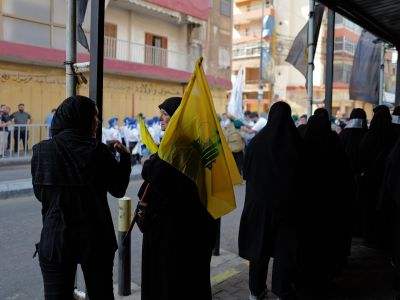
"How can we give up our weapons while the genocide continues in Gaza under American cover? How can we give up our weapons when we still need to liberate our land?"
On Thursday, Israel bombed five villages in southern Lebanon, in an intense air raid that targeted homes along the border. Qassem condemned Israel's actions, which he said were carried out "with impunity."
"Why does [the Lebanese government] not question the army about its plan to drive out the Israelis?"
Aug. 5 vs. Sept. 5
The government's attempts toward achieving a monopoly on arms has taken many twists and turns, the latest, Qassem pointed out, appeared — to some — to have come in Hezbollah's favor. "Thank God we avoided the disaster of Aug. 5 thanks to the reversal of Sept. 5," Qassem said.
Cabinet adopted a decision on Aug. 5 to affirm the disarmament of militias and the arms monopoly. During the next discussion, on Sept. 5, Cabinet "welcomed" the army's plan, but did not officially adopt it and did not set a timeline — a result Hezbollah considered a 'victory.'
Needless to say, critics of Hezbollah interpreted the Cabinet meeting differently, claiming it as a victory for themselves as well.
"We are ready to assume our responsibilities together with the army, as you would like, provided it is against the Israeli enemy," Qassem said. "They don't want to disarm us but to sacrifice us and force us to surrender, without any American guarantee of Israeli restraint."
Regarding Aqil, whose martyrdom he was commemorating, the Hezbollah secretary-general described him as a "leader with two characteristics that earned him this enlightened leadership role that led to his martyrdom: the first was his deep Muslim faith and learning, and the second, the jihad for the liberation of Palestine."
 Israeli army carries out demolition at Jabal Amel School in Houla as strikes continue