


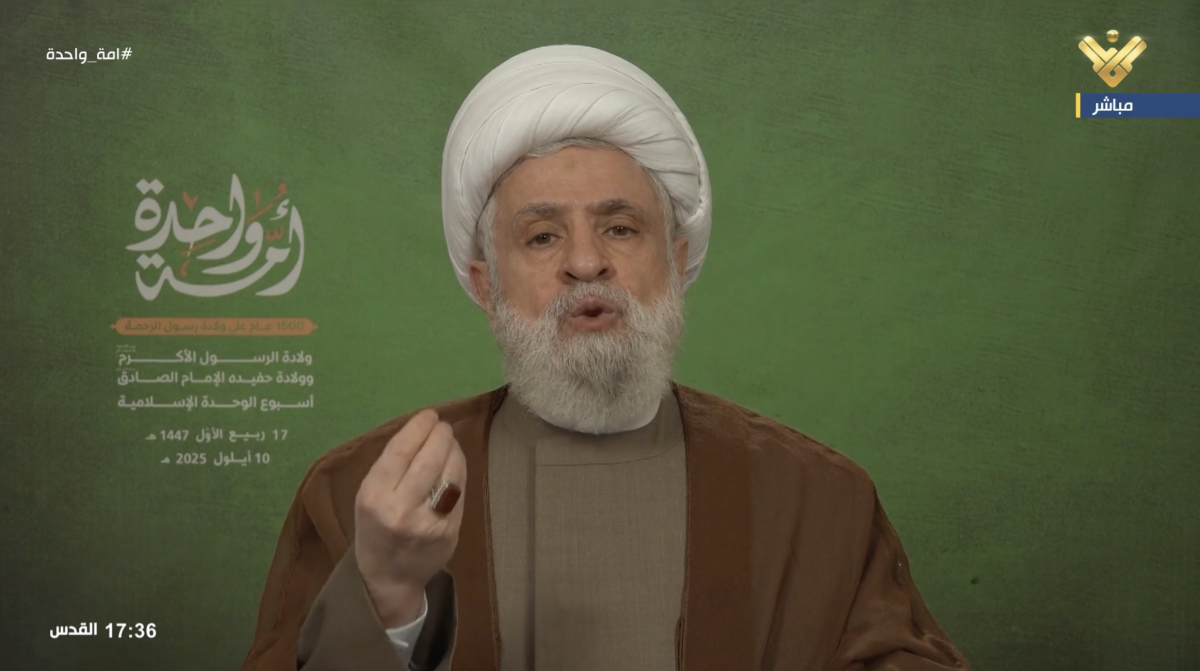
Hezbollah Secretary-General Sheikh Naim Qassem delivering a speech on Sept. 10, 2025. (Screenshot from al-Manar broadcast)






BEIRUT — In a speech given Wednesday evening to mark the birth of Prophet Mohammad, Hezbollah Secretary-General Naim Qassem rejected the government's calls for a monopoly on arms, advocating instead for a discussion on a "national security strategy."
His opposition to a state monopoly on arms comes despite the concept's inclusion in the ministerial statement of Nawaf Salam's government (which had received Hezbollah's confidence) as well as it having been mentioned in President Joseph Aoun's inaugural address. However, both Salam and Aoun have, on many occasions, also called for a "national security strategy."
On Sept. 5, following a Cabinet session in which the government "welcomed" the army's plan to disarm Hezbollah (and all militias), Information Minister Paul Morcos told reporters that "the government is committed to developing a national security strategy, implementing the principle of the state's exclusive authority over all its territory."
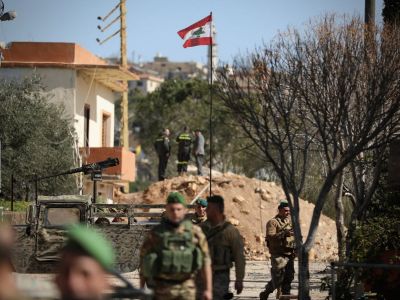
On Tuesday, Foreign Minister Joe Rajji shared details of the five-stage army plan, which begins with the removal of weapons south of the Litani River, to be completed within three months.
"There will be no warehouses, no weapons, no weapons transfers, no fighters, and no display of arms" in the area, Rajji said. In parallel, the army will "tighten and increase the number of checkpoints, prevent the movement and carrying of weapons" throughout the country, "but without conducting raids, arresting individuals, or confiscating weapons from warehouses," Rajji added.
"Stop talking about the arms monopoly," Qassem said on Wednesday. "Anyone who thinks they can strip the enemy of their pretexts is mistaken, because the enemy is pursuing its particular project."
"Lebanon is a permanent homeland for all its citizens, and we are part of it," he insisted, warning of Israel and its "expansionist and colonial ambitions in the South since the creation of modern Lebanon."
"The highest form of patriotism is to defend the country and liberate the land," Qassem said. "That's what the army has done to the best of its abilities, as has 'The Resistance," he added, arguing that Hezbollah has offered a great deal "to defend Lebanon, especially Hassan Nasrallah."
Nasrallah led the party for more than 30 years before being assassinated by Israel in a massive bombing attack on Beirut's southern suburbs. He led the party when it forced occupying Israeli forces to withdraw from Lebanon in 2000.
Qassem praised his party for "thwarting Israel's objectives" and preventing the country from occupying Lebanese territory during the war, but he criticized the cease-fire for failing to hold, seeing as Israel has been violating the agreement almost since it came into effect.
'Building our country together'
The government's priority should be Lebanese sovereignty, Qassem argued, which requires it to "expel" Israel from the five positions it continues to occupy north of the Blue Line.
"How can the government hold its head high when the Israeli aggression has reached Hermel?" he posed, referring to Israeli strikes that killed five people in the northeastern Lebanese district. "Why would we forgo Lebanon's strength, when no alternative exists to defend the country?"
Qassem accused the United States of being ready to "deliver Lebanon" to Israel and of being complicit to Israeli aggression. "The U.S. has withdrawn from its commitments to Lebanon," he said, criticizing moves to disarm Hezbollah before Israel has been made to meet its own end of the agreement.
"The United States and the enemy share a single goal: to deprive Lebanon of its strength, so it becomes easy prey for the 'Greater Israel' project. The West does not care about Lebanon, just Israel."
"The collapse in Lebanon is due to corruption and to non-compliance with the Taif Accord, and Israeli aggression has worsened this collapse," he added, arguing that "'The Resistance' contributed to Lebanon's stability by allowing for the launch of the presidential mandate and the rise of President Joseph Aoun, and by confronting the enemy."
Qassem criticized the Cabinet meetings of Aug. 5 and 7, which focused primarily on Hezbollah's disarmament, as being "contrary to the National Pact," and insisted that "no discussion outside of the national security strategy is possible, as it is the only way to reach a solution."
"Lebanon's recovery requires full sovereignty, the enemy's withdrawal, rejecting Arab and American tutelage, reorganizing the operation of the state and its institutions, launching reconstruction, and fighting the corruption that has caused the collapse," Qassem said.
"We call on you to build our country together and to be united partners against our enemies; this is the responsibility of all of us," Qassem declared. "The continuity of 'The Resistance' is a necessity for everyone and represents Lebanon's strength."
"We call for a return to Islamic and national unity, and a return to four priorities: ending the aggression against Lebanon, ensuring Israeli withdrawal, releasing prisoners and initiating reconstruction. These are the priorities that will put Lebanon back on track."
'Do not betray The Resistance'
Qassem started his speech by denouncing Israel's assassination attempt against Hamas leadership in Doha the previous day. "We stand by Qatar and consider the aggression against this country unacceptable; we stand by the Palestinian resistance."
"For two years, the enemy has step-by-step advanced its project of 'Greater Israel' in Gaza and the West Bank, and the attack on Qatar is part of this project extending from the Nile to the Euphrates," Qassem said. "It is clear that the main thing slowing down Israel's project is 'The Resistance' and its refusal to surrender in Palestine, in Lebanon, and in the region."
Speaking to Arab countries, Qassem questioned their lack of support for resistance movements, "financially, in the media, politically, socially, or within international institutions?"
"If the enemy eliminates 'The Resistance' — which it will not be able to do — your turn will come next," Qassem warned. "At the very least, do not betray 'The Resistance' and do not side with Israel."
 Israeli army carries out demolition at Jabal Amel School in Houla as strikes continue