







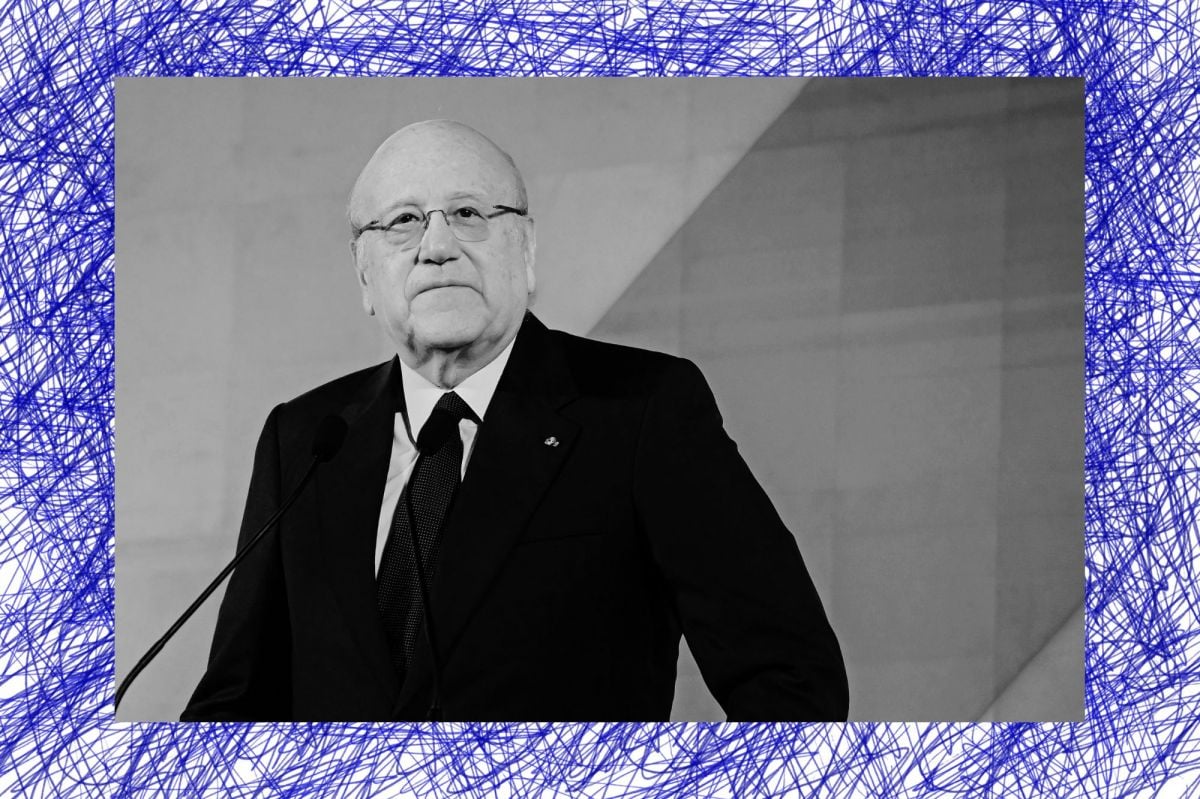
Collage by Jaimee Lee Haddad.






On Sept. 14, France’s National Financial Prosecutor’s Office opened a preliminary investigation into former Lebanese Prime Minister Najib Mikati.
Mikati, who has served multiple times as prime minister, is worth an estimated $3.2 billion, according to Forbes. He comes from Tripoli, Lebanon’s poorest city, where residents still lack basic infrastructure.
So what is this case really about? Who filed the complaint? And what does it mean for justice at home?
Let’s break it down.


1. Who filed the complaint and why?
In April 2024, French NGO Sherpa and a Lebanese group called the Collective of Victims of Fraudulent and Criminal Practices in Lebanon (CVFCPL) filed a complaint against Najib Mikati, his brother Taha, and other family members.
They accused the Mikatis of money laundering, concealment, and “organized criminal conspiracy.”
The CVFCPL is made up of a group of depositors in Lebanon who lost access to their savings in the aftermath of the 2019 financial collapse, when banks locked deposits and imposed withdrawal limits.
A year later, the two groups submitted more evidence to the French prosecutor. They detailed how, they claim, the Mikatis used fraudulent means to acquire assets in France and abroad, often through intermediaries.
Sherpa founder, Lawyer William Bourdon told L’Orient-Le Jour the evidence was strong enough to justify “opening an investigation for extremely serious offenses, particularly concerning money laundering.”

2. What are the Mikatis accused of? The plaintiffs point to luxury assets in France, Monaco, and Saint-Jean-Cap-Ferrat, two private jets, and two yachts worth $100 million and $125 million. They also cite investments in the fashion house Façonnable and stakes in Bank Audi.
The Bank Audi deal is one of the main allegations.
The plaintiffs also raise past cases of alleged abuse of office. In the 1990s, during Syrian control of Lebanon, the Mikatis’ telecom companies LibanCell and Cellis received lucrative state contracts.
Both were later accused of underreporting revenues and depriving the treasury of hundreds of millions in taxes, before a political deal cut the fines.
In 2001, their company Investcom won a telecom license in Syria under former Syrian President Bashar al-Assad. Later investigations in Europe also flagged multimillion-dollar transfers linked to Mikati and Salameh through offshore companies.

The Mikatis deny wrongdoing. A close associate dismissed the French probe as a “smear campaign,” insisting the family has “never been convicted of any offense, in Lebanon or elsewhere.”

3. How are these allegations tied to Lebanon’s central bank, and how will this be reflected at home?
In 2010, the Mikatis bought about 11 percent of the bank’s capital (later 14 percent), financed with $300 million in loans from none other than Bank Audi itself.
That move raised eyebrows. Buying a chunk of the bank with the money borrowed from the same bank is exactly what Lebanese law is meant to forbid. In fact, Lebanese law prohibits acquiring more than 5 percent of a company’s capital with loans granted or guaranteed by the same company.
The Money and Credit Code also restricts loans to shareholders and forbids pledging shares bought on credit.
Yet the deal went through, reportedly receiving special treatment from Banque du Liban, Lebanon’s central bank, then led by Riad Salameh. Instead of consolidating the Mikatis’ shares as a single entity, the central bank treated them separately — a move that may have helped them dodge regulatory caps.
A banking source linked to the deal insisted it was done “in accordance with existing rules and laws” and that the BDL “supervised the entire process in accordance with the Code of Money and Credit.”
Local prosecutor Ghada Aoun had tried to reopen the case before retiring, but no legal action was taken in Lebanon.
Now how is this reflected at home?
For this to move forward, Lebanon would need to receive a formal request for judicial cooperation from the French courts. If that happens, the Lebanese judiciary would be expected to summon Najib Mikati and others for questioning, although that depends on whether Lebanon actually responds.
In other words, we could see a process similar to what happened in Riad Salameh’s case.
The investigations are still in their early stages and are expected to cover Taha and Najib Mikati, Bank Audi, and ostensibly Salameh, who oversaw the sale of Audi’s shares to Mikati.
The key first step is judicial cooperation. If that is granted, French investigators would come to Beirut to question Taha and Najib Mikati, Salameh, and possibly Samir Hanna of Bank Audi.
It should be noted that this isn’t Mikati’s first brush with controversy. His holding company, M1 Group, has faced heavy criticism from human rights groups for doing business in countries under authoritarian regimes, from Syria and Sudan to Myanmar, after the 2021 coup.
Critics say the Mikatis have often turned crises into business opportunities, raising questions about whether their record abroad matches their reformist promises at home.
