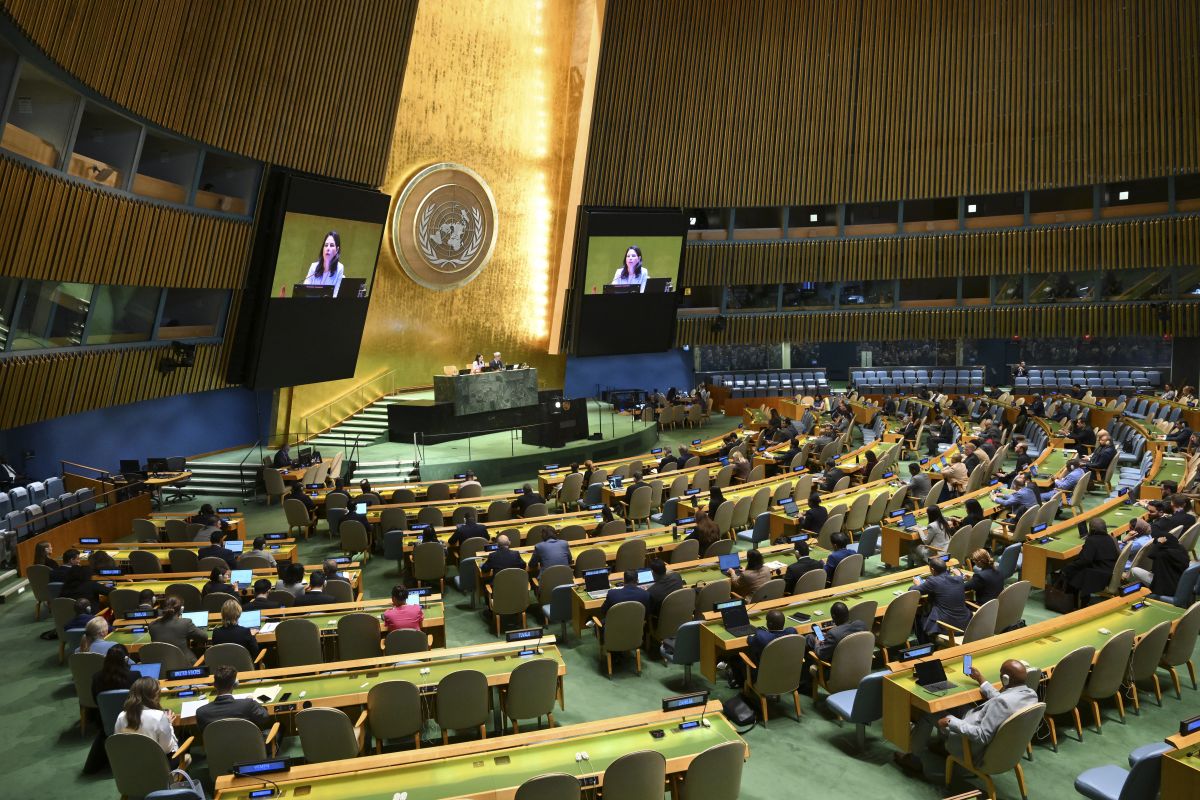
Former German Foreign Minister and president of the 80th session of the United Nations General Assembly, Annalena Baerbock, speaks at a General Assembly meeting on the vote regarding the two-state solution for the Palestinian issue, at the U.N. headquarters in New York, Sep. 12, 2025. (Credit: Angela Weis / AFP)






Lebanese Prime Minister Nawaf Salam welcomed on Saturday the “New York Declaration,” adopted the previous day by a large majority at the UN General Assembly, aimed at giving new momentum to the two-state solution, Israeli and Palestinian, without Hamas.
“I contacted President Mahmoud Abbas to congratulate him on the major diplomatic success achieved at the United Nations General Assembly with the adoption, by an unprecedented majority, of the ‘New York Declaration,’ which not only affirms the two-state solution but also sets its implementation within specific timelines,” Salam said in a message posted on his X account.
“I also contacted officials from Saudi Arabia and France to thank them for sponsoring this declaration and for their joint efforts to achieve this result and to increase recognition of the Palestinian state,” he added.
Foreign Minister Rajji also praises vote
Lebanese Foreign Minister Joe Rajji also welcomed the vote on his X account. “There can be no just and lasting peace without the two-state solution. 142 votes ‘for’… the path of diplomacy remains the most effective,” he wrote.
Illustrating their messages, both Nawaf Salam and Joe Rajji published a photo detailing the voting results.
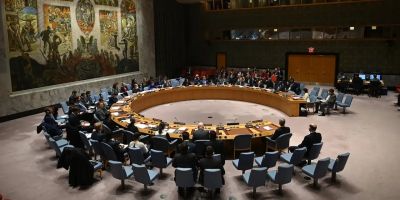
The text, prepared by France and Saudi Arabia, was adopted by 142 votes in favor, 10 against (including Israel and the United States), and 12 abstentions, just ten days before a summit co-chaired by Paris and Riyadh on Sep. 22 at the U.N., where Emmanuel Macron has pledged to recognize the Palestinian state.
Illustrating his message, Nawaf Salam published a photo detailing the voting results. Since taking office earlier this year, the Prime Minister has repeatedly stated that Lebanon’s position on the Israeli-Palestinian conflict follows the one defined at the Arab League summit in Beirut in 2002, known as the “Arab Peace Initiative,” which calls for Israel’s withdrawal from all occupied territories, including the West Bank, Gaza and the Golan Heights, and the creation of a Palestinian state within the 1967 borders, in exchange for normalized relations with Arab countries.
About three-quarters of the 193 U.N. members states recognize the Palestinian state declared by the Palestinian leadership in exile in 1988. However, with the war devastating the Gaza Strip, the expansion of Israeli settlements in the West Bank, and statements by Israeli officials about annexing occupied territory, some fear that the creation of a Palestinian state may become physically impossible. Israeli Prime Minister Benjamin Netanyahu was very clear on Thursday: “There will be no Palestinian state.”