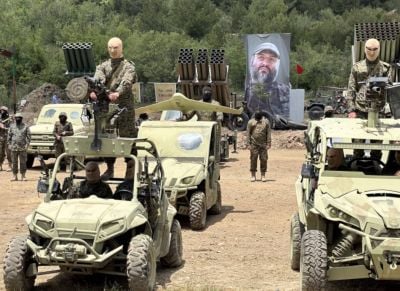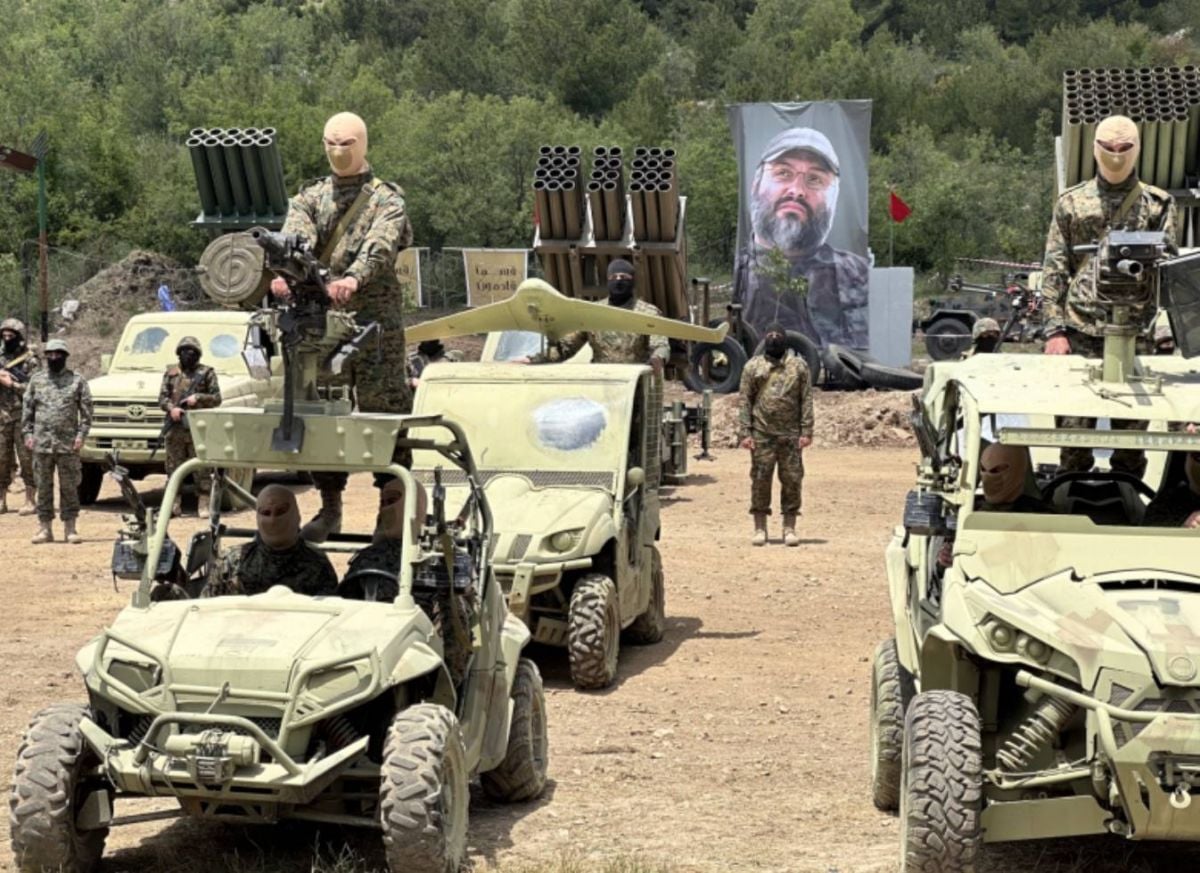
Hezbollah fighters during a military parade in southern Lebanon, May 21, 2023. (Credit: Jad Abou Jaoudeh/L’Orient-Le Jour)






“Return to wisdom,” “preservation of civil peace”: the Amal-Hezbollah bloc cautiously welcomed the government’s decision on Friday to implement the Lebanese Army’s plan to dismantle militia arsenals, including those of the party, though no specific timeline was set. This remains a key demand for Hezbollah, which refuses to hand over its weapons as long as Israel continues to violate the cease-fire in Lebanon. On the other side of the political spectrum, the compromise reached by Prime Minister Nawaf Salam’s cabinet was also well received.
Commenting on the government decision, Hezbollah’s deputy head of the political council, Mahmoud Qomati, told Reuters that the party saw it as an opportunity to return to wisdom and reason, thus preventing the country from plunging into the unknown. He also emphasized that the pro-Iranian group had drawn conclusions based on the government’s statement after Friday’s session, which indicated that the implementation of Tom Barrack’s U.S. roadmap for disarming Hezbollah remains conditional on Israel’s commitment to respect the ceasefire. He added that, without a halt to Israeli strikes and a withdrawal of Israeli troops from southern Lebanon, the plan’s implementation by Beirut should remain suspended until further notice.
Last August, the government tasked the army with developing a plan to establish a state monopoly on weapons and approved the objectives of the U.S. roadmap aimed at disarming the party in exchange for a halt to Israeli military operations in Lebanon. Mahmoud Qomati told Reuters that Hezbollah “categorically rejects” both decisions and expects the government to develop a national defense strategy.
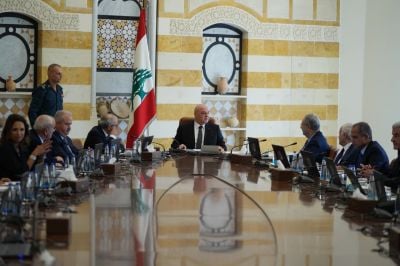
On Friday, the Council of Ministers said it had “welcomed” the army’s plan to dismantle militia arsenals, starting with Hezbollah. It opted for a carefully measured compromise, using nuanced wording to avoid formally adopting the army’s plan, in order not to completely antagonize the Amal-Hezbollah bloc, whose four ministers withdrew from the session. The fifth Shiite minister in the cabinet, Fadi Makki, considered independent of the bloc, also withdrew and called for “more communication with the Shiite community,” raising the specter of a resignation.
Preserving civil peace
Meanwhile, Parliament Speaker Nabih Berri told the pan-Arab daily Asharq al-Awsat that “things are positive.” “I think the toxic winds have begun to subside,” he added, noting that “what happened regarding the army’s military plan preserves civil peace.”
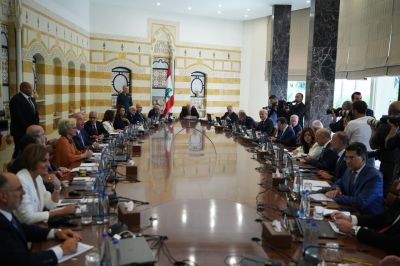
Prime Minister Nawaf Salam reiterated that there will be no reversal on the issue of the state’s monopoly over weapons, emphasizing that the government is continuing the process of extending state authority by its own means, in accordance with the decisions of the Aug. 5 session, which formalized Hezbollah’s disarmament. He told Asharq al-Awsat that these measures “are not linked to any other conditions; they constitute the implementation of what is stipulated in the Taif Agreement, in the president’s inauguration speech, as well as in the government’s ministerial declaration.” He added that “the plan of U.S. envoy Tom Barrack, which was modified by Lebanon in agreement with the Americans and whose objectives were approved by the government, requires reciprocal implementation by both parties, which Israel has not yet respected.”
Administrative Development Minister Fadi Makki told al-Jadeed that “all parties welcomed and approved the army’s plan.” He also stressed that he does not align with any faction and takes orders from no one.
Meanwhile, Minister for the Displaced Kamal Shehadeh stated that “the government will monitor the implementation of the plan through monthly reports,” describing it as “a major strategic step that has not taken place in Lebanon for decades.”
Shehadeh also told the al-Hadath channel that “the approval of the plan on the state’s monopoly over weapons was made in line with the Aug. 5 decision, and no dialogue on a defense strategy has taken place with any party outside the government.” He added: “There will be no negotiations or backtracking on the decision regarding the monopoly of arms, and the results of this process will be visible in the coming weeks.”
Full confidence in the army
Justice Minister Adel Nassar also praised the government’s compromise on Saturday via X, noting that “the army commander presented the plan to advance the state’s monopoly on weapons, a step we greatly appreciate.” He added that “the army will submit monthly reports to the government on the implementation of its plan,” emphasizing that “the state-building process is accelerating, and our confidence in the national army is complete.” He stressed, “There is no turning back; any obstacle to extending the authority of the state over its entire territory constitutes a threat to Lebanon and the Lebanese people.”
Free Patriotic Movement (FPM) leader Gebran Bassil voiced support for the government while underscoring the need for “a wise national policy to protect Lebanon and preserve its sovereignty.” He said, “There is no solution outside developing a defense strategy or a national security strategy. Ultimately, it is the government’s responsibility to establish such a policy, as it committed to in its ministerial declaration, and to ensure its implementation.”
Lebanese Forces MP Antoine Habchi added that “the monopoly on weapons is no longer in the hands of Hezbollah or Amal, but in the hands of the state’s political authority.”
The army’s plan includes no specific timeline and is structured around five stages aimed at limiting weapons to the state alone. The military retains the authority to determine the details of its deployment across different regions.