












The “big brother” isn’t so wise after all. Nabih Berri, the perennial Parliament speaker and a seasoned strategist on Lebanon’s political stage, is once again playing his favorite card.
At a pivotal moment in the country’s history — as the government seeks to assert its sovereignty by calling for a monopoly on arms under state control — Berri, who also heads the Amal Movement, is orchestrating a subtle yet powerful counteroffensive: pushing for the well-worn notion of a ‘national dialogue,’ a formula that turns every crisis into an endless roundtable.
As a loyal and steadfast ally, he is aiming to water down the government’s initiative through a labyrinth of consensus talks, granting Hezbollah the time and space it needs to safeguard its arsenal — all in the name of a compromise he knows how to tailor to his advantage.
In just 13 minutes on Sunday, Berri — himself at the head of a mini-militia — effectively buried what remained of the national consensus around the president’s inaugural address and the government’s ministerial statement.
He appeared in a threatening tone, evoking the specter of the May 17 Agreement — the 1983 treaty signed between Lebanon and Israel, which was ultimately scrapped under pressure from Syria and its allies, but which remains etched in the collective memory of a significant segment of Lebanese society as a symbol of national capitulation.

By reviving an old trauma, Berri is seeking to delegitimize his opponents, implicitly accusing them of selling out Lebanon’s sovereignty to the U.S. and Israel. In essence, the speaker of parliament — a dual role that only adds to the confusion — is equating the current government’s decisions with a new betrayal orchestrated from abroad.
That ‘abroad’ is embodied by Tom Barrack, the American envoy behind a “loaded” document, seen by Berri as “even more dangerous” than last November’s cease-fire agreement that he himself had approved at the time.
So, which Berri should we believe? The statesman, arbitrator and guardian of a Shiite community that has already endured profound suffering? Or the political actor aligned with (Hezbollah’s) narrative and (Iran’s) agenda, who continue to militarize his community, even at the risk of leading it toward ruin?
Hezbollah has gone too far in its new war — this time waged against the legitimacy of the state — crushing any remaining hope of cooperation. It has now become clear that it will only accept “dialogue” on the condition that the state yields to its demands and resurrects the infamous army–people–resistance triad from the ashes.
From this point, a crucial question arises: where does Berri stand on Hezbollah’s chosen path — a point of no return away from the state? So far, he has been playing both sides. He receives envoys from the so-called “greatest satan” and negotiates with them, while Finance Minister Yassine Jaber, close to Amal, offers a calm and measured tone regarding the government’s decisions and the monopoly on arms.
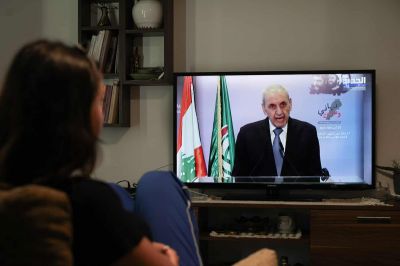
At the same time, Berri speaks on behalf of the two inseparable allies and stands ready to call his supporters into the streets to defend a sacralized arsenal.
This ambiguity can no longer be sustained — even under the commendable pretext of maintaining a line of communication between the state and Hezbollah, and between Hezbollah and foreign envoys. Berri needs to understand that continuing to shield the party will have consequences, just as distancing himself from the suicidal logic of his “younger brother” would.
The first choice would endanger the entire Shiite community, whose fate would then be determined by Barrack and those he represents, effectively severing it from the national fabric. The second would bring it back under the authority of the state, offer it protection, and make its members true partners in the country’s recovery project.
Will Berri make a final decision once and for all? This time, his tricks won’t be enough to save the situation. Lebanon will not survive another sleight of hand.
This article was originally published in French in L'Orient-Le Jour and translated by Joelle El-Khoury.