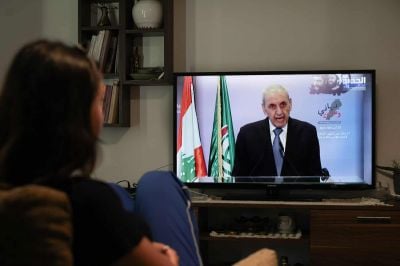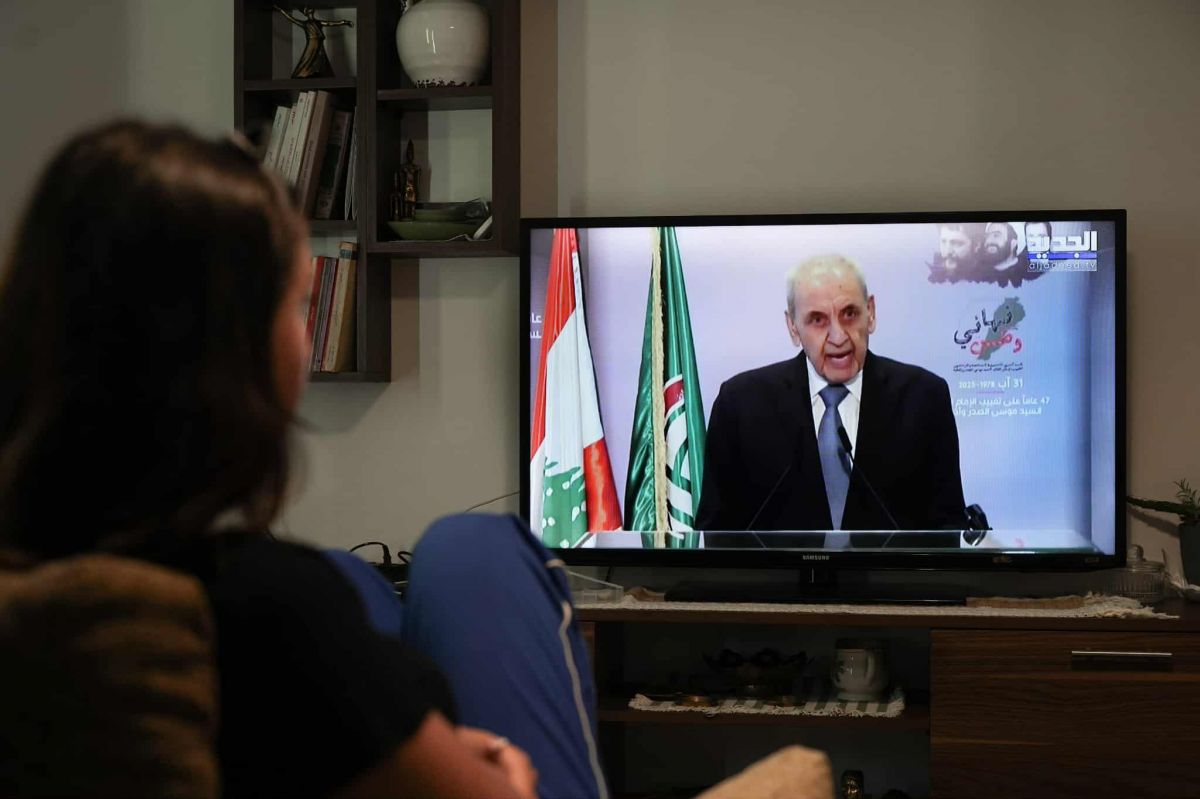
A young woman watching Parliament Speaker Nabih Berri's speech on Aug. 31, 2025. (Credit: Mohammad Yassine/L'OLJ)






BEIRUT — The Cabinet’s decision on ensuring the state’s monopoly over weapons — and the implementation plan the army is expected to present to the government Friday — remains divisive.
Behind the scenes, contacts are intensifying to find a way out of the deadlock, particularly after Tel Aviv’s response last week, delivered by a U.S. delegation. Israel dismissed the “step for step” principle, arguing the Cabinet’s decision was insufficient to prompt a withdrawal from southern Lebanon.
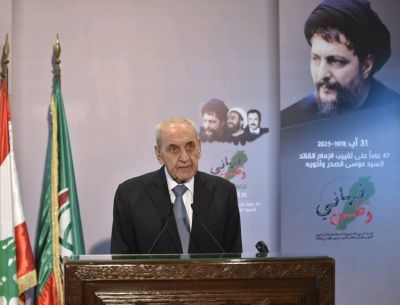
L’Orient Today has learned that Parliament Speaker Nabih Berri is central to these negotiations. He submitted an initiative to President Joseph Aoun and Prime Minister Nawaf Salam ahead of his forceful speech Sunday marking the disappearance of Imam Moussa Sadr. The move was intended to signal that he was not closing the door to compromise.
The initiative aims to move beyond the proposal of U.S. envoy Tom Barrack, which Israel rejected and failed to implement. In this framing, responsibility for the document’s collapse lies with Tel Aviv, not Beirut. Lebanon could then leverage this stance to ease the polarization that dominated the Cabinet sessions of Aug. 5 and 7 and adopt a calmer approach to the weapons issue.
The approach does not necessarily mean returning to the formula Berri invoked in his speech — “dialogue” around a “defense strategy,” often seen as stalling — but rather keeping debate inside Cabinet while awaiting a decision.
The initiative’s second element calls for full ministerial participation in the Sept. 5 session, when the army is to present its plan to disarm Hezbollah by year’s end. The military will detail actions already taken and those still required, with general timeframes. It is not expected — under this initiative — to set a specific start or end date. Instead, it will explain its operational course, how long it took to secure areas south of the Litani, and the time needed to move north.
The army will also outline its requirements for financial, military, logistical, technical and intelligence support to locate weapons depots, which would necessitate Hezbollah’s cooperation.
After the presentation, the initiative calls for the government merely to take note of the plan, without issuing an order to begin execution or tying it to the deadlines in the American proposal. Berri’s initiative separates the rejected document’s strict timelines from its overarching objective: reestablishing the state’s monopoly over arms, in line with President Joseph Aoun’s inauguration speech and the Cabinet’s ministerial statement.
The initiative also includes explicit Lebanese conditions: linking the achievement of the Cabinet’s adopted goals — Israel’s withdrawal from the South and an end to strikes and aggression — to the process.

So far, no official response has been given. Political circles are studying the initiative, and numerous meetings are expected before Friday. If consensus is reached, the government will have upheld its decisions and received the army’s plan without moving to act on it.
Such a compromise would not be backtracking. For Hezbollah, it would represent success in easing pressure, slowing government momentum and delaying disarmament. But Hezbollah’s rivals would likely mount fierce opposition, pressing the government to insist on its authority over arms without reference to the U.S. document or any other framework. This scenario would also expose Lebanon to increased international pressure to follow through on its commitments.
For now, Hezbollah and Amal’s ministers will attend Friday’s session, confirmed Monday by Finance Minister Yassine Jaber. But without consensus, they are expected to withdraw, shifting attention to the fifth Shiite minister, independent Fadi Makki.
Some ministers may push to postpone the decision to another session, triggering further political reviews of the army’s plan. If positions harden, the most explosive scenario could emerge: putting the issue to a vote, which would force all parties to take a stand.