






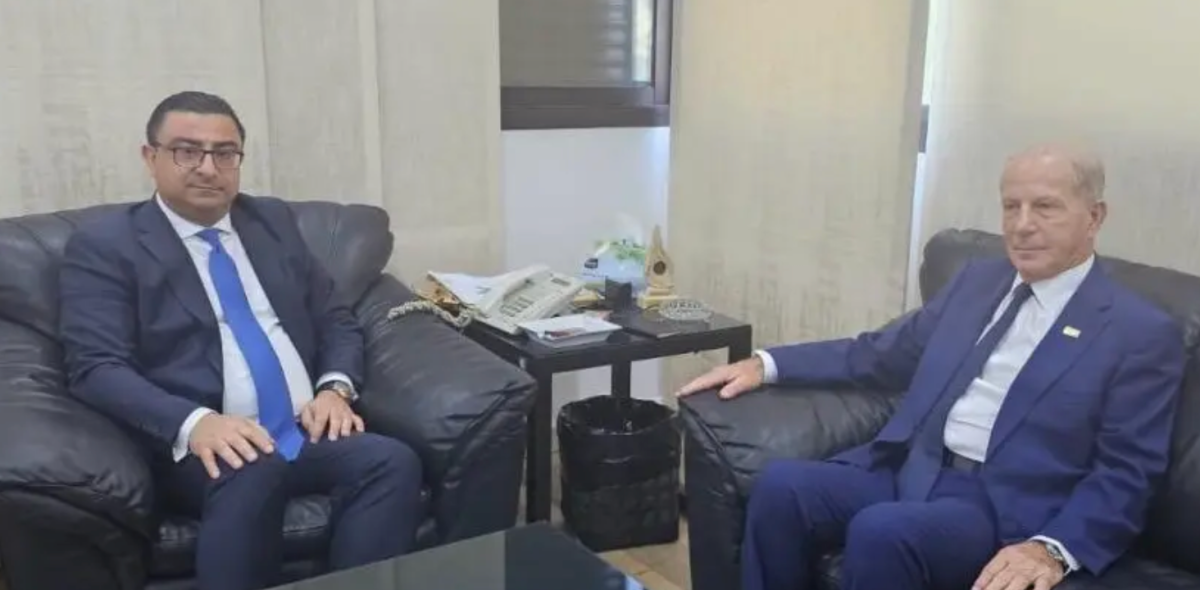
The Attorney General at the Court of Cassation, Judge Ahmad Rami al-Hajj, receiving the United States ambassador to Lebanon, Michel Issa, on Aug. 10, 2026. (Credit: NNA)






BEIRUT — As the Lebanese Army deploys in the “pilot zones,” questions are growing over its authority to conduct searches, particularly in private homes.
Prosecutor General at the Court of Cassation Ahmad Rami al-Hajj met with U.S. Ambassador to Lebanon Michel Issa at the Justice Palace on Monday, but a senior judicial source told L’Orient-Le Jour that the issue was not discussed.
Searching private homes presents a challenge for the army, which must respect the constitutional principle that homes are inviolable. However, some argue that, given Lebanon’s exceptional circumstances and the government’s decision to place weapons under state control, the army should have more leeway to search for weapons in the areas under its responsibility. The issue mainly concerns the authorizations that must be issued by the public prosecutor’s office.
“For the time being, I have not made any decision authorizing the search of any home,” the prosecutor told L’Orient-Le Jour. “It is out of the question to search every house. We have no interest in carrying out systematic searches. If the army searches a large number of homes and finds nothing, it would be seen as a failure and damage its credibility.”
According to the judicial source contacted by L’Orient-Le Jour, the meeting between the prosecutor and U.S. Ambassador Michel Issa focused on judicial cooperation between the two countries. The state-run National News Agency reported that Issa told Judge al-Hajj that the United States was ready to provide the Lebanese judiciary with assistance, particularly in information, equipment and technology, to strengthen its capabilities and improve its work. The two sides agreed to maintain regular coordination and exchange information.
The meeting also addressed Lebanese nationals who hold American citizenship and are suspected of having committed crimes or offenses in the United States. The two sides discussed the possibility of prosecuting them in Lebanon based on the available evidence. The United States said it was ready to provide Lebanese judicial authorities with any information it has on these individuals and the alleged acts, allowing Lebanese authorities to take appropriate measures in accordance with the law.

 8 p.m. recap: Israel again threatens Beirut’s south suburbs; 2 ships hit near Hormuz; Riyadh football matches canceled