






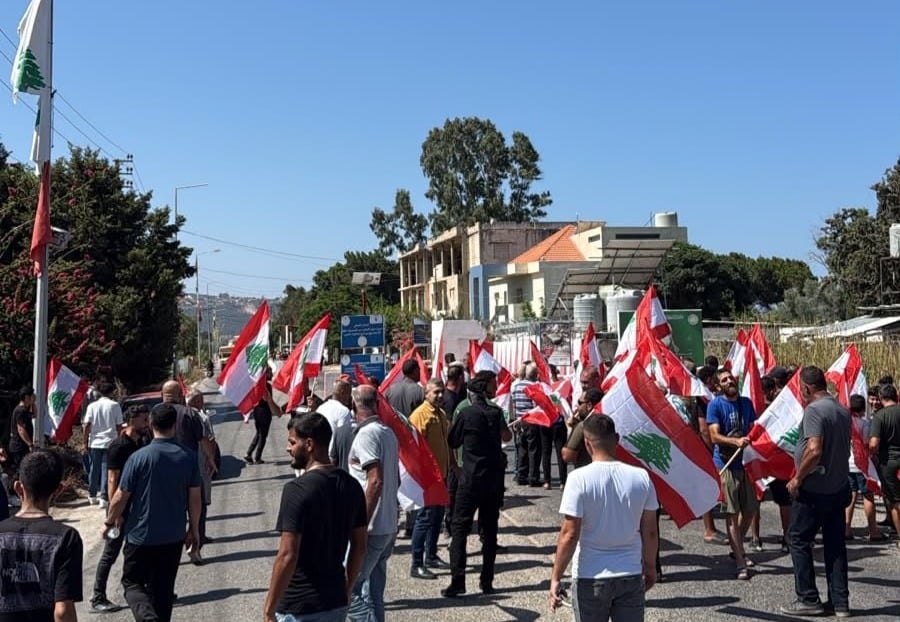
Residents of Mansouri demand to return to their village during a peaceful demonstration near a Lebanese army post, close to the village entrance, on Aug. 10, 2026. (Credit: Photo received by our correspondent in south Lebanon, Muntasser Abdallah)






SOUTH LEBANON — Less than a week after the Israeli army issued an evacuation order for Mansouri, residents of the Sour district village protested Monday, demanding to return to their homes. The municipality called on the Lebanese state to intervene.
Meanwhile, Israeli forces continued operations across southern Lebanon. They tightened their control around the heights of Ali Taher, where a drone dropped explosive barrels, set fire to houses in Khiam (Marjayoun) and carried out several detonations in other areas, according to our south Lebanon correspondent.
By late morning, Mansouri residents gathered near a Lebanese Army post at the village entrance, calling for permission to return home. The village had come under heavy artillery fire overnight. At the end of July, around 60 families were still living in the village center, which is now divided by the “yellow line” marking the “buffer zone” imposed by Israel.
The Israeli army issued the evacuation order last Wednesday after Israeli soldiers were killed and wounded in a booby-trap explosion in nearby Majdal Zoun, in the Sour district.
During Monday’s peaceful gathering, the president of the Mansouri municipal council called on the Lebanese state to act to allow residents to return. “This mobilization is not directed against anyone. We are protesting the fact that the Israeli enemy is preventing us from entering our village and returning to our homes,” he told our correspondent. He also called on the cease-fire monitoring committee, known as the “mechanism,” to “put pressure on Israel.”
Continued Israeli detonations
Israeli artillery fire continued on the heights of Ali Taher, a strategic hill south of Nabatieh, until the early hours of Monday. In the early afternoon, an Israeli army drone dropped explosive barrels on the area.
Shortly afterward, Israeli soldiers set fire to houses in Khiam, around six kilometers from the border. In Meis al-Jabal, near the border, an Israeli force infiltrated the town’s western outskirts and shelled a house, sparking a fire.
Other fires were reported in a wooded area between Beni Hayan and Markaba following artillery fire.
The Israeli army also carried out new detonations Monday morning in Majdal Zoun (Sour) and Zawtar Sharqieh (Nabatieh). Southern Lebanon had already seen a series of Israeli detonations overnight Sunday and into Monday, including in Kfar Tibnit (Nabatieh), Haddatha (Bint Jbeil), and between Taybeh and Deir Siryan (Marjayoun).
Destruction in Bint Jbeil
Also Monday, a delegation from Bint Jbeil presented Culture Minister Ghassan Salameh with a detailed report on what it described as the “systematic” destruction of the city during a meeting at the ministry in Beirut.
Titled “Bint Jbeil: Chronicle of a Crime,” the report documents damage to residential neighborhoods, businesses, schools, health and cultural institutions, as well as sites of historical significance.
At the end of the meeting, the head of the municipality said he hoped Salameh would share the report with relevant international organizations to “underline that what is happening amounts to a war crime.”
According to the municipal official, Salameh said the Lebanese government was preparing to convene to reaffirm the delegation’s demands and “reject everything the Israeli enemy is doing” in Bint Jbeil and other villages in southern Lebanon.
Reporting contributed by our south Lebanon correspondent Muntasser Abdallah.