






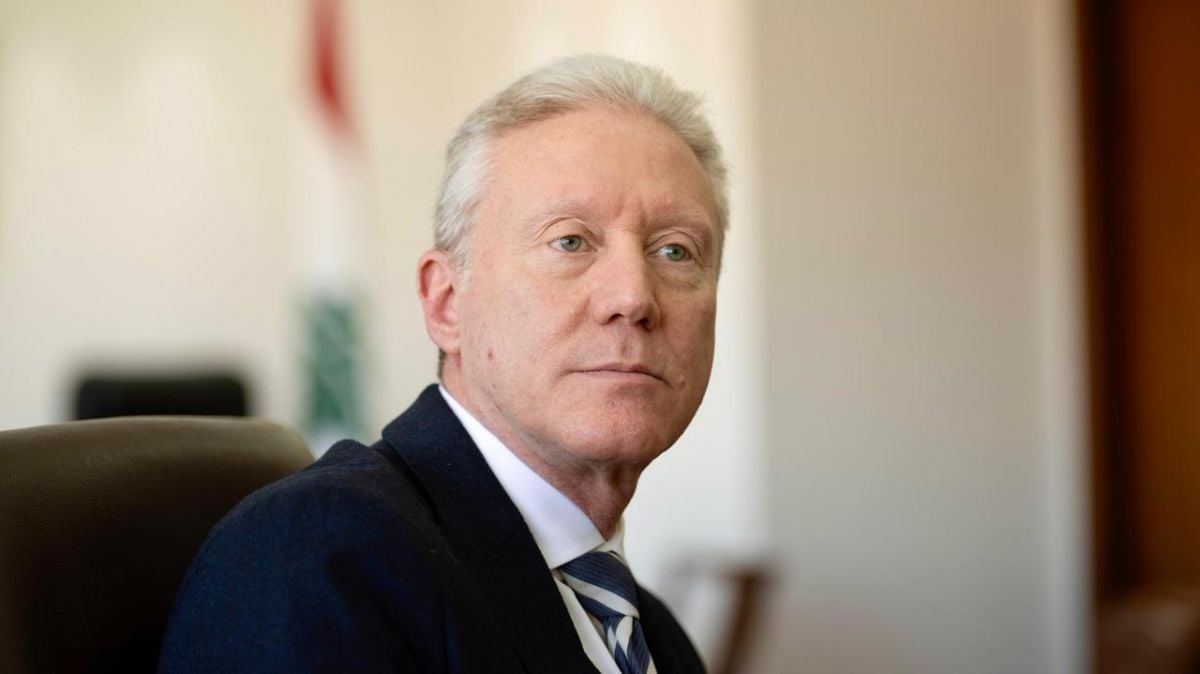
Lebanese Foreign Minister Joe Rajji. (Credit: The ministry's press office)






BEIRUT — Foreign Minister Joe Rajji said in an interview with UAE newspaper Al-Ittihad, published on Sunday, that the Israeli army's withdrawal from Lebanon and the release of Lebanese prisoners held by Israel are two essential conditions before any progress can be made in finalizing the Lebanese-Israeli border demarcation.
Despite a cease-fire agreement reached in November 2024 following more than 13 months of conflict between Hezbollah and Israel, the latter still occupies at least six areas in southern Lebanon and still carries out near-daily strikes in the region.
In the interview, Rajji affirmed that the "border with Israel has been demarcated since the 1949 armistice agreement," and that the demarcation needs to be "finalized through indirect negotiations under the auspices of the United Nations or the United States," stressing that "Israel's immediate withdrawal from the five occupied points in the South and the release of Lebanese prisoners are two essential conditions before any further progress can be made."
The 1949 Armistice Agreement was a cease-fire negotiated by the United Nations between Lebanon and Israel following the 1948 Arab-Israeli War. Signed on March 23, 1949, the agreement established a demarcation line between the two countries, ending hostilities and laying the foundation for maintaining peace through the United Nations Truce Supervision Organization (UNTSO).
'UAE stands by Lebanon'
Regarding UAE-Lebanese relations, Rajji affirmed that the "UAE always stands by Lebanon, whether on the political, economic, or social level," praising the warm welcome given to the Lebanese delegations in the UAE and explaining that the visits of Lebanese President Joseph Aoun to the Arab Gulf countries, especially the UAE, have "restored Gulf-Lebanese relations to their fraternal and strategic nature."

President Joseph Aoun visited Saudi Arabia in March, and then Qatar and the UAE in April, aiming to revive relations, which have been strained by regional tensions and the influence of Hezbollah.
Rajji pointed out that "previous governments had damaged Lebanese-Arab relations as a result of their proximity to certain internal parties that had taken hostile positions," stressing that the "current government had corrected the course."
He noted that the "biggest challenge facing the current Lebanese government is to prove its ability to impose the rule of law throughout Lebanese territory, and that achieving this will be a turning point for the country's future," adding that Lebanon's success in this task "will not only have an internal impact, but will also reflect on the stability of the entire region."
Hezbollah's weapons
Regarding Hezbollah's weapons, Rajji highlighted the importance of the Lebanese government's Aug. 5 decision for the state to reclaim its monopoly on arms before the end of the year, describing it as a "historic decision that has been awaited since the Taif Agreement, signed 35 years ago, and which marks the beginning of the establishment of the rule of law, sovereignty and the monopolization of decisions on war and peace at home and abroad. "
He added that the "Lebanese had waited a long time for the state to return to impose its full authority."
The Lebanese minister added that the international community, including major financial institutions such as the World Bank and the International Monetary Fund, "had linked any support for Lebanon to two basic conditions: the implementation of economic reforms to combat corruption and the restriction of weapons to the state."
Demarcation with Syria
Rajji finally talked about demarcating the border with Syria, saying that this is a "purely technical matter that requires the formation of joint committees to address some overlaps," noting that "Lebanon is waiting for the new Syrian administration to take an interest in this issue."
On Monday, during a visit to Beirut by a Syrian delegation — including two former ministers and the head of Syria’s National Commission for Missing Persons — Lebanon and Syria agreed to form two commissions tasked, among other things, with resolving the border issue.