






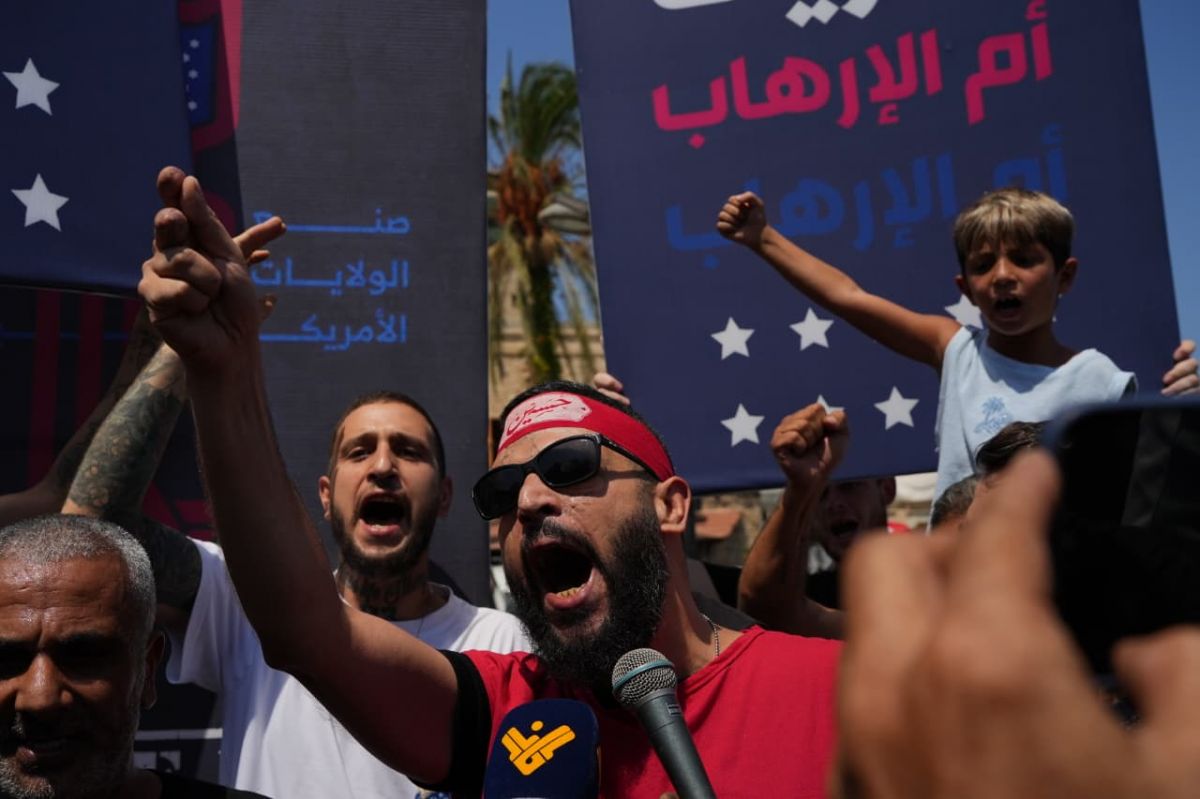
A protester during a sit-in against a planned, then canceled, visit by American envoy Tom Barrack, in Sour, on Aug. 27, 2025. (Credit: Mohammad Yassine/ L'Orient Today.)






SOUTH LEBANON — U.S. envoy Tom Barrack canceled planned visits to Khiam and Sour on Wednesday, after protests erupted over his push to disarm Hezbollah and his remarks to journalists a day earlier at the presidential palace.
Barrack began his tour in Marjayoun, where, according to the state-run National News Agency (NNA), he traveled by helicopter to the François al-Hage army post, while the Lebanese Army beefed up its deployment in the south.
Protests in Khiam and Sour
The cancellation was announced late in the morning when residents of Khiam and several villages of southern Lebanon gathered there for a sit-in. Khiam was at the heart of heavy clashes last autumn between the Israeli army, who entered Lebanese territory, and Hezbollah.
Protesters criticized the envoy's visit and stomped on a Star of David drawn on the ground, while the slogan "Barrack is an animal" was written in English on the ground, referring to a phrase uttered by the diplomat to journalists the previous day, when he told them to "be civilized," threatening to leave the room if the situation became "animal-like."
Protesters carried flags of Hezbollah and Amal, as well as photos of fighters killed in Israeli strikes and the party's former leader, Hassan Nasrallah.
Residents of southern Lebanon, where Hezbollah holds strong influence, rejected the visit, opposing a U.S.-backed plan approved by Nawaf Salam’s Cabinet on Aug. 7 that aims to disarm Hezbollah in exchange for an Israeli withdrawal from occupied areas in the south.
One of these positions is on the outskirts of Khiam, on the hill known as "Tallet al-Hamames."
'A blow with a sole to the head'
There was also a protest in Sour, near the city's fishing port, according to our journalist on the scene. Dozens of protesters gathered beneath banners reading "America is the mother of terrorism," while excerpts from speeches by Hassan Nasrallah were broadcast.
"He will get a blow with a sole to the head if he dares to come," chanted protesters about the American envoy as they removed their shoes. Throwing shoes at someone is a deeply insulting and contemptuous gesture in Arab culture. A notable example of this gesture took place in 2008 when an Iraqi journalist threw his shoe at U.S. President George W. Bush during a press conference.
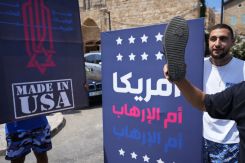
"I am not at all worried [about taking part in a protest against the United States,] why should I be afraid to tell the truth?" explained Noura Dakka, originally from Aitit.
"I came here to support the people of the south. I would have liked to meet Tom Barrack to tell him what the southerners think and those who lost their families during the war and the occupation," explained the Lebanese-American journalist, well-known on social media for a video in which she confronted members of the United Nations Interim Force in Lebanon (UNIFIL).
"There is nothing pathetic [in the speech of the Hezbollah leader, Naim Qassem,]" she said, making reference to a comment by U.S. deputy envoy Morgan Ortagus, who asserted that the party's leader "did not represent the Lebanese people."
'If Sheikh Naim tells us to go to war, we will go'
"If Sheikh Naim tells us to go to war, we will go," said Mohammad Abed, who was injured during the beeper attacks in Lebanon on Sep. 17, 2024. Next to him, a representative of the families of the "Hezbollah martyrs" remained furious: "We will prevent any U.S. envoy from coming to the city of Tyre, even if we have to stop him with our corpses. Those people who sacrificed their sons and their land will never let their killer enter the city," he told L'Orient Today.
"We are the resistance. We say to the president of the Republic [Joseph Aoun]: 'Don't fall into the American trap and do not confront the people. Where are you going? Tell them no,'" said another protester, Raja Chaar. "They want to pit the people of southern Lebanon against the army," he explained.
Under heavy U.S. pressure and amid fears of increased Israeli strikes on its territory, the Lebanese government this month directed the army to devise a plan to disarm Hezbollah by the end of the year.
Hezbollah backed by Iran and strongly entrenched in southern Lebanon, emerged greatly weakened from over a year of conflict with Israel, including two months of open war before a cease-fire on Nov.27.
Hezbollah, conditions any discussion of its arsenal on a halt to daily Israeli strikes and the withdrawal of Israeli troops still held in southern Lebanon despite the cease-fire.
Reporting by our journalist on the ground Ghadir Hamadi.