






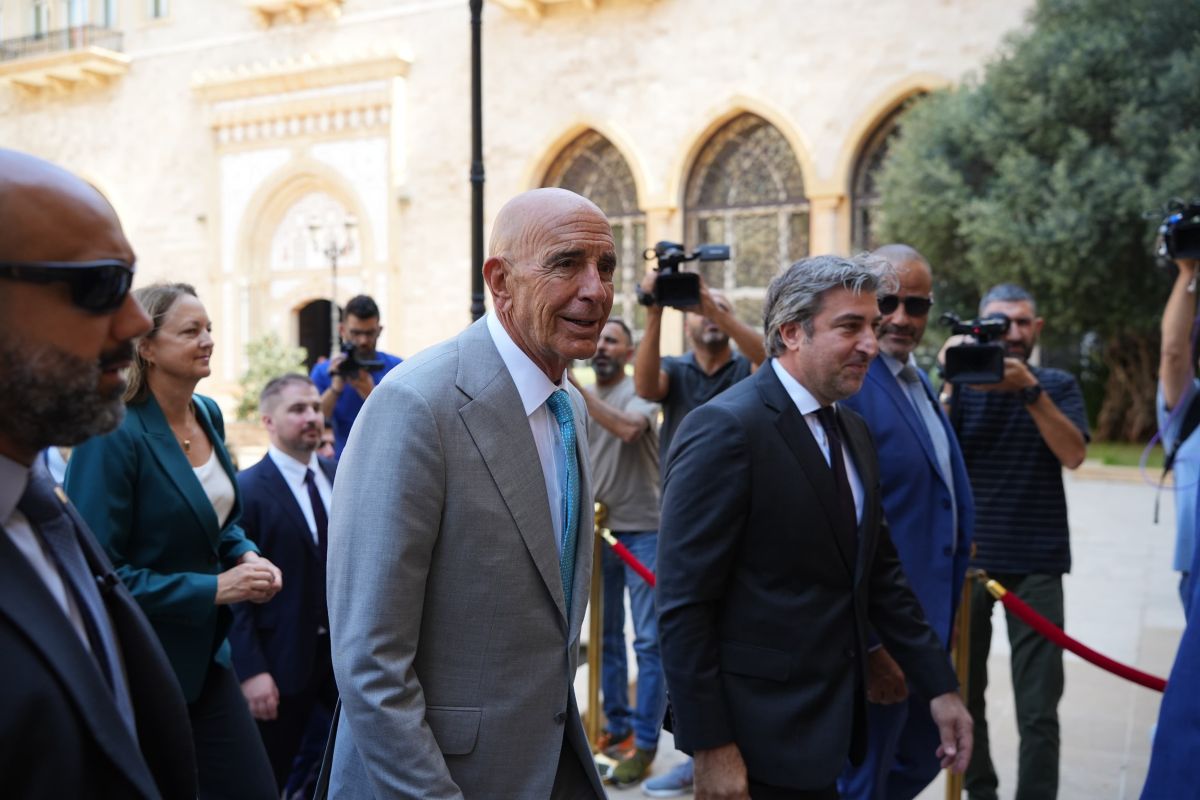
The American envoy Tom Barrack arrives for a meeting with Prime Minister Nawaf Salam, in Beirut, on Aug. 21, 2025. (Credit: Mohammad Yassine/L’OLJ)






About 24 hours before the start of U.S. envoy Tom Barrack’s tour, Israeli Prime Minister Benjamin Netanyahu welcomed “Lebanon’s efforts to work toward the disarmament of Hezbollah” by the end of the year. He also proposed to “reduce” Israel’s presence in the South if this disarmament is carried out.
In a statement posted Monday on X, the Israeli prime minister’s office said it recognizes “the important step taken by the Lebanese government,” calling it a “crucial opportunity for Lebanon to regain its sovereignty and restore the authority of its state institutions.”
The statement added: “In light of this important development, Israel is ready to support Lebanon in its efforts to disarm Hezbollah and to work together for a safer and more stable future for both countries.” It specified that “if the Lebanese Army takes the necessary steps to implement Hezbollah’s disarmament, Israel will take reciprocal measures, including a gradual reduction of the Israeli army’s presence in coordination with the U.S.-led security mechanism.”
Barrack to deliver Israeli response
“The Israeli prime minister is throwing the ball back into Lebanon’s court,” a government source told L'Orient-Le Jour. “Instead of responding to Lebanon’s step with a goodwill gesture, he is demanding that Beirut go even further with disarmament before honoring his part of the deal.”
“Moreover, he is not talking about a withdrawal, but only a reduction of the Israeli military presence,” he added.
Beirut now appears in a difficult position, having wagered that the Cabinet’s adoption of a decision to disarm Hezbollah by year’s end would push Israel toward compromise. After his visit to Beirut last week, Barrack praised Nawaf Salam’s government for its “historic” decision. The next day, Axios reported U.S. progress in Tel Aviv, suggesting Israel was willing to meet Lebanon halfway.
Now, following Netanyahu’s comments — after his talks Sunday with U.S. envoys — that bet looks shakier, at least until Barrack delivers Israel’s official response on Tuesday, accompanied by U.S. Deputy Special Envoy for the Middle East Morgan Ortagus and Sen. Lindsay Graham, known for his strong anti-Iran hardliners.
“We’ll wait to see what the Americans say,” the source said. “In the meantime, we’re studying our options.”
Qassem also plays on words
Lebanon is under even greater pressure because Hezbollah, on the other hand, does not appear ready to cooperate either. In a speech on Monday, Hezbollah Secretary-General Naim Qassem praised cooperation with the army, which “must protect the country,” and described the “resistance as its auxiliary.” He also called on the government to hold intensified meetings “to study diplomatic means of restoring sovereignty” and urged political parties to devote this week to drafting proposals in that direction.
“I have chosen this slogan: ‘We demand the government restore national sovereignty,’ and we must all work under this slogan for at least one week to show our support for the Cabinet,” he said.
“Expel the enemy from our land, end the aggression, free the prisoners [Lebanese held in Israel], and begin reconstruction. That is the roadmap to follow. Afterward, you can move to a defense strategy,” he then told the Cabinet as he shifted his tone. “We will not abandon the weapons that protect us from our enemy. We will not allow Israel to dictate terms in our country (...). What is your alternative if the resistance stops? To surrender to Israel?”
Tehran struck the same chord, with continued opposition to Hezbollah’s disarmament voiced by several officials, the latest being Brig. Gen. Iraj Masjedi, deputy coordinator of Iran’s Islamic Revolutionary Guard Corps’ Quds Force. He said the “U.S.-Zionist plan” to disarm Hezbollah “will never be implemented.”
“Neither the Lebanese people nor Hezbollah’s resistance force will accept this plan, and it will never come to pass,” Masjedi told Iranian state television, according to IRIB. “The resistance is the weapon of the Lebanese people to defend the territory against the Zionist regime’s aggressions,” he added, insisting that while the debate “is not new, it will never be implemented.”
Since early August, Iranian officials have repeatedly criticized the Cabinet and its plan to disarm Hezbollah. Several of these statements have been condemned by Lebanon’s Foreign Ministry as “interference in Lebanese internal affairs,” though it has stopped short of summoning Iranian Ambassador to Beirut Mojtaba Amani.
During a visit to Lebanon on Aug. 13, Iranian envoy Ali Larijani was told by President Joseph Aoun and Prime Minister Nawaf Salam that there would be no turning back on Hezbollah’s disarmament, while Larijani called for “dialogue” among the different parties.

 1 p.m. recap: Hezbollah offers extensive aid package for the displaced; ICRC warns of 'disaster' in Middle East; explosive device found in the Bekaa