






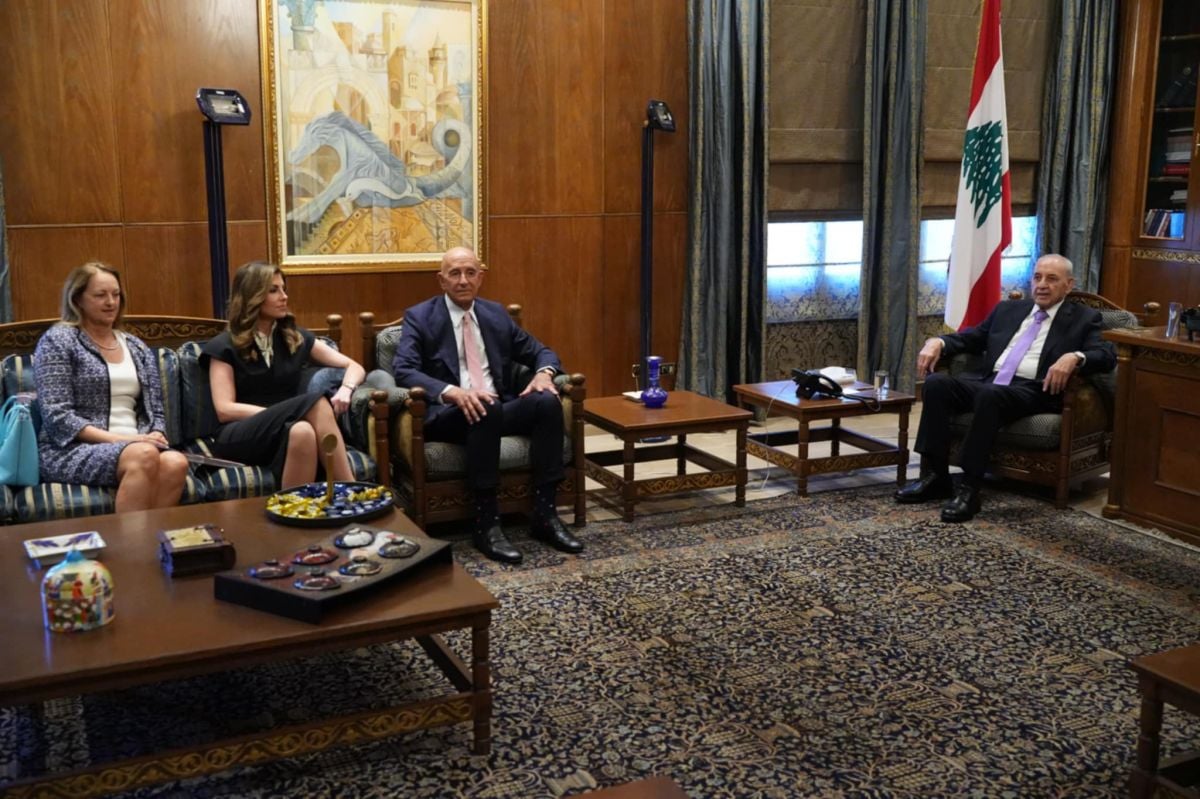
American emissaries Tom Barrack and Morgan Ortagus meeting with Parliament Speaker Nabih Berri on Monday, Aug. 18, 2025. (Credit: Mohammad Yassin)






The visit of American envoys Tom Barrack and Morgan Ortagus to Beirut revolved around three main points. The first was to provide support to the Lebanese state after its decision to restore the monopoly on weapons and adopt the American roadmap, as well as to understand the planned implementation mechanism. The second concerned discussions on renewing UNIFIL's mandate, especially since Ortagus will be directly involved with this issue in her new role at the U.S. mission to the United Nations. The third point dealt with examining ways to pressure Israel to take steps corresponding to the "first move" made by Lebanon.
Given the statements he made after his meetings, Barrack was relatively satisfied and delivered a clear message on the need for Israel to commit to respecting the provisions of the document and begin implementing corresponding measures, since Lebanon had accepted them and was about to start applying them.
"There is always a step-by-step approach. I think the Lebanese government ... has taken a first step," he said after meeting with President Joseph Aoun. "What we need now is for Israel to make a reciprocal commitment."
Asked about an Israeli troop withdrawal from Lebanon and an end to the "violations" of the agreement, Barrack said that this was "exactly the next step."
"In the coming weeks, you will see progress on all sides," stated the American envoy, adding that "this means a better life for people" in the region. Barrack is also the one who proposed the "step by step" principle, while Lebanon advanced the idea of "simultaneous steps." In the settled equation, Lebanon began by taking the first step, which led the American envoy to send an explicit signal about the need for Israel to respond with a corresponding measure.
The key at Ain al-Tineh
The essential phrase remains the one Barrack said after his meeting with Parliament Speaker Nabih Berri: "Everyone is moving in the right direction and everyone will benefit from economic improvement." From Baabda Palace, he similarly said that "the Shiites will benefit from the withdrawal of Hezbollah's weapons." What he means by benefit for the Shiites concerns Israel's withdrawal, the end of strikes and assassinations, as well as entering a process of reconstruction and opening up to many investments in Lebanon, which should, in his view, have positive effects for all the Lebanese people.
During his meeting with the American envoy, the speaker noted what the two men had agreed upon, namely the need for Israel to take serious measures for the arms monopoly process to move forward. This position was unified among the three leaders – president, prime minister and speaker – who insisted on the importance of putting pressure on Israel to stop its operations and begin at least a gradual withdrawal, even if this move would take place in parallel with other measures taken by Lebanon.
This is the prism through which one should read President Aoun's remarks to his American interlocutors, in which he stated that "what is needed today is for the other parties to commit to respecting the contents" of the cease-fire agreement. The president also called on the international community, especially the U.S. and France, to "further support the Lebanese Army and accelerate the required international measures to launch the reconstruction process in areas affected by Israeli attacks."
Prime Minister Nawaf Salam stated, during his meeting with Barrack at the Grand Serail, that the Trump administration must now "shoulder its responsibilities by pressuring Israel to halt its attacks, withdraw from the five points [still occupied in southern Lebanon], and release the Lebanese prisoners." He said that the government's decisions were made in the "national interest" and insisted on the priority of strengthening support for the army, "financially and materially," so that it can accomplish its assigned missions.
The key phrase of this visit remains the one Barrack made at Ain al-Tineh. It reveals a certain convergence with the speaker, who represents Hezbollah in the negotiations. This statement came after Berri stated that "no one in Lebanon wants civil war," in an implicit but clear response to statements by Hezbollah Secretary-General Naim Qassem. Barrack's stance, combined with Berri's, aligns with numerous diplomatic indicators suggesting that some within Hezbollah are now convinced of the need to move toward an arms monopoly by the state.
Hezbollah aware, but waiting for Iran
According to diplomatic sources, Hezbollah is now raising its tone to gain as much as possible, as it has realized that the issue of its arsenal is now on the negotiating table. The same sources believe that the party may be willing to discuss the matter, provided it can integrate its weapons into the building of Lebanese power, or even include itself as an integral part of that national force under the command of the state and the Lebanese Army. However, this idea has yet to appear in the party's official discourse, especially since the visit to Lebanon by the secretary of Iran's Supreme National Security Council, Ali Larijani. This can only fit into the broader context of Iranian-American negotiations at the regional and international level.
Returning to the outcomes of Barrack's visit, sources close to the matter say he insisted that Lebanon continue implementation of the plan adopted by the government, telling Lebanese officials that he would go to Israel to obtain a clear response regarding its commitment to apply the planned measures. He also said that he would return to Lebanon at the end of the month, once the army's plan was finalized and presented to the Cabinet. According to L'Orient-Le Jour's information, his questions focused on the concrete steps the army would have to take. In return, Lebanese officials insisted on the need to put pressure on Israel to respect its commitments and called on him to work toward granting aid to the army and preparing a conference to mobilize reconstruction funds.
