






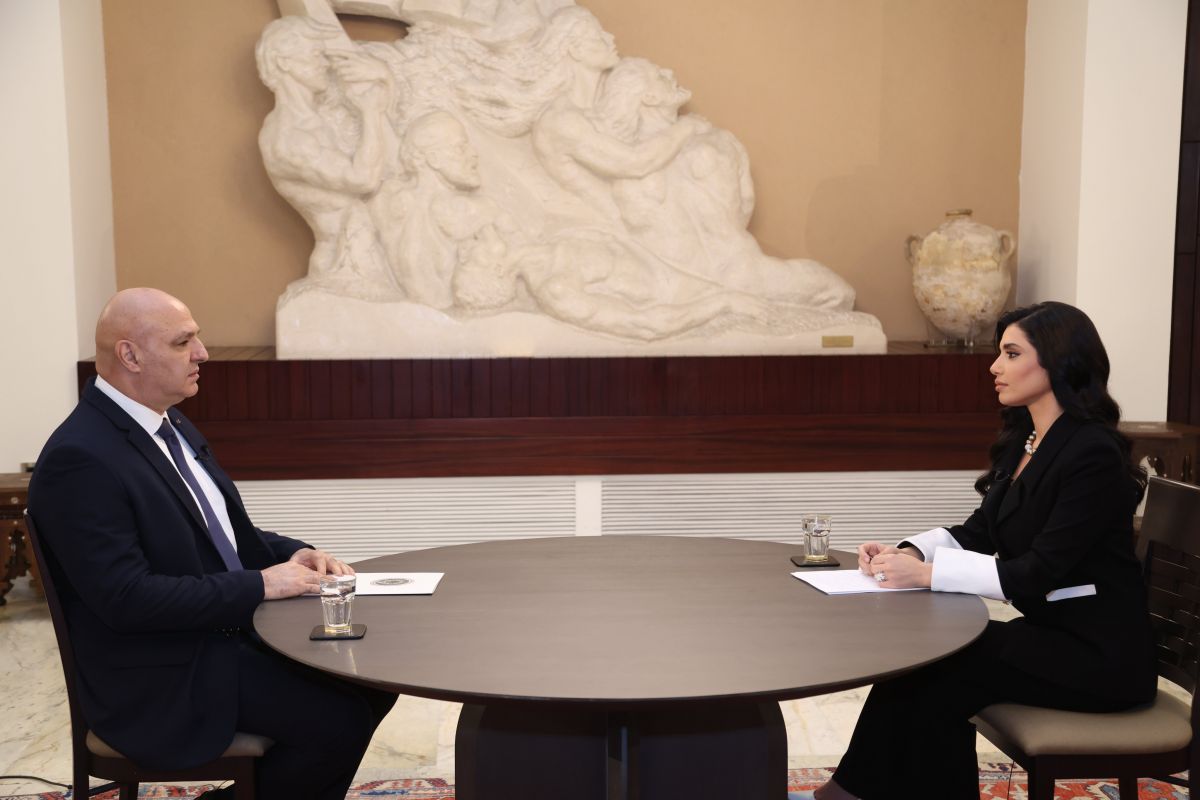
President Joseph Aoun during an interview with al-Arabiya, on Aug. 17, 2025. (Credit: X/@LBPresidency)






After 48 hours of speeches and contrasting reactions to Hezbollah leader Naim Qassem’s comments, who brandished the threat of "confrontations" in Lebanon should the government persist in disarming Hezbollah without an agreement, President Joseph Aoun said that instilling fear of the other among the Lebanese was "unjustified."
The government decided on Aug. 5 to mandate the Lebanese Army to draw up a plan for the state to regain its monopoly on arms by the end of the year. The army is to present this plan within the next two weeks. Two days later, the government approved a roadmap prepared by American envoy Tom Barrack to ensure proper implementation of the terms of the cease-fire that took effect on Nov. 27, after 13 months of war between Hezbollah and the Israeli army.
'Two options' regarding the Barrack plan
The president mentioned warnings, mainly from the Hezbollah-Amal Movement alliance, during an interview with al-Arabiya about a civil war in the event of imposed disarmament, and "the fear of the other instilled among the Lebanese." For him, these warnings were nothing but "words, and they were not justified." Aoun said that the Shiite community was "a fundamental component in Lebanon and there is no reason to fear for any community." The disarmament of Hezbollah is "an internal matter and only constitutional institutions are competent to address this issue. I do not think that anyone in the country has a problem with the principle of the monopoly of arms," he added.
Concerning the American roadmap, Aoun said he found himself facing "two options: either accept the document and ask the world to obtain Israel's agreement" for a stop to attacks targeting Lebanon, "or not accept it and see the aggressions and economic isolation of Lebanon intensify."
"We made observations on the American document, so it became a Lebanese document. It will only become enforceable after the approval of the concerned states and we insisted on the step-by-step principle," he added. He also stated that all contacts with Israel "are made through the Americans, the French and parties who simply want to help. But there is no party or mediator conducting a Lebanese-Israeli dialogue."
Iran and Saudi Arabia
The president stated that Lebanon’s neutrality, and keeping it apart from conflicts, "is what will protect it against all challenges." The Lebanese Army "is strong and fulfills its missions in all regions of the country, which strengthens stability and reassures the Lebanese inside and outside the country," he said.
Returning to the statements by Iranian officials who rejected the decisions of the Lebanese government that were condemned by Lebanese officials, Aoun referred again to what he had already said to envoy Ali Larijani during the latter's tour in Beirut this week. "Iran is a friendly country, but on the basis of mutual respect and preservation of sovereignty. We do not allow ourselves to interfere in its affairs nor in those of any other state, nor do we accept interference in our internal affairs," he stressed.
Regarding relations with Gulf countries, notably with Saudi Arabia, Aoun explained that he had told Saudi Crown Prince Mohammad bin Salman and the officials he met during his travels in the Arab world in recent months: "I do not want donations, I want investments. Investments can take several forms and we have many sectors in which you can invest."
"We are counting heavily on Saudi Arabia’s role in the revival of Lebanon. No one could give up the relationship between our two countries," he added.
"I promise the Lebanese, in the country and abroad, that we will move forward. There will be no turning back," the president said. "Change does not happen overnight, but it has begun and it is tangible," stressing that "the steps restoring the confidence of Lebanese and foreign countries in the State have begun."
"No one is protected, not even me. And the depositors' funds will return," he said.
Berri: No fear of civil war
Parliament Speaker and head of the Amal Movement Nabih Berri called for a "dialogue on the state's monopoly on arms, but not in the way it is currently being proposed."
"I will listen to the American envoy to know his vision regarding the modalities of disarmament, but I have nothing to submit to him on my side," he also said on al-Arabiya. "There is no fear of a civil war nor any threat to internal peace," arguing that "no decision regarding the disarmament of a party can be applied as long as Israel refuses to implement its commitments," notably by withdrawing from national territory and freeing Lebanese detainees in its prisons.
"Hezbollah has not fired a single shot since the cease-fire took effect, while Israel continues its strikes," he added.
Hezbollah did fire an artillery round a few days after the start of the truce in early December 2024, provoking a severe and deadly retaliation by the Israeli army.
