






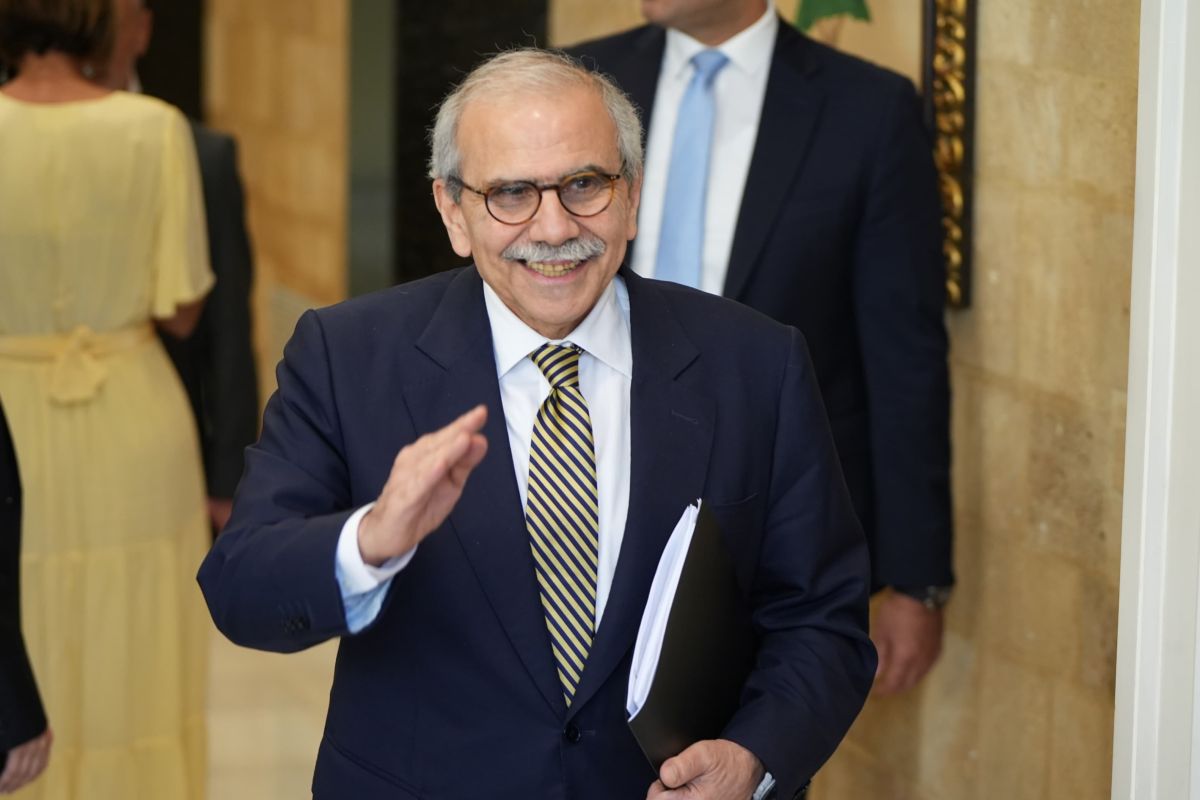
Prime Minister Nawaf Salam upon his arrival in Baabda for the government meeting chaired by President Joseph Aoun, on Aug. 7, 2025. (Credit: Mohammad Yassin/L'Orient-Le Jour)






After setting a deadline on Tuesday for the Lebanese state to fully exercise a monopoly on arms by the end of the year, the Cabinet on Thursday adopted the objectives of the roadmap proposed by the American envoy Tom Barrack. This twofold decision sparked mixed reactions in Lebanon, where some see it as a step toward sovereignty, while others denounce it as aligning with Israeli interests. Internationally, France and the U.S. hailed the initiative as "courageous" and "historic." Here is a look back at the main stances.
A 'courageous decision'
The first to react, Tom Barrack congratulated the Lebanese authorities for having made "a historic, courageous and just decision." "The resolutions adopted this week in Cabinet finally launch the implementation of the principle 'One nation, one army' for Lebanon. We support the Lebanese people," he wrote on X.

U.S. State Department spokesperson Tommy Pigott said on Thursday that "the United States welcomes the decision taken Tuesday by the Lebanese government to task the Lebanese armed forces with implementing a plan to bring all arms under state control by the end of the year."
"This is an important step toward Lebanon's sovereignty. We continue to closely monitor developments in Lebanon," he added. He also said that "Envoy Tom Barrack has clearly expressed what President Donald Trump expects."
"As long as Hezbollah retains weapons, words are not enough," he stated. "The Lebanese armed forces must fully commit, starting now, to implementing the government's decision."
"The credibility of the Lebanese government rests on its ability to match principles with action," he said.
In a post on X, French Foreign Minister Jean-Noël Barrot stated that France welcomed "the courageous and historic decision by the Lebanese government to move toward full sovereignty." He said the decision is "one of a strong state, holding the monopoly of legitimate force, able to ensure the protection of all communities, to rebuild a country devastated by war and economic crisis, and to guarantee its territorial integrity within borders agreed with its neighbors."
'No turning back'
"Congratulations to Lebanon for this government that embodies sovereignty and national decision-making, and that does not allow opportunists, sectarians, and militias to disrupt the path of state-building," wrote protest movement MP Mark Daou on X. "The decision is final, there is no turning back. Return to the state and abandon the logic of militias. We have a government and we are building a state based on the Constitution."
Kataeb leader and MP Samy Gemayel joined the others in praising the government's steps during a visit to the Baabda Palace on Friday. After meeting with President Aoun in the presence of the party's MPs in Baabda Palace, he said that Kataeb was proud of the "courage shown by Aoun and the government in building a state for all Lebanese."
“The new page that President Aoun is trying to open is for Lebanon to be free of tutelage for the first time in its history and to be built through partnership between all Lebanese," Gemayel said, according to the state-run National News Agency.
"The decision taken yesterday is in the interest of all Lebanese, regardless of their sect ... It is our duty to reassure anyone who feels that the decision is against them and to assure them that no one is being excluded," he added.
'The objectives of Israel'
The first Hezbollah member to comment on the government decision, MP Amine Sherri stated that his party "rejected the American roadmap, because it reflects the objectives of Israel." He said that "the measures taken by the government neither strengthen sovereignty nor allow for the liberation of territories," calling for "serious debate on defense strategy," while adding that "dialogue remains open with the government of Nawaf Salam."

The vice president of the Higher Shiite Council, Sheikh Ali al-Khatib, meanwhile said in a statement that "the American envoy Tom Barrack achieved his objective by turning a Lebanese-Israeli conflict into a political confrontation inside the Lebanese government, removing Israel from the circle of international public opinion accusations as the party failing to respect the agreement and blocking the deployment of the Lebanese army throughout the territory south of the Litani, as stipulated by the international resolution."
'A spectacle of humiliation'
The head of the Free Patriotic Movement (FPM), MP Gebran Bassil, said during a meeting with party youth: "We are among those who want weapons to be exclusively in the hands of the state, and only the army to be in charge of defending the country. We want the decision to belong to the state, to its constitutional institutions, but we do not want this decision to come from elsewhere."
He added: "Let the government come and tell us that it has adopted a national defense strategy, or that it has submitted an approved Lebanese document, and not just met to adopt an American document."
"We are for the exclusivity of weapons in the hands of the state and policy in the hands of the state, but we are against subservience to Israel, Syria or any other country. Today we are reliving a spectacle of humiliation that recalls the days of tutelage," he stated.
"They should at least keep up appearances! And adopt a Lebanese roadmap, neither American, nor Syrian, nor Iranian, nor dictated by any other nation! What a shame!" he wrote on X shortly after the government's announcement.