






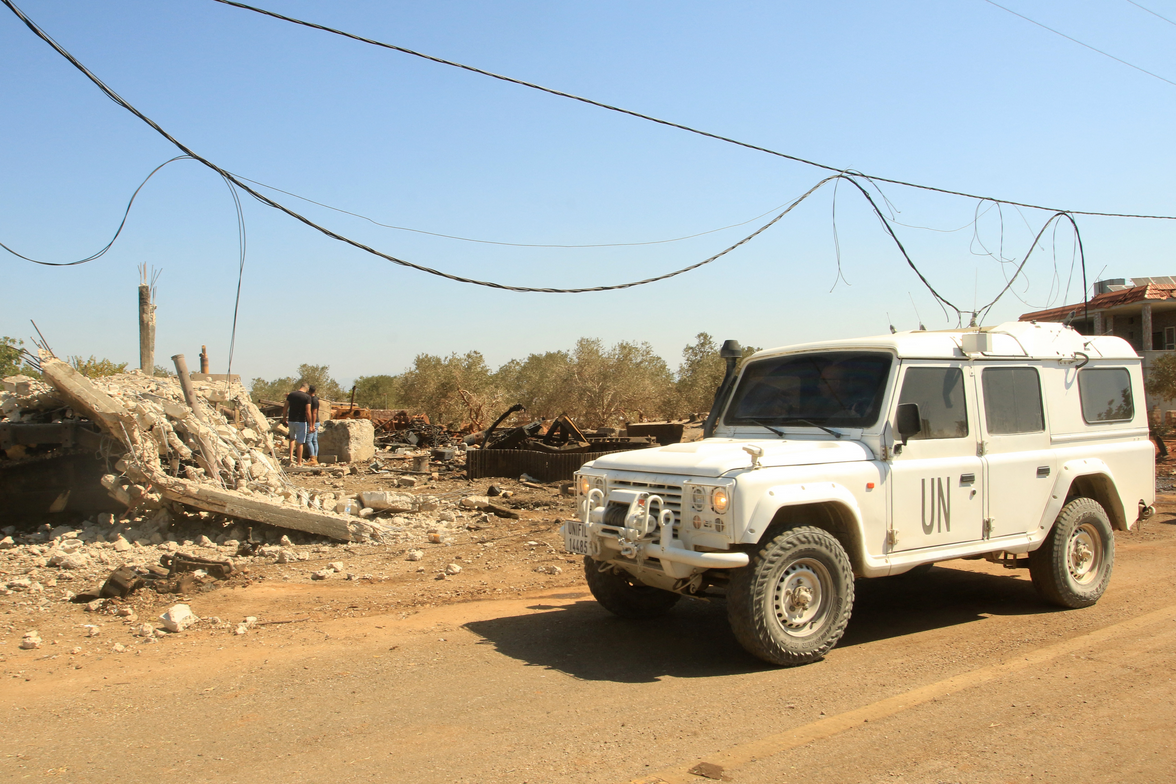
Peacekeepers of the United Nations Interim Force in Lebanon (UNIFIL) drive past the site of an overnight Israeli strike in the southern Lebanese village of Deir Siryan, in the Nabatieh district, on Aug. 7, 2025. (Credit: Mahmoud Zayyat/AFP)






BEIRUT — During its second meeting convened this week to discuss a state monopoly on arms, Cabinet saw all of its Shiite ministers walk out following their refusal to discuss a U.S. "roadmap" that lays out how Lebanon should go about disarming Hezbollah, a group that was once one of the most powerful non-state actors in the world.
The U.S. proposal, which was delivered to Lebanon through U.S. envoy Tom Barrack, sets the end of the year as a deadline for Hezbollah's disarmament, a timeline that Cabinet adopted during Tuesday's meeting. Instead of adopting the American plan directly, Prime Minister Nawaf Salam's ministers assigned responsibility for drawing up a plan to effectuate an army monopoly to the Lebanese Army, which it has been tasked to submit by the end of August.
Hezbollah and its allies accused the government of "bowing to foreign pressure" and categorically refused to discuss disarmament so long as Israeli attacks against Lebanon and its occupation of several areas of the South was ongoing. Cabinet was set to discuss the U.S. proposal during Thursday's meeting, which was adjourned shortly after the walkout.
According to copy of the Cabinet agenda reviewed by Reuters, the U.S. plan, drawn up by the U.S. State Department, sets out the most detailed steps yet for disarming Hezbollah.
It aims to "extend and stabilize" a cease-fire agreement brokered in November, that, while ending an all-out war, has not prevented Israel from continuing its attacks against the country.
"The urgency of this proposal is underscored by the increasing number of complaints regarding Israeli violations of the current cease-fire, including airstrikes and cross-border operations, which risk triggering a collapse of the fragile status quo," it said.
Here is an outline of the U.S. proposal that brought Thursday's Cabinet meeting to a halt:
Phase 1: The Lebanese government issues a decree within 15 days committing to Hezbollah's full disarmament by Dec. 31, 2025. In this phase, Israel would also cease ground, air and sea military operations.
Phase 2: Lebanon begins implementing the disarmament plan within 60 days, with the government approving "a detailed [Lebanese Army] deployment plan to support the plan to bring all arms under the authority of the state." This plan will specify disarmament targets.
Israel begins withdrawing from positions it holds in southern Lebanon and Lebanese prisoners held by Israel would be released in coordination with the International Committee of the Red Cross (ICRC).
Phase 3: Within 90 days, Israel will withdraw from the final two of the five points it holds, and funding will be secured to initiate rubble removal in Lebanon and infrastructure rehabilitation in preparation for reconstruction.
Phase 4: Within 120 days, Hezbollah's remaining heavy weapons must be dismantled, including missiles and drones.
The United States, Saudi Arabia, France, Qatar and other friendly states will organize an economic conference to support the Lebanese economy and reconstruction and to "implement President Trump's vision for the return of Lebanon as a prosperous and viable country."