


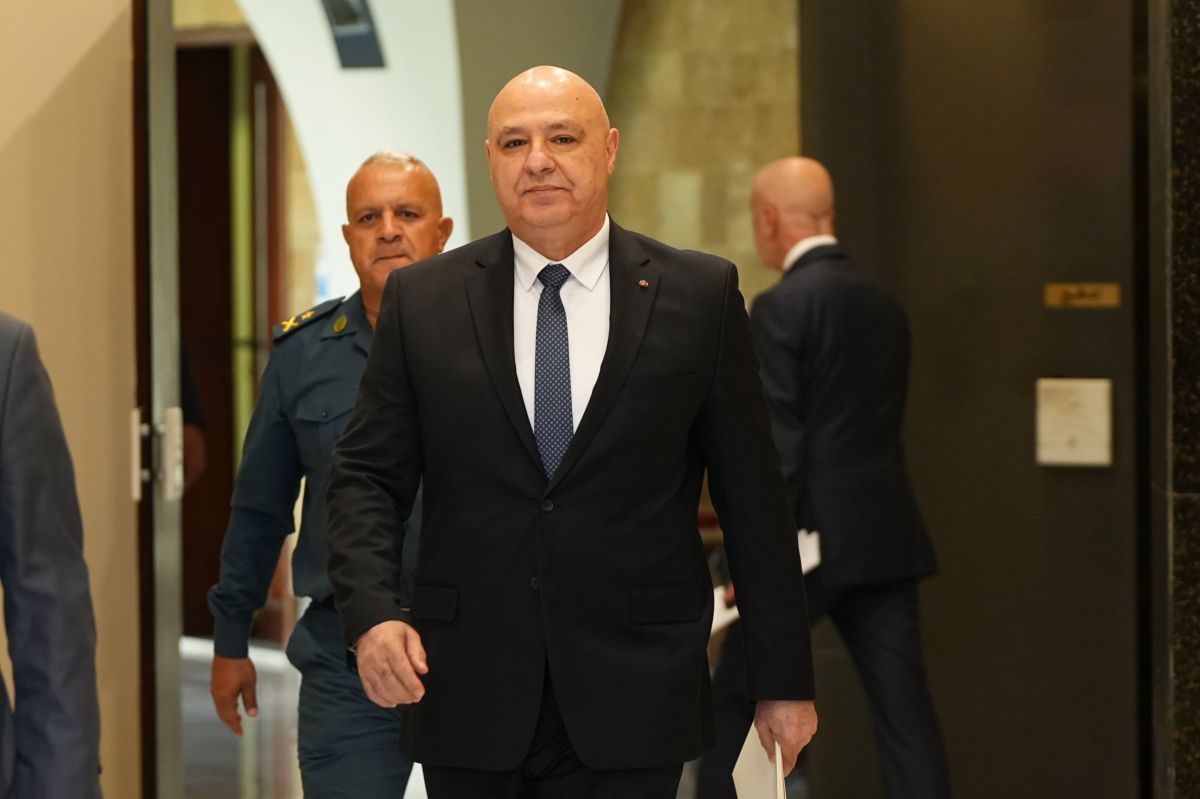
Lebanese President Joseph Aoun arriving at a Cabinet meeting in Baabda, Aug. 5, 2025. (Credit: Mohammad Yassin/L'Orient-Le Jour)






Two days after the Lebanese government adopted a plan to restore the state's monopoly on arms — including dismantling Hezbollah’s arsenal by the end of the year — Cabinet reconvened Thursday at the presidential palace in Baabda to continue discussions, including on a proposal from U.S. envoy Tom Barrack.
Ahead of the session, President Joseph Aoun told reporters that Prime Minister Nawaf Salam’s government would “finalize” decisions regarding the state’s exclusive control over weapons.
Among the ministers from the Amal-Hezbollah alliance — which has reiterated its rejection of disarmament — only Finance Minister Yassine Jaber (Amal) was absent. He was also missing on Tuesday, citing travel abroad. Labor Minister Mohammad Haidar (Hezbollah), who was absent earlier in the week, attended Thursday’s session. During the meeting, Haidar opposed any disarmament of Hezbollah so long as Israeli forces continued attacks and occupied parts of southern Lebanon.
“I am a son of this people,” Haidar said. “How could I face the mother of a martyr, a father still living in a tent, or a young person suffering daily existential anxiety, and tell them they must surrender and give up the only guarantee that protects them?”
He added: “We cannot speak of disarming the resistance while the enemy has not withdrawn, our prisoners haven’t returned, the aggression continues, and reconstruction hasn’t begun. Otherwise, I’m sorry — I cannot take responsibility for an unjust decision against my people, and I will never accept that the state abandons its own.”
Around 6:30 p.m., roughly three hours after the session began, all Shiite ministers — both those with and against the Amal-Hezbollah alliance — walked out of the Cabinet meeting.
Meanwhile, Hezbollah’s parliamentary bloc, Loyalty to the Resistance, issued a statement describing the government’s disarmament decision as a “free service” to Israel. “We call on the Lebanese government to correct the situation it has created by yielding to U.S. demands that serve the enemy’s interests,” the bloc said.
Continued pushback from Hezbollah and Amal
On Wednesday, Hezbollah condemned the Cabinet’s disarmament plan as a “grave sin.” Amal criticized the government for offering “free concessions to the enemy” instead of focusing on strengthening the cease-fire and stopping Israel’s “killing machine.” Amal-Hezbollah ministers Tamara Elzein and Rakan Nasreddine had already walked out of Tuesday’s session when the disarmament plan was raised.
Fadi Makki, the Minister of State for Administrative Reform and the only Shiite minister not aligned with the Amal-Hezbollah bloc, told L’Orient-Le Jour before the meeting that he would attend Thursday’s session because decisions as critical as the weapons monopoly “cannot be made without Shiite ministers present.”
Still, he admitted he wasn’t sure how he would respond if the others walked out. “It’s a heavy responsibility,” he said.
For his part, Displacement Minister Kamal Shehadeh said the Lebanese government stands by its decision to restore the weapons monopoly and “will not go back on it.” Speaking to Saudi-owned channel Al Arabiya, Shehadeh said the Amal-Hezbollah duo is “the only side protesting the measure, now facing a majority of Lebanese who support it.”
Aoun: “The arms monopoly does not undermine sovereignty”
Speaking to Al Hadath and Al Arabiya, President Aoun reaffirmed that “the arms monopoly will be enforced, regardless of the difficulties or obstacles.” He said the Cabinet is awaiting a plan from the Lebanese Army to be submitted by the end of August, as mandated earlier this week, so it can be discussed and approved.
The Cabinet session, he said, would “finalize the decisions needed on the weapons monopoly,” allowing the government to move toward fulfilling the commitments laid out in his inauguration speech in January and in the Salam government’s ministerial declaration. Recovering exclusive control of weapons for the Lebanese state and army, Aoun stressed, “does not violate Lebanon’s rights or sovereignty.”
The president added that implementing the roadmap presented in Beirut by U.S. envoy Tom Barrack — which outlines steps for respecting the cease-fire established in November 2024 — would also require the agreement of Syria and Israel, backed by U.S. and French guarantees, not only Lebanese commitments. That plan includes not only the disarmament of militias but also reforms and border demarcation with Syria.

 7 p.m. recap: 1 person killed near border with Lebanon; 200 kilos of explosives carried by mules; Riyadh shuts its airspace