






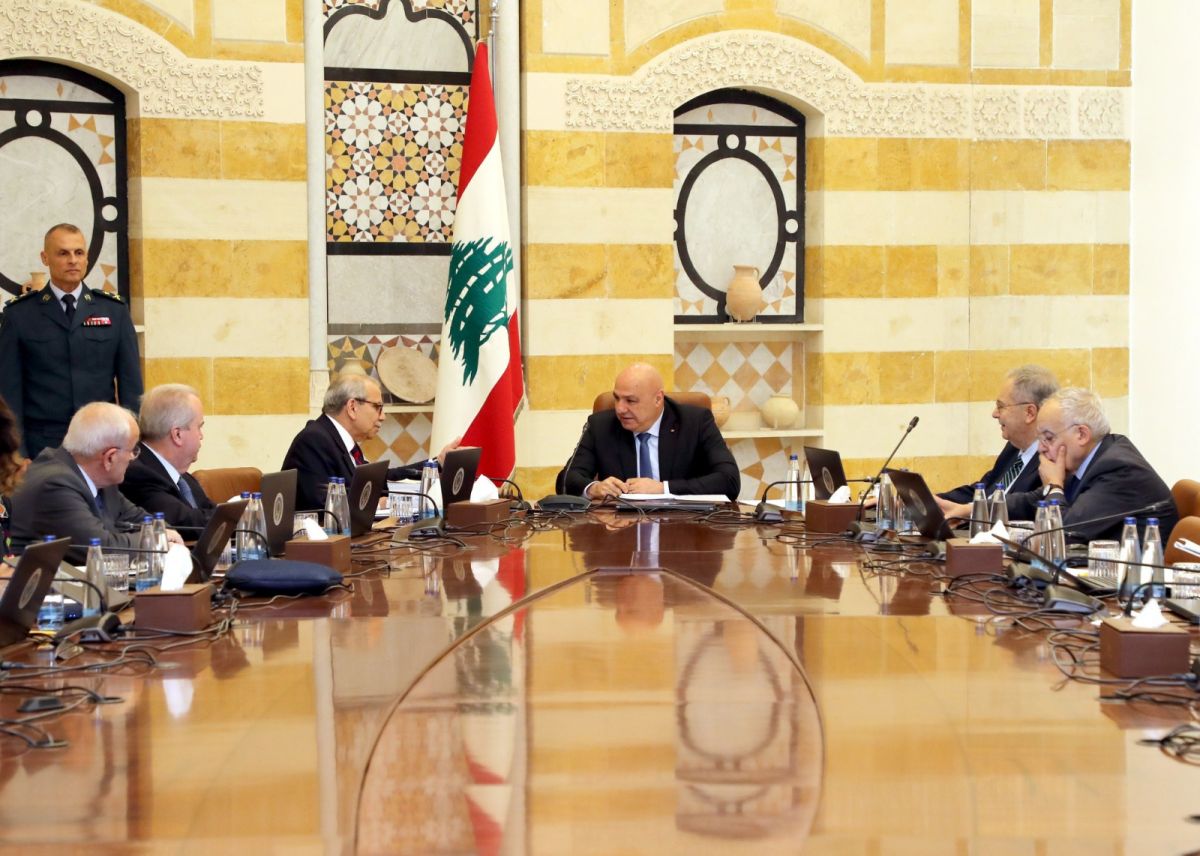
A government meeting in Baabda on July 17, 2025. (Credit: @lbpresidency/X)






Until late on Monday evening, political discussions continued to reach a consensus on the issue of Hezbollah’s weapons and their transfer to the Lebanese Army. These contacts are expected to continue up until the last moments before the Cabinet meeting dedicated to the issue on Tuesday.
Especially since, according to L'Orient-Le Jour's information, Hezbollah has made its participation conditional on knowing in advance what decisions will result from the meeting. It relies on Parliament Speaker Nabih Berri, who is working to find a formula acceptable for all internal parties, as well as the international community. The latter is calling for the establishment of a timeline for the state's monopoly on arms.
L’Orient-Le Jour has learned that a meeting took place on Monday between President Joseph Aoun and Prime Minister Nawaf Salam. Berri was also expected to go to the Baabda Presidential Palace for talks with the president.
These contacts are happening at a time when some stakeholders remain firmly attached to the idea of adopting a clear and public decision on the withdrawal of all weapons outside the authority of the state, with a precise timeline and an implementation program to be completed no later than the end of 2025.
The side calling for Hezbollah's disarmament argues that it represents the majority of the Lebanese people, especially after some of Hezbollah’s allies — including MP Tony Frangieh — have also called for the state to have a monopoly on arms. They believe they have a two-thirds majority in Cabinet, especially with the support of ministers close to the president and prime minister, prompting them to demand a clear decision, even if it means resorting to a vote.
Israel is convinced it won and that Lebanon, like Hezbollah, is in a position of weakness after the damage they have suffered. This means, according to Israel, that Hezbollah must make the expected concessions, and that Lebanon must commit to the proposed path.
Hezbollah’s conditions
Hezbollah is standing firm on its position. While it does not reject the principle of a debate over the state’s arms monopoly, it makes any disarmament contingent on a prior Israeli withdrawal, a halt to violations, the release of prisoners and the launch of the reconstruction process.
The party has prepared an argument it considers clear, stressing that it accepted the cease-fire agreement, which stipulated that Israeli operations should cease and a withdrawal should take place within 60 days of the cease-fire, along with a reconstruction conference.
Since none of the Israeli conditions were met, Hezbollah will therefore insist on Tuesday that priority be given to that first.
On Monday, the party’s media services shared a video on social media in which Secretary-General Naim Qassem and his predecessor Hassan Nasrallah stated that handing over the weapons is out of the question. Hezbollah also remains on guard against any initiative that could catch it off guard, such as the adoption by vote of a decision for weapons withdrawal with a specific timetable.
This risk is all the more present given reports that Lebanon’s international partners are insisting on the approval, without further debate, of the cease-fire roadmap that has been presented to Lebanon. This is why the party demands to know in advance the government’s decision, so that it's not blindsided.
Several proposals
Proposals have emerged to avoid a confrontation, government crisis, rising political tensions, or public unrest.
One such proposal would involve presenting the American envoy Tom Barrack’s roadmap, discussing it and sharing Lebanese observations during the meeting. The debate would be initiated, and Lebanon would enter a serious dynamic toward a state monopoly on arms. The final decision could then be postponed to another session, on Thursday or the following week, to defuse tensions and continue discussions toward a clear decision.
Among the ideas mentioned is also the possibility of mandating the Lebanese Army or the Higher Defense Council to report on the progress made so far and to propose a mechanism for completing the army’s deployment and implementing the state’s monopoly on arms, with a realistic timeline.
This solution may not be enough for the U.S. and Israel, who insist on the establishment of a timeline.
