


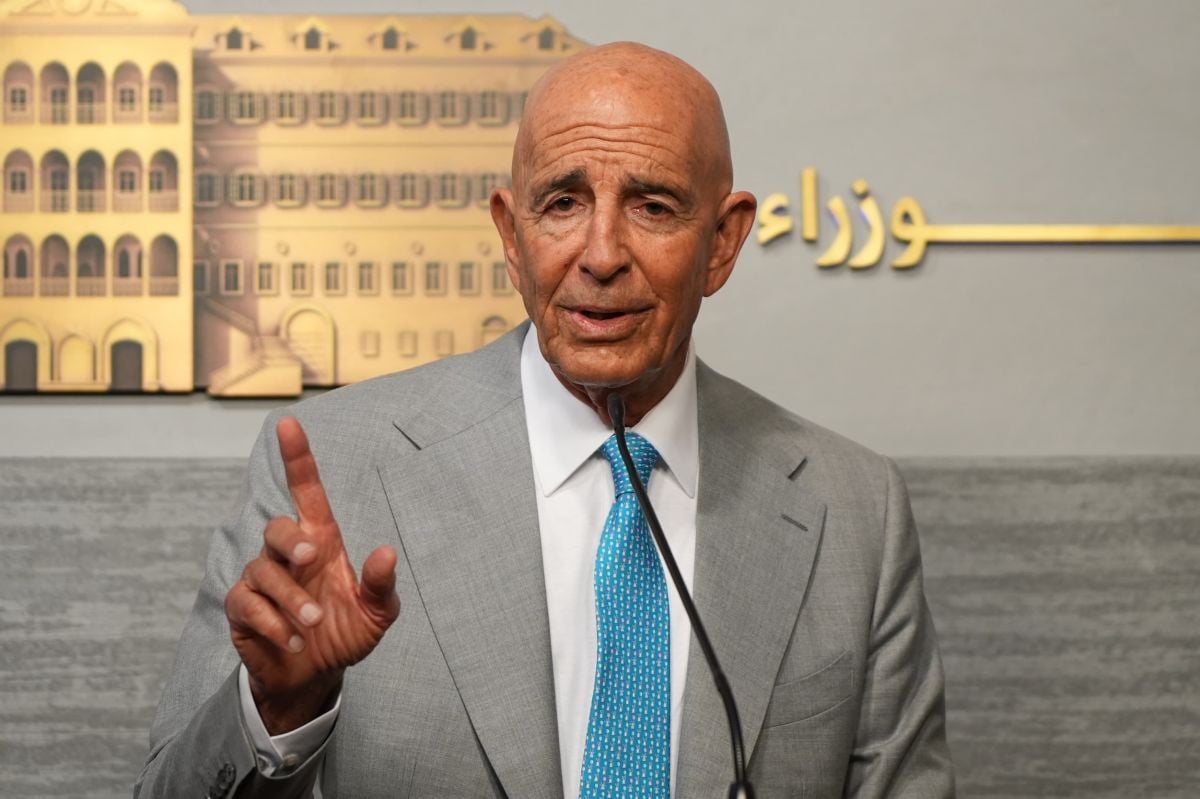
U.S. envoy Tom Barrack speaking at the Grand Serail in Beirut, on July 21, 2025. (Credit: Mohammad Yassine/L’Orient Today.)






BEIRUT — The ball is in the Lebanese court. That is the main message from U.S. envoy Tom Barrack during his third visit to Beirut on Monday, to discuss the issue of Hezbollah’s disarmament.
Barrack reaffirmed that this matter is up to the Lebanese authorities, who must define the approach themselves. After his meeting with Prime Minister Nawaf Salam, the U.S. envoy said that Hezbollah's disarmament is "an internal Lebanese issue," as Hezbollah circles accuse the Americans of wanting to impose this disarmament to "reassure Israel."
“The United States is not here to force Israel to do anything. We are here to use our influence to bring calm minds together around a solution,” he continued, believing that the cease-fire agreement reached in November to end the war between Hezbollah and Israel “did not work.”
Arriving in Beirut on Sunday evening, the U.S. envoy was first received by President Joseph Aoun before his meeting at the Grand Serail. According to the presidency, Aoun handed him a “draft memorandum of understanding” outlining Lebanon’s commitments since the cease-fire. These include points from the truce agreement, the president’s inauguration speech, and the ministerial statement of Salam’s Cabinet.
Among these commitments, the presidency cited “the urgent need to save Lebanon by extending the state’s authority over its entire territory with nothing but its own forces, monopolizing arms exclusively in the hands of the Lebanese Army and asserting the authority of the Lebanese constitutional institutions over decisions of war and peace.”
These factors must be ensured “simultaneously and in parallel with maintaining Lebanese sovereignty over all its international borders, reconstruction, and the initiation of economic recovery.”
Hezbollah is 'a terrorist organization'
In his remarks, Barrack stated that “President Donald Trump attaches importance to the situation in Lebanon and the restoration of stability in the region.”
“My return to Lebanon comes as Syria and the region have once again become unstable, and today we must focus on Lebanon to restore stability,” he stressed, affirming that he would “continue his meetings with Lebanese officials working towards solutions,” whether on security issues or economic reforms.
He also claims not to have taken note of Hezbollah’s “remarks” on his roadmap, adding that for the American administration, Hezbollah is “a terrorist organization” with which it does not engage in dialogue.
In short, no tangible progress was recorded during this tour. The U.S. envoy still insists on the need to move to operational steps for the state’s weapons monopoly, through a clear and public decision by official Lebanon and with the approval of all parties.
Certainly, according to L'Orient Today's information, the Lebanese response he received reaffirms Lebanon’s attachment to the weapons monopoly as well as its commitment to the ministerial statement and the presidential inaugural address. But what Washington now expects is a concrete mechanism for implementation and the start of its execution.
This mechanism is still to be defined in its details. These details concern the launch date of its implementation, considering it is meant to be conducted in several stages. The first would consist of a clear government decision in favor of the state’s monopoly on arms.
The second would see Hezbollah begin to hand over its weapons north of the Litani River, notably missiles and drones, with the United States pressuring Israel to avoid escalation, cease its aggressions, violations, and targeted assassinations.
The third step should concern Beirut and its suburbs, especially the southern suburb, concurrently with American pressure on Israel to initiate a withdrawal from occupied points. The fourth stage would be dedicated to the withdrawal of weapons from the Bekaa region.
Nabih Berri’s proposal
In this context, Lebanon has clearly expressed its requirements, particularly the effective cease-fire implementation by Israel, the need to activate the monitoring committee’s work on the agreement, and the importance of maintaining the role of the United Nations Interim Force in Lebanon (UNIFIL).
Barrack emphasized that the Lebanese state must prove its effectiveness and remain attentive to regional developments.
Lebanon has also insisted on obtaining guarantees regarding control of the situation in Syria, in light of concerns expressed by several Lebanese factions regarding the repercussions of recent events in Syria, especially after the clashes in Sweida.
Some believe that Hezbollah is using Syrian instability as a pretext to keep its weapons, citing the defense of the Shiite communities' presence in the area and the protection of the border region. But Barrack’s logic is clear: to end Israeli violations and strikes, Lebanon must begin to regain the weapons monopoly, as the State alone is responsible for the security of its citizens.
The Lebanese response has not received Hezbollah’s approval, as it does not consider itself concerned by this document. On Friday, Hezbollah leader Naim Qassem rejected the American proposal, believing that Washington is trying to reach a new agreement and is pressuring the Lebanese Army to remove his party’s weapons at the risk of provoking civil war.
In this context, the main issue remains Tuesday’s scheduled meeting between Barrack and Parliament Speaker Nabih Berri. According to some reports, Berri is expected to put forward a proposal consisting of a 15-day suspension of Israeli military operations during which a serious dialogue would take place with Hezbollah on the mechanism for returning weapons to the state.
The Americans have not yet responded to this proposal, but according to well-informed sources, Barrack should travel to Israel to discuss it with officials.
Other meetings
The envoy was also received by Elias Audi, the Greek Orthodox Metropolitan of Beirut, with whom he discussed the situation in Lebanon and the region, and by Druze leader Walid Jumblatt.
L’Orient Today learned that Maronite Patriarch Bechara al-Rai will meet with Barrack on Wednesday, who is also expected to meet with the commander of the army, General Rodolph Haykal. A dinner bringing together several MPs is also planned at the U.S. Embassy.