


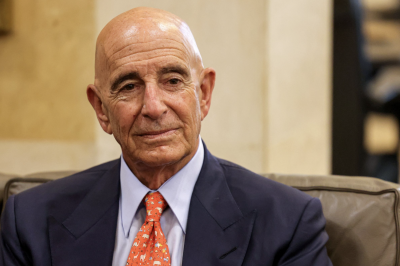
U.S. Special Envoy for Syria, Tom Barrack speaks after a meeting with Lebanese President Joseph Aoun at the presidential palace in Baabda, July 7, 2025. (Credit: Mohamed Azakir/Reuters)






American envoy Tom Barrack arrived in Lebanon on Sunday to follow up on the implementation of the cease-fire between Israel and Hezbollah, although his visit had originally been expected early in this week. Mr. Barrack’s arrival was announced early in the afternoon by the National News Agency (NNA).
According to our information, Barrack is scheduled to meet on Monday with President Joseph Aoun, and then with Prime Minister Nawaf Salam. According to a government source, the reason Barrack brought his visit forward is unclear.
This marks the diplomat’s second visit in two weeks. During his previous trip, he received Lebanon’s response to an American proposal aimed at restoring stability in southern Lebanon and the broader region, which notably included the disarmament of Hezbollah.
On July 14, Beirut received feedback from the U.S. embassy on this response, calling in particular for the completion of the disarmament process by the end of the year, especially regarding medium and heavy weapons.
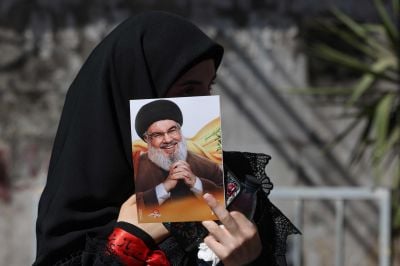
Barrack’s visit will be an opportunity to continue the dialogue and bridge the gap between positions. According to our information, Beirut will clearly commit to the exclusive right of the state to bear arms and will propose carrying out this process “in stages,” which would progress as Israel fulfills its part of the deal by withdrawing from southern Lebanon. This position openly diverges from that of Hezbollah, whose Secretary General, Naim Qassem, on Friday called on officials to “postpone the issue of exclusive weapons control.”
No new deal for Naim Qassem
“We will renounce neither our faith nor our strength. We are ready to confront the enemy. There will be no surrender and no capitulation to Israel, and Israel will not receive our weapons,” Naim Qassem declared during a ceremony honoring a senior military official of the party.
“We know the confrontation will be very costly, but submission would leave us with nothing,” he added. “We are ready to defend ourselves in case of Israeli aggression.” He went on: “Barrack is inciting the Lebanese Army to disarm the resistance by force and provoke a civil war.”

Qassem said that President Joseph Aoun, Prime Minister Nawaf Salam, and Parliament Speaker and Amal Movement leader Nabih Berry “are showing wisdom and cooperation to pull the country out of the crisis.” He also stated that “all sects in Lebanon are under threat.” “Lebanon faces three real threats: Israel in the South, Daesh-affiliated groups [Arabic acronym for the Islamic State group] in the East, and American hegemony that seeks to control the country, place it under guardianship, and prevent it from living freely,” he continued.
He further claimed that Hezbollah had “fully respected the cease-fire agreement south of the Litani River,” noting that “the Lebanese Army has been deployed where it could be.” “Today, the United States is proposing a new agreement, as if the last eight months of violations never happened,” said Qassem. “The new proposed agreement whitewashes Israel for the entire previous period of aggression.”
For his part, Prime Minister Nawaf Salam said in an interview Friday evening on al-Jadeed that he “is counting on the army, the wisdom of Lebanese political leaders, and the awareness of the Lebanese people” to avoid dragging Lebanon into another spiral of violence.
“We are surrounded by flames, and what matters to us is how to protect Lebanon from those flames. We will only succeed by preserving our national unity and avoiding being drawn into any reckless adventure or internal conflict,” the prime minister said, in reference to the situation in Syria.
Salam: Israeli withdrawal ‘complementary’ to Hezbollah’s disarmament
Regarding Tom Barrack’s visit, the prime minister stated that the U.S. proposal includes “a set of ideas related to the implementation of the statement on cessation of hostilities arrangements, adopted by the previous government, and to which our government has reaffirmed Lebanon’s commitment.”
According to the head of government, the main idea of this roadmap is the “complementarity” between Israel’s withdrawal from southern Lebanon and the reestablishment of the state’s monopoly over weapons, which would only be held by a limited number of forces or bodies — the Lebanese Army, Internal Security Forces, General Security, State Security, Customs, and Municipal Police — as stipulated in the cease-fire agreement.
“The roadmap from the U.S. envoy proposes ideas for practically implementing these two complementary goals. There is the idea of complementarity and phased implementation. It’s not something that happens overnight. We discussed and submitted comments on this roadmap.”
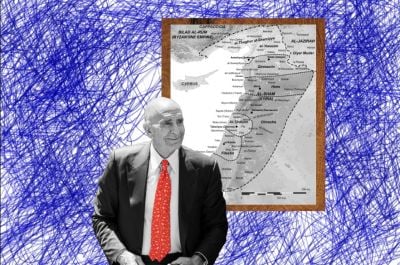
The prime minister also addressed the issue of intercommunal violence in Syria. “From the very first day, I’ve been in contact with all the ministers and heads of security agencies in the country,” Nawaf Salam assured. “Stability in Syria matters a great deal to us, just as it does to the Syrian people, given the repercussions that destabilization could bring, God forbid. We know what it means to kill each other. We lived through it for many years and paid the price. I hope we’ve all learned the lessons from that period and won’t repeat it,” he added.
In this context, Salam met Saturday night in Dimane, North Lebanon, with Maronite Patriarch Bechara Rai. On this occasion, Salam stressed the importance of the role played by the head of the Maronite Church in “consolidating national constants and strengthening partnership among Lebanese.” On Friday, President Joseph Aoun also received Speaker Nabih Berri for consultations ahead of Tom Barrack’s visit.
 The 7 p.m. recap: Houthis advance, government announces counteroffensive; Iran raises stakes; Israeli shells hit close to journalists in south Lebanon
 2 Israeli soldiers injured in 'operational accident,' as army continues attacks in the South