



Collage by Jaimee Lee Haddad.






You don’t usually hear about Bilad al-Sham in today’s politics. Suddenly, it’s all over the headlines. U.S. envoy Tom Barrack recently warned that “if Lebanon does not move, it will return to Bilad al-Sham.”
President Joseph Aoun hit back swiftly, calling the unity of Lebanese territory a “national constant.” Former Progressive Socialist Party (PSP) leader Walid Joumblatt also weighed in, emphasizing the importance of preserving the “current entities,” meaning the present-day states in the region, and reaffirmed his support for Greater Lebanon as established in 1920.
But wait, what exactly is Bilad al-Sham? What does it have to do with Lebanon? And why did Barrack’s comment stir such strong reactions?
Let’s break it down.

1. What is ‘Bilad al-Sham’?
Short answer: It’s an old name for a much bigger region.
‘Bilad al-Sham’ literally means ‘the land to the north’ in Arabic, referring to everything north of Mecca. For early Arab-Muslim geographers, the world was divided relative to the holy city: the land to the right (south) was Yemen, and to the left (north), Sham.
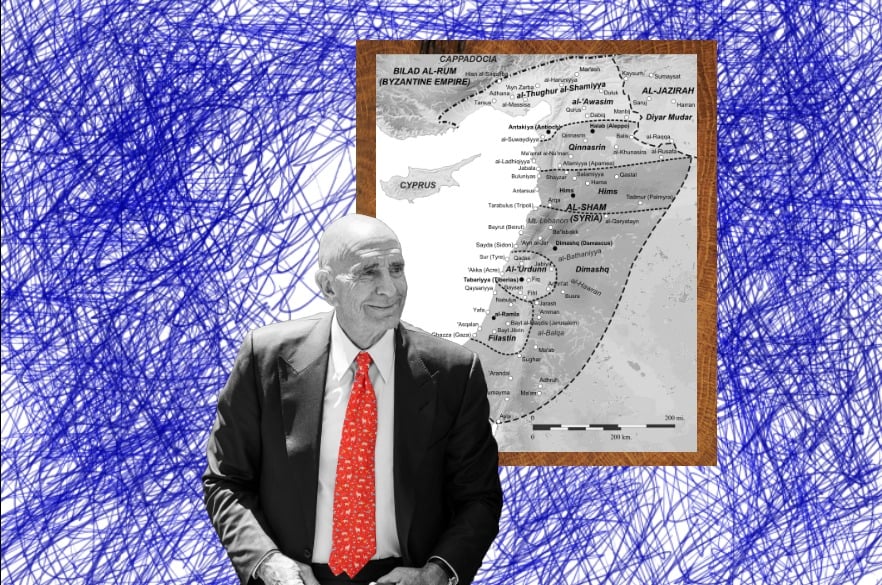
Historically, Bilad al-Sham referred to a large stretch of territory covering what we now know as Syria, Lebanon, Jordan, Palestine, parts of Iraq and even southern Turkey.
Some medieval maps bounded it by the Sinai and Hejaz to the south, the Taurus Mountains (Turkey) to the north, and the Syrian Desert to the east. It was also part of what people call the Fertile Crescent, due to its rich soil and early civilizations.
But here’s the catch:
It was NOT a single political or sovereign unit. And no, it doesn’t mean 'Syria' the way we understand it today, with borders, a capital in Damascus and a flag.
So why do some people confuse it with present-day Syria?
Over time, ‘Sham’ became a popular shorthand for Damascus and by extension, modern Syria. But historically, Bilad al-Sham, and Syria itself was just a broad geographic reference, not a state.
Under the Ottomans:
Under Ottoman rule, which began in 1516 after Sultan Selim I’s defeat of the Mamluks near Aleppo, the region was reorganized into several vilayets (provinces). Initially, these included:
- The Vilayet of Aleppo and the Vilayet of Damascus, which together covered most of modern Syria and extended into Palestine;
- Later, the Vilayet of Tripoli (established in 1579), which included the coastal region from Latakia to Maameltein (near present-day Jounieh);
- And the Vilayet of Saida (created in 1660), covering the southern Mount Lebanon area down to Haifa, including coastal territories formerly attached to Damascus.
Then, in 1864, the Ottomans created a large new administrative entity called the 'Vilayet of Syria,' which merged the provinces of Damascus, Tripoli and Saida. But this super-vilayet was short-lived. As historian Charles Hayek notes: “the province was too large to be administered.” In 1888, it was broken up, and Tripoli and Saida were attached to the newly elevated province of Beirut, the economic hub of the region at the time.
Between these provinces, boundaries shifted frequently but the idea of one unified 'Greater Syria' didn’t exist under Ottoman rule. Even 'Greater Lebanon' wasn’t born until 1920, when the French mandate redrew the map and officially declared a new Lebanese state. As Hayek notes, “Neither Syria nor Lebanon existed in unified form before the mandate period.”
So when Barrack mentioned Bilad al-Sham, he wasn’t (just) talking about Syria. He was referencing an old regional concept that once included Lebanon, and that still carries serious political weight.

2. Has anyone ever tried to bring it back?
Yes. A few times, and not quietly.
After World War I, Arab nationalists under King Faisal tried to establish a unified Arab Kingdom based in Damascus that included most of Bilad al-Sham. That project collapsed after the Battle of Maysalun in 1920, when French forces invaded and dismantled the short-lived kingdom.
In 1932, Lebanese politician Antoun Saadeh founded the Syrian Social Nationalist Party (SSNP). His vision? A secular 'Natural Syria' (Surya al-Tabi’yah) that included Lebanon, Syria, Jordan, Palestine, Iraq, parts of Turkey and even Cyprus. Saadeh’s concept was based on shared geography and history, not Arab identity or religion.


3. Why did Barrack bring it up now?
His original comment was framed as a warning: if Lebanon doesn’t implement structural reforms and disarm Hezbollah, it risks falling under Syrian influence again.
“You have Israel on one side, Iran on the other, and now you have Syria manifesting itself so quickly…”
But many in Lebanon weren’t just alarmed by the warning. For some, it sounded like a revival of Syrian annexation dreams, or a diplomatic green light for foreign trusteeship.
That’s why President Aoun doubled down on constitutional sovereignty while Joumblatt expressed support for reconciliation in southern Syria and stressed his attachment to Lebanon’s current borders.
Other reactions from politicians across the political spectrum ranged from warnings about foreign tutelage and affirmations of Lebanese sovereignty to fierce pro-Syrian rhetoric accusing the U.S. of manipulation and regional interference.
Barrack later walked back his comments, calling talk of annexation “fantasy” and affirming U.S. support for two sovereign states.
