


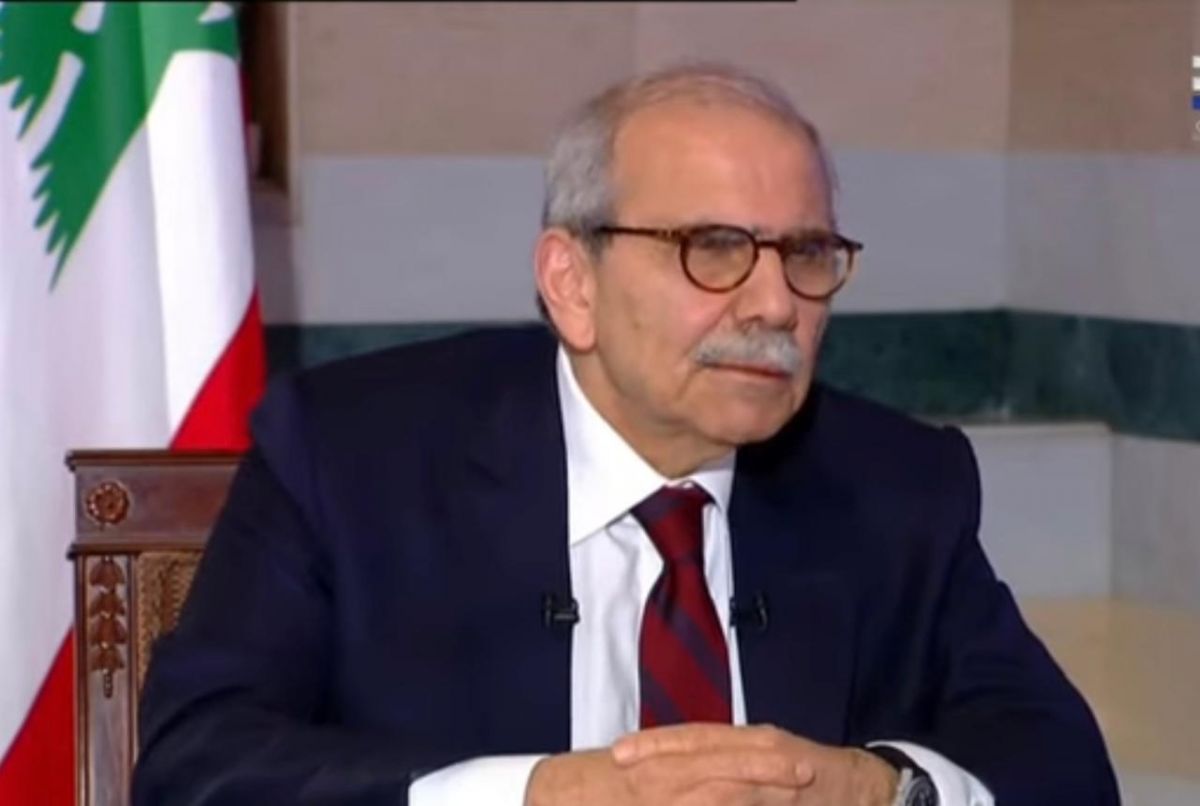
Prime Minister Nawaf Salam, during his interview broadcast Friday evening on Al-Jadeed. Screenshot.






Caretaker Prime Minister Nawaf Salam said Friday night he was relying on the Lebanese Army, the wisdom of political leaders and the awareness of the Lebanese people to prevent the country from being dragged into a new spiral of violence amid sectarian clashes in neighboring Syria.
In an interview with Al-Jadeed TV, Salam also confirmed that U.S. envoy Tom Barrack is expected in Lebanon early next week to follow up on the implementation of the cease-fire between Israel and Hezbollah.
“We are surrounded by flames. What matters now is how to protect Lebanon from them,” Salam said, referring to the deadly fighting in Syria’s southern province of Sweida. “We can only do that by preserving our national unity and avoiding any adventure or internal conflict.”
Over 940 people have been killed and tens of thousands displaced in Syria since July 13, as tribal militias and Sunni Bedouins clashed with Druze residents, according to an NGO. The Syrian government declared a second cease-fire on Saturday after another brief truce collapsed. The violence has sparked limited sectarian tensions in parts of Lebanon, particularly the Bekaa Valley and North Lebanon.
‘Dangers’ and ‘opportunities’
“Since day one, I’ve been in constant contact with all ministers and heads of Lebanon’s security forces,” Salam said. “Syria’s stability matters greatly to us and to the Syrian people, considering the potential fallout if the country unravels.”
He warned of Lebanon’s own painful history: “We know what it means to kill each other. We lived through that for many years and paid the price. I hope we’ve all learned the lessons from that time and won’t repeat them.”
Asked about recent comments by Druze leader Walid Joumblatt, who spoke of a prolonged war and the threat of partition in Syria, Salam said the situation was still fluid.
“Nothing is written yet — everything depends on our behavior. If, God forbid, Syria doesn’t stabilize soon, we must hold onto our national unity even more tightly,” he said. “I’m counting on the army, our leaders’ wisdom and the people’s awareness, because they do not want to return to those dark days, despite recent incidents in Tripoli and the Bekaa.”
Salam ended on a cautiously optimistic note: “Syria faces many dangers, including the risk of partition, which threatens its unity. But there’s also a real opportunity — the fall of the previous regime on Dec. 8, growing Arab support for the new government, and possibly even the lifting of sanctions. I believe Syria is on a path toward stability, despite the challenges.”
Awaiting the U.S. envoy
Salam confirmed that U.S. envoy Tom Barrack is expected in Beirut early next week, though he did not specify whether the visit would begin Monday or Tuesday. It will be Barrack’s second trip to Lebanon in two weeks.
During his last visit, Barrack received Lebanon’s official response to a U.S. proposal aimed at reinforcing the cease-fire agreement reached in November between Israel and Hezbollah. That deal has since been regularly violated by Israeli airstrikes, while Hezbollah has yet to formally commit to transferring its weapons to the state.
Salam said the American proposal outlines “a set of ideas related to implementing the cessation of hostilities statement adopted by the previous government, to which our government has also confirmed its commitment.”
At the heart of the proposal is the principle of “complementarity” between two goals: the withdrawal of Israeli forces from southern Lebanon and the reassertion of the state’s monopoly over weapons. Under the plan, arms would be held only by official bodies: the Lebanese Army, Internal Security Forces, General Security, State Security, customs and municipal police.
“The roadmap suggests practical steps to implement these two complementary goals gradually,” Salam said. “This won’t happen overnight. We’ve discussed the plan and provided our comments.”
 Israeli army carries out demolition at Jabal Amel School in Houla as strikes continue