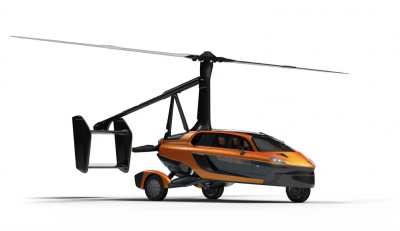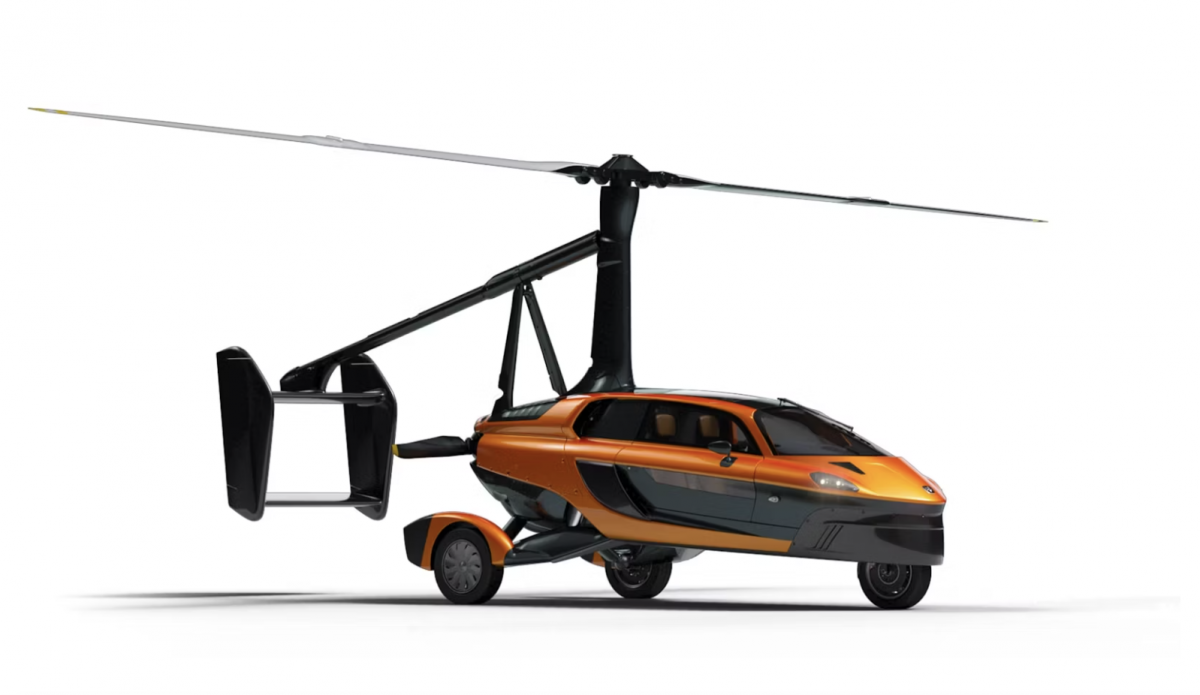
The "Liberty" vehicle from the Dutch company PAL-V. (Credit: Taken from their website)






This will be a first worldwide. With a unit price close to $800,000, the "Liberty" vehicle from the Dutch company PAL-V — equipped with three wheels, a rotor and a propeller and capable of both driving and flying — will be deployed in the United Arab Emirates (UAE) in 2027, once certified for aerial use, reports the magazine Arabian Business.
"The world's first commercially available flying car will debut in the UAE at the beginning of 2027," revealed Marco van den Bosch, the company's commercial director, to the Emirati media. He stated that the PAL-V "Liberty" model, which will enter production next year in the Netherlands, "will see its first deliveries in Europe at the end of next year before being deployed in 2027 in the Gulf country through a partnership with Jetex," one of the global leaders in the business aviation sector.

The flying car, capable of traveling about 500 km on a single battery charge, runs on unleaded fuel and can accommodate two passengers. On the road, it can reach 160 km/h and travel 1,300 km. In the air, at 3,000 meters altitude, its speed is the same. The transition from one mode to another takes about 10 minutes, the time needed to deploy the main rotor, the rear propeller and press a button to raise the chassis.
Before the commercial launch, the European company will conduct 100 hours of "verification flights" at the beginning of 2026, explained van den Bosch to the magazine. "The regulatory hurdles, which typically take 10 to 12 years for new aircraft, have now been overcome with the approval of the EASA and the FAA," which are the European Aviation Safety Agency and the Federal Aviation Administration of the United States, a government agency responsible for regulations and controls regarding civil aviation in the country.
In early April, the EASA issued a technical non-objection opinion regarding this helicopter-like vehicle, a decision that marked the opening of the seventh and final step towards its full certification, synonymous with flight authorization. Developed since 2008, the vehicle was already certified in 2020 for road use.

Desert climate of the United Arab Emirates
The PAL-V "Liberty" model was specifically designed to withstand desert environments, making the United Arab Emirates – a country characterized by arid and dry desert-type climates – an "ideal market," said van den Bosch, explaining that "the aircraft is particularly suited to sandy conditions."
The flying car requires relatively modest infrastructure: a takeoff area of only 200 meters by 30 meters, easily set up at various points in the region. As for landing, the necessary space is even more limited, just 30 meters, according to the media.
The official also minimizes the risks of such a means of transport, highlighting several elements, such as the fact that it has two engines, a flying parachute and the ability to make emergency landings.

A double license
"For Dubai residents, the flying car could significantly reduce travel times during peak hours," added van den Bosch.
Owners of these vehicles will need both a driver's license and a private pilot's license to operate them. And for busy customers, "mostly entrepreneurs," PAL-V offers a private and accelerated training program. The company has already opened a flight school in the Netherlands and plans to expand its network with new facilities in Italy and the United Arab Emirates to meet its growing customer demand.
The company admits it is primarily targeting professional and government uses but also states that it has "a large order book from individuals."
This article was translated from L'Orient-Le Jour.