






Israeli drone fires a stun grenade on Kafra
An Israeli drone fired a stun grenade on a house in the Jbeil neighborhood of Kafra.
Meanwhile, the al-Jadeed television channel reported that the commander-in-chief of the Lebanese army, Rodolph Haykal, had informed U.S. General Joseph Clearfield, who heads the cease-fire monitoring mechanism in Lebanon, that Israeli attacks were hampering the military’s operations, particularly in the "pilot zones," despite the army fulfilling its responsibilities during periods of escalation.
Israeli drone fires sound bomb near Yater as army detonates blast in Taybeh
An Israeli drone fired a stun grenade near the outskirts of Yater (Bint Jbeil), while the Israeli army carried out a controlled detonation in Taybeh (Marjayoun), our correspondent in the South reported.
Israeli explosions in Aita al-Jabal, Bani Hayyan, sound bomb in Kfar Kila
A large explosion was carried out by the Israeli army in the woods of the town of Aita al-Jabal (Bint Jbeil), according to our correspondent in the south.
An explosion was also reported in the town of Bani Hayyan (Marjayoun).
An Israeli drone dropped a sound bomb on the outskirts of Kfar Kila (Bint Jbeil).
The movement of Israeli Merkava tanks was also observed near the eastern outskirts of Kfar Shuba (Hasbaya), our correspondent in the South reported.
Iran demands compensation following oil spill in Strait of Hormuz
Iran has warned of environmental damage in the Strait of Hormuz after an oil slick reached the island of Qeshm, in the south of the country, and has demanded compensation for the damage caused.
“Initial findings suggest that a foreign bulk carrier may be responsible” for the pollution, said Foreign Ministry spokesperson Esmail Baghaei on X.
He argued that “any party benefiting from commercial shipping through the Strait of Hormuz has a legal and moral obligation to repair the environmental damage” caused.
However, according to the maritime tracking website TankerTrackers, “the oil spill appears to have originated from the Iranian attack on the bulk carrier Minoan Pioneer,” which took place in Omani waters on Aug. 3.
Israel attacks Bani Hayyan with gun-fire, artillery shelling, and burns of homes
Israel carried out machine gun sweeps and artillery fire in Bani Hayyan (Marjayoun). Its forces also set fire to several houses on the outskirts of the village, according to our correspondent in southern Lebanon.
The Israeli army also carried out a large explosion in Majdal Zoun (Sour).
Israeli forces demolish Kfar Tibnit complex housing 60 apartments, mukhtar says
The mukhtar of Kfar Tibnit (Nabatieh), Abu Mustafa Yassin, told L’Orient Today that “one of the major demolitions carried out by Israeli forces in the town in recent days targeted the Ward residential complex, made up of 14 buildings containing around 60 apartments.”
"The complex was completely destroyed," Yassin said, adding that "the demolition took place around 10 days ago."
Several other homes in Kfar Tibnit were also targeted in similar demolition operations, he added.
Temporary crossing built over Litani River in Qaaqaaiyet al-Jisr
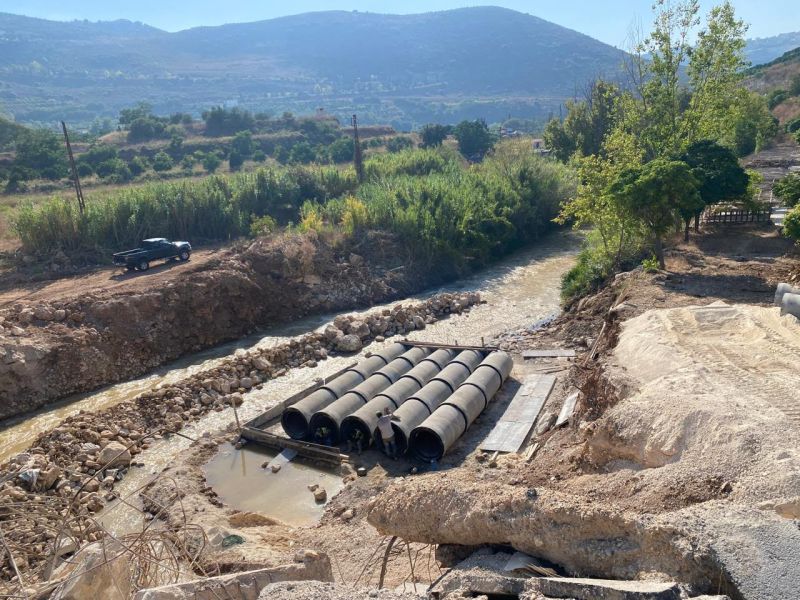
(Credit: Muntasser Abdallah/L'Orient Today)
Lebanon’s Public Works and Transport Ministry, in coordination with the Litani River Authority and with support from the Lebanese Army, has begun work on a temporary crossing over the Litani River in Qaaqaaiyet al-Jisr (Nabatieh) after Israeli attacks destroyed bridges and other key infrastructure in southern Lebanon, the Ministry said in a statement.
“The crossing aims to provide a safe route across the river, reconnect southern areas and facilitate the movement of residents, vehicles and agricultural products,” the ministry said.
“The Litani River Authority is providing technical oversight in coordination with the ministry, the consultant and contractor to ensure hydraulic and structural safety, maintain the river’s flow and protect its channel and infrastructure,” the statement concluded.
Hormuz Strait: Araghchi says U.S. making an 'even more serious miscalculation' than over Iran war
Iranian Foreign Minister Abbas Araghchi said the United States was making an “even more serious miscalculation regarding the Strait of Hormuz” than it did over the “war against Iran” launched in late February, in a post on his X account.
“The United States has long been making miscalculations due to intelligence failures,” he wrote. “Worse than fake news: fake intelligence. Be careful.”
“Allah is great, greater than ALL power on Earth. In Allah we place our trust,” Araghchi concluded.
The day before, U.S. President Donald Trump had said on his Truth Social platform that the United States had “total control” of the strategic waterway.
French chargé d’affaires visits Rmeish and Ain Ebel to ‘support southern communities’
France’s chargé d’affaires in Lebanon, Bruno Pereira da Silva, visited Rmeish and Ain Ebel in southern Lebanon amid the ongoing hardship caused by the war, the French Embassy in Lebanon said in a statement Thursday.
In both Rmeish and Ain Ebel, Pereira da Silva met with the respective municipal councils to reaffirm “France’s commitment to serving communities in southern Lebanon.” Discussions focused on the “challenges facing the two isolated villages, as well as their priorities and residents’ needs.”
In Rmeish, he met beneficiaries of the "Food Security and Nutrition" project, funded by France and implemented by Action Against Hunger France.
"As the war further destabilizes living conditions, this project helps meet the basic needs of families, breastfeeding mothers and children in early childhood," the embassy said.
In the largely Christian southern Lebanese border villages of Rmeish, Ain Ebel, and Debel remain largely isolated and encircled due to the ongoing conflict between Hezbollah and Israel, infrastructure destruction, and severe movement restrictions.
Israeli artillery shelling continues in southern towns, Israeli forces moving between Aita al-Jabal and Beit Yahoun
Israeli artillery also fired a shell at the outskirts of Kfar Shuba (Hasbaya), while Israeli forces opened machine-gun fire toward the town’s outskirts from the Ruwaisat al-Alam position. Israeli artillery later targeted the outskirts of Beit Yahoun and Braachit (Bint Jbeil.)
Separately, an Israeli infantry force was spotted moving around the Shahid al-Thaleth religious seminary in the area between the towns of Aita al-Jabal and Beit Yahoun (Bint Jbeil), our correspondent in the south reported.
Israel carried out demolition operations in 9 southern localities on Wednesday
The Israeli army carried out demolition operations in nine southern localities on Wednesday, destroying homes and infrastructure, including public buildings and a school in Zawtar Sharqieh, according to a tally of Wednesday’s attacks reported by our correspondent in south Lebanon.
Homes were also set on fire in two localities, while roads and houses were bulldozed in another. Israeli drones also dropped bombs and explosives on four southern localities.
Israeli warplanes carried out a strike on one locality, while a drone targeted another. Ten southern localities were also subjected to intense and sustained artillery fire, with dozens of shells.
South Lebanon: Israeli army continues shelling and demolition operations, strikes Mansouri and Deir Siryan
The Israeli army continued shelling southern Lebanon overnight from Wednesday to Thursday, alongside demolition operations, our correspondent in south Lebanon reports. In the Bint Jbeil district, Beit Yahoun was targeted by machine-gun fire and artillery shells, which also hit Braasheet.
Haddatha came under artillery fire, followed by two demolition operations targeting several homes. Similar machine-gun fire targeted Mansouri (Sour), where the army also carried out a demolition operation targeting homes on communal land, followed by medium-caliber machine-gun fire toward the village.
The Israeli army also carried out a detonation in Khiam (Marjayoun district).
In the evening, a drone dropped explosives on the strategic heights of Ali al-Taher, in the Nabatieh district. Later overnight, Israeli artillery again targeted Ali al-Taher, toward Nabatieh Fawqa, as well as Wadi al-Hujeir in the Marjayoun district.
After midnight, two Israeli army drones exploded in Zawtar Gharbieh, the first in the air above the church and the second near several residents who were alongside Lebanese Army soldiers in the village. After 1 a.m., artillery fire resumed, targeting Wadi Slouki toward Touline in the Marjayoun district, as well as the area between Zawtar Sharqieh and Mayfadoun.
Israeli warplanes also carried out two consecutive strikes on Mansouri, alongside another strike targeting Deir Siryan in the Marjayoun district.
US rebukes Katz after refusal of any Israeli withdrawal from south Lebanon
The U.S. State Department late Wednesday criticized Israeli Defense Minister Israel Katz after he said earlier that Israel would not “withdraw” from occupied areas of southern Lebanon.
The U.S. administration said such remarks were “not consistent with the commitments made under the agreement” between Beirut and Tel Aviv reached in late June and brokered by Washington.
“The United States expects all parties to act in a manner consistent with the framework they agreed upon, and Israel has clearly stated that it has no territorial ambitions in Lebanon,” a State Department official said in a statement sent to journalists seeking a response to Katz’s remarks, according to several Israeli and U.S. media outlets.
“The United States fully supports Lebanon’s territorial integrity and sovereignty,” the official added, stressing that the U.S.-brokered framework between Israel and Lebanon “clearly provides a path, subject to certain conditions, toward a phased redeployment linked to the verified disarmament of Hezbollah and the dismantling of its infrastructure.”
“The Lebanese Armed Forces are implementing the first pilot zone, and the United States will continue to support the full implementation of this process,” the official added, referring to Zawtar al-Gharbieh, where the Lebanese Army began deploying two weeks ago following a reported Israeli withdrawal. Israeli forces had previously made incursions into the area before the process began. Israeli troops were nevertheless seen again in the village earlier this week.
Good morning and welcome to our live coverage of south Lebanon
The Israeli army continues to occupy more than 600 square kilometers along the border and destroy village after village.
We will also follow developments across the Middle East, where tensions remain high between the United States and Iran.
Already have an account? Login here
You have reached your article limit
Stay informed about a Middle East in crisis.
Subscribe now and save 30%: just $8.9/month instead of $12.9.
This article is only available to L’Orient Today subscribers.
Already have an account? Login here

