






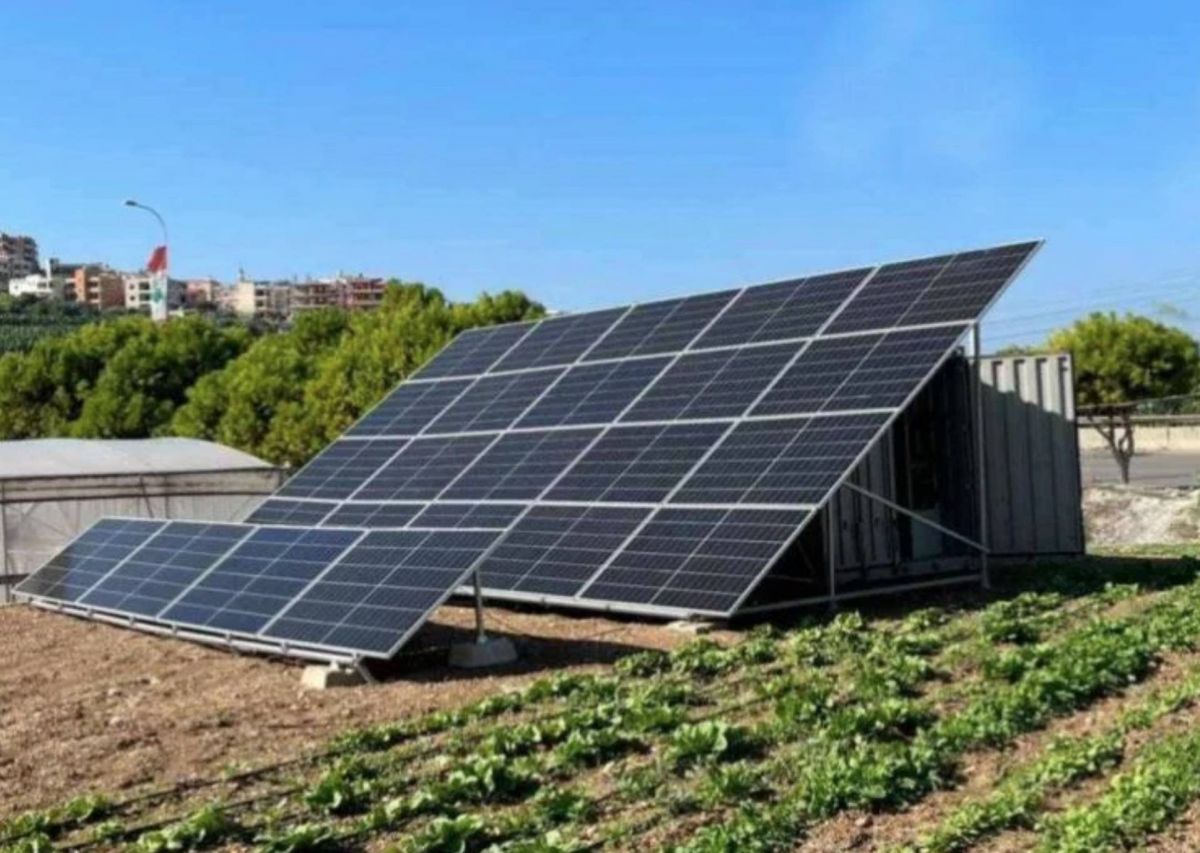
(Photo courtesy of YY Regen)






In the green village of Wata al-Jawz, in Kesrouan, a water pump runs tirelessly on a scorching August day. Joseph Khalil Salame, the owner of a vast expanse of greenhouses, faces a challenge.
With inconsistent power supply from the government, Salame resorted to the pricy option of using his own diesel-fueled generator to draw water from the well.
Luckily, a new opportunity emerged during the summer, thanks to “Regen-R8” (read “regenerate”), a solar energy initiative launched by the Lebanese engineering company YY Regen.
The project, founded by Amer Khayyat and Hasan Jaafar, aims to provide solar energy solutions to farms.
This summer season, the once-constant hum of Salame’s generator fell silent, at least during the daytime. It was replaced by two solar panel units set up at the farm’s entrance.
Salame didn’t purchase these solar panel units; he is renting them for a set period of time. He is one of only 14 farmers to try this new method in the past year.
“As a part of Regen-R8, we’ve created 10 portable photovoltaic units, eight are currently operating, and 10 are waiting to be set up,” explained Joe Rahme who manages the Regen-R8 project in collaboration with the YY Regen founders.
“These units can be moved around and offered to farmers across all regions,” Rahme said. “The goal is to address electricity supply challenges in rural areas and to cut down on the cost of using diesel-based generators.”
Their plan is to have 12 operational units by the end of the year.
These units can deliver between 15 to 18 kilowatts each, and multiple units can be set up on a single farm.
They proved to be immensely valuable for farmers impacted by the economic crisis.
“These two units you can see here have been instrumental in helping me pump water for a portion of my crops – approximately 30 dunums (equivalent to 3 hectares) of greenhouses,” Salame said indicating to the panels. “This means I can switch off the generator during the daytime and only use it at night when necessary.”
“Most importantly, it saves me the hassle of constant repairs,” he added.
According to Rahme, photovoltaic units require much less maintenance in comparison to diesel-fired engines.
Another benefit of these installations in agricultural areas is their positive ecological impact.
“While it’s true that both noise and air pollution from the generator have significantly decreased, I must admit that ecological considerations aren’t the primary focus of farmers who are battling for their livelihood,” Salame said.
Yet, this initiative does play a role in combating greenhouse gas emissions.
“Based on our calculations, each of our units reduces CO2 emissions by 1.5 tons per month,” Rahme said.
An expert called AI
Regen-R8 is currently the only initiative of its kind in Lebanon.Similar projects exist across the region, like in Egypt, and worldwide..
“The parts used in the units we produce are all available on the market,” Rahme explained. “The novelty primarily lies in how we put them together to create adaptable structures, but also in our business approach and the software we employ.”
“This software gathers data like weather information to aid farmers in enhancing their crop production,” he added.
Regarding its business model, the company charges per kilowatt/hour.
“The price is $0.27 per kw/h, which is notably lower than the average cost of generators (at around 36 cents),” Rahme said. “It’s important to note that maintenance for solar energy is minimal.”
The founders also have plans to leverage artificial intelligence in the future by integrating it into their software, especially to enhance data collection.
“With the data we gather, AI will enable us to make predictions like weather forecasts and soil moisture levels, which would be beneficial not only for the unit’s operation but also for the farmers in their tasks,” Rahme explained.
Additionally, the software will be capable of providing important information to technicians in case of a breakdown and can automatically halt water pumps when sunlight decreases to save battery power.
“Artificial intelligence is set to become our primary expert in renewable energy,” Rahme said.
Regional expansion
Regen-R8 initiated its journey with a pilot project funded by the Berytech incubator. Its initial endeavor focused on creating the first unit. Subsequently, the company’s co-founders invested their own capital along with donations to establish the remaining seven units. The cost of each unit ranges between $15,000 to $20,000.
“After the initial units were set up, the positive effects on farmers became evident right away,” Rahme said. “We gathered their feedback and could easily showcase that many more were intrigued by the solution we were offering.”
This successful portfolio caught the attention of both local and international donors, especially those who endorse small and medium-sized enterprises and the agricultural sector.
“In Lebanon, our aim is to double the number of units and assist even more farmers,” Rahme said.
However, they don’t intend to confine their efforts to Lebanon alone; they plan to extend their reach throughout the MENA region.
“There are many far-flung areas in countries such as Egypt and Iraq that lack access to national electricity grids, which would greatly benefit from units like ours,” he added.
On Salame’s farm, the photovoltaic units have garnered some unexpected admirers: the goats find solace in their shade and peacefully graze despite the sweltering heat. Salame expressed he would gladly embrace the opportunity again.
“My only regret is that the system doesn’t operate during the night,” he quipped.
This article was originally published in French in L'Orient-Le Jour. Translation by Sahar Ghoussoub.