






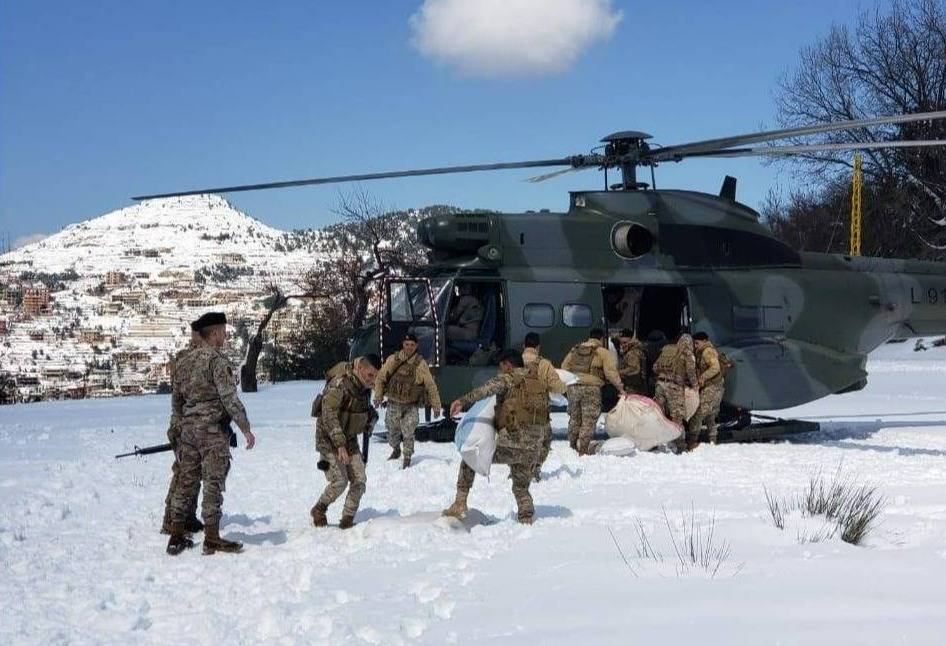
A Lebanese Army team lands in the snow. (Credit: Michel Hallak/OLJ)






Want to get the Morning Brief by email? Click here to sign up.
Lebanon’s Fransabank closed all of its branches in the country yesterday after a judicial order froze its assets based on a legal dispute with a man seeking to unlock his funds. The judicial order required Fransabank to reopen the account of Egyptian depositor Ayad Ibrahim and pay out his deposit in cash, or else the bank’s assets would be seized, his lawyer Rami Ollaik said. A Fransabank source told Reuters that following the asset freeze the bank would not be able to make any payments, including salaries. After the news broke, the Lebanese banking association criticized what it described as “arbitrary and illegal measures” being taken against lenders, saying these threatened to “topple the banking sector.” Lebanese banks have locked most savers out of their hard currency deposits since the start of the country’s financial meltdown in 2019, but this is the first ruling that challenges the imposition of those informal capital controls. It remains unclear for how long Fransabank will remain closed to customers.
Cabinet has approved the electricity sector reform plan, Energy Minister Walid Fayad announced yesterday evening. The reform plan was prepared by Fayad and structured around three axes, one of which is a short-term emergency measure: an agreement with Iraq to import fuel, along with two US initiatives unveiled in August 2021 to import electricity from Jordan and gas from Egypt, the financing of which has not been finalized yet. However, the World Bank said it would bankroll both projects pending the cabinet's endorsement of a reform plan. According to Al Jadeed TV, the previous plan was amended to move up the creation of an electricity regulatory authority to 2022 rather than in 2023, as insisted upon by the World Bank. Then-acting Information Minister Abbas Halabi indicated in February that electricity prices would go up once electricity supply reached 8-10 hours per day, but that people’s income would be taken into account, although it remains unclear how such a measure would work in practice. Reforming the electricity sector, which has been malfunctioning for decades but has completely disintegrated during the country’s financial collapse, is a main requirement for the state to unlock sorely needed assistance from the International Monetary Fund and donor countries.
Some 1,043 individuals have thrown their hats in the ring to compete in May 15’s parliamentary elections. Interior Minister Bassam Mawlawi, following the candidacy filing deadline of midnight Tuesday, said that 77 more candidates had registered than in 2018. Of those who filed by the deadline, 155 — about 15 percent — were women. In 2018, 111 women candidates registered, 11 percent of the total. The electoral lists for each district will not be finalized until April 4. If a candidate is not included on an electoral list by that date, their candidacy will be annulled. In the 2018 elections, women represented 86 out of the 597 candidates who made it to the final lists, or about 14 percent, but in the end, women took six out of the 128 seats, less than 5 percent.
The 2022 draft budget will not be adopted in its current form, neither before nor after the parliamentary elections, Ibrahim Kanaan warned yesterday. The head of the parliamentary Finance and Budget Committee made the comments after a meeting devoted to studying the budget plan prepared by Finance Minister Youssef Khalil, which was approved by the cabinet. Kanaan, a Free Patriotic Movement MP, harshly criticized the cabinet’s delay in adopting a budget, saying, “Go ahead, government, for the first time in the history of post-Taif Lebanon, admit your mistake. You have to start reform, and it begins with restoring confidence locally and internationally. Restoring confidence requires restructuring public debt, banks, and fiscal and monetary policy.” The Finance and Budget Committee has been meeting for two weeks to examine the 2022 budget. The constitutional deadline to adopt the 2022 budget plan expired at the end of January.
The polar winds that have been whipping through Lebanon and the region these last few days can be attributed to exceptionally low-pressure zones. Abdel Rahman Zawawi, head of the forecasting service at Meteo-Lebanon, the country’s weather service, explained why such polar temperatures are affecting the southern Mediterranean basin and the Middle East this year. “The jet stream, an air current which is at an altitude of 10 kilometers, generally represents a dam at the arrival of such low-pressure zones towards our region.” However, this jet stream has moved to other latitudes this year, Zawawi says. Faced with the economic crisis and the collapse of infrastructure, the Lebanese have suffered under these weather conditions, especially in the mountains. But it was Akkar that suffered the most, having been without electricity for several days. Yesterday, a rescue team arrived in Akkar after a 14-hour trek to rescue three shepherds, one of whom was found in critical condition in addition to having suffered the loss of 150 goats, half of his herd, to the freezing cold and lack of nourishment. Snowfall was observed at 350 meters, and starting at 450 meters, some roads were cut off. In the Bekaa, the snow that fell at 500 meters and above covered the entire plane up to Baalbeck. The roads in the region were cut off and villages located at 1,300 meters were completely isolated.
In case you missed it, here’s our must-read story from yesterday: “Just how long can the central bank keep propping up the lira?”
