




Search
Search
What's cooking? - Lebanese recipes, chefs and restaurants

Recipes - CHEF'S RECIPE

Anissa Helou's orange blossom jam (mrabba al-zahr)

Anissa Helou's orange blossom jam (mrabba al-zahr)

Anissa Helou's orange blossom jam. Photo sent by the chef.

  • Cooking time 80 min

  • Difficulty

    Medium

Ingredients
  • 1 kilogram orange blossoms (petals only)
  • 800 grams granulated or fine sugar
  • A few drops of natural red food coloring
  • The juice of 3 medium lemons
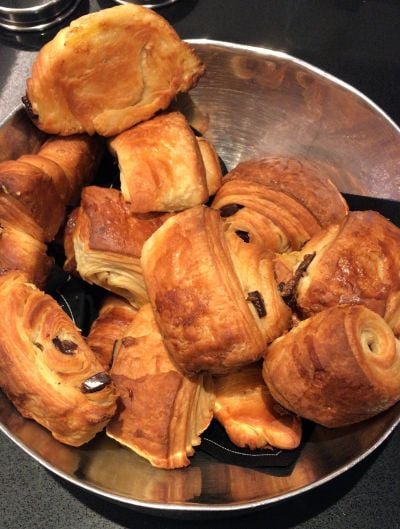
All ingredients
Preparation Anissa Helou's orange blossom jam (mrabba al-zahr)
  1. Put the petals in a saucepan. Submerge in water and heat over medium.
  2. Bring to a boil, then simmer gently for 30 minutes. Drain and rinse them in cold water.
  3. Transfer them to a bowl and submerge in fresh water. Let them soak while you prepare the syrup.
  4. Put the sugar in a saucepan. Add 1.5 liters of water and heat over medium. Bring to a boil. Add the red food coloring— Lebanese confectioners make a very red syrup; I prefer to keep mine a delicate pink. Simmer for about half an hour. Turn off the heat and let it cool.
  5. Drain the flowers well and add to the syrup. Let them marinate for 24 hours.
  6. Next, remove the flowers from the syrup with a slotted spoon and place them in a bowl, then put the syrup back over medium heat.
  7. Bring to a boil and simmer gently for 10 minutes.
  8. Return the flowers to the syrup and simmer another 10 minutes.
  9. Add the lemon juice and simmer for another 10 minutes.
  10. Remove from heat.
  11. Allow to cool a little before transferring the jam to sterilized jars.
  12. Let cool completely before sealing the jars.
  13. The jam is ready to eat immediately. It also keeps for several months if stored in a cool place. I keep mine in the fridge and take it out about an hour before serving.
Anissa Helou's orange blossom jam (mrabba al-zahr)
  • Cooking time 80 min

  • Difficulty

    Medium

Ingredients
  • 1 kilogram orange blossoms (petals only)
  • 800 grams granulated or fine sugar
  • A few drops of natural red food coloring
  • The juice of 3 medium lemons
All ingredients
Rate this recipe
Anissa Helou, chef of all trades
bio

Since her book Lebanese Cuisine, nominated for the prestigious André Simon Award and named one of the best cookbooks of 1998 by the Los Angeles Times, Anissa Helou's journey has led her to a new destination.

She has become a well-known chef, gives cooking classes and lectures, and continues to publish internationally successful books, including: Cafe Morocco (1999); Mediterranean Street Food (2002) – (which won Best Mediterranean in the English Language, 2002 Gourmand Awards); The Fifth Quarter: An Offal Cookbook (2005) – (which won Most Innovative UK Food Book, 2005 World Gourmand Awards); Savory Baking from the Mediterranean (2007); Modern Mezze (2007); Levant: Recipes and Memories from the Middle East (2013); and Feast: Food of the Islamic World (2018).

Read more

Anissa Helou's orange blossom jam (mrabba al-zahr)

Before moving into my own house in Sicily, I rented a small "casetta" (little house) on the farm of my friend Mary Taylor Simeti, author of the seminal work on Sicilian cuisine, Pomp and Sustenance, 25 Centuries of Sicilian Food.

I managed to be there for the orange blossom season, though I arrived just at the end. That year, my friend Amy Dencler, a chef at Chez Panisse, visited me. One of the first things we did was go down to Mary's citrus orchard to pick enough blossoms to make mrabba al-zahr.

Most of the blossoms were already gone, but there were still enough left for us to gather for the jam. The fact that the blossoms were at the end of their life made picking them easier. All we had to do was shake the branches for the petals to fall from the buds and land in our basket.

That said, making the jam is a challenging — or more precisely, time-consuming — task, and picking the blossoms was actually the easiest part.

We first had to carefully remove the petals from the buds, taking care not to mix in the pollen with the petals. Because the blossoms were past their prime, this job took less time than if we’d picked them at their freshest. Most petals dropped as soon as we touched them, which was the easiest part.

The rest of the process is detailed in the recipe below, but the final result is really worth the effort. Not only is the jam beautiful, but it's also incredibly delicious, with a delicately perfumed taste that makes it truly unique.

In Lebanon, it's mostly used to top pastries filled with cream, but I like to serve it for dessert over whipped yogurt or eat it for breakfast, whether on yogurt, sheep's-milk ricotta, or jibneh khadra, provided the cheese isn't too salty. I start by spreading the cheese of my choice on some bread before adding the jam on top.

Read more
Rate this recipe
comments (0) Leave a comment

Comments (0)

Retour en haut