


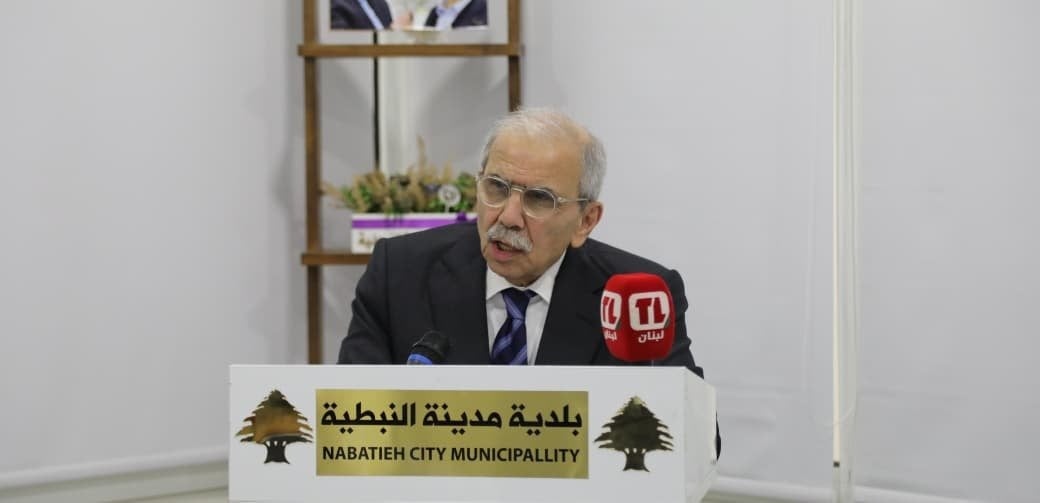
Prime Minister Nawaf Salam at the Nabatieh municipality on Oct. 3, 2026. (Credit: X/@grandserail)






BEIRUT — Prime Minister Nawaf Salam said on Sunday evening in a lengthy interview with NBN, the channel affiliated with the Amal Movement, that “The framework agreement with Israel needs a schedule and precise deadlines, and disarmament should not be tied to Israeli withdrawal from south Lebanon. These two processes should move forward in parallel.”
Salam said the main goal of his efforts and the negotiations was “complete Israeli withdrawal from Lebanese territory.” He added that the framework agreement signed in June with Israel is based on “two fundamental principles: reciprocity and gradualism.”
Regarding the latter, he said the agreement lacks a timetable. “I want to know: When will Israel withdraw from the South? We need a timeline so that this framework is translated into concrete steps.”
On reciprocity, the prime minister stressed that restoring the state’s monopoly on weapons and extending state authority across all of Lebanon are not “new commitments,” but “an issue we agreed on back in 1989 and the Taif Accord,” which ended the Civil War (1975-1990).
The agreement specifically reads that the state must “extend its sovereignty over all of its territory and deploy the Lebanese Army in the border area adjacent to Israel.” It also provides for the “dissolution of all Lebanese and non-Lebanese militias” and the handover of their weapons to the state.
In addition to the Taif Accord, the state’s monopoly on weapons is stipulated in U.N. Security Council Resolution 1701 (2006) and the 2024 cease-fire agreement. According to Salam, the Israeli withdrawal and Hezbollah’s disarmament are, within this framework, parallel processes and do not constitute commitments made under foreign pressure.
UNIFIL and reconstruction in the South
Discussing the Lebanese Army’s deployment in the South, Salam said troops are “there to protect the population and our borders,” while expressing hope that there would be “no vacuum” in south Lebanon after the United Nations Interim Force in Lebanon (UNIFIL) mission ends.
The force’s mandate expires at the end of the year, and its withdrawal will proceed gradually. “We will always need the presence of an international force in the South,” he said.
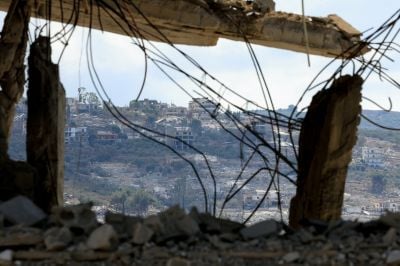
The prime minister also said the state would continue to launch rehabilitation projects in the South. On Friday, during a visit to Nabatieh, he announced the opening of several dozen tenders for such projects, while reiterating that the government has limited resources and will need external funding.
“Our means are modest, but I want to mobilize all our available capacities to support the return and recovery, while initiating reconstruction,” Salam said.
No Cabinet reshuffle
Salam also addressed relations with Iran, 10 days after a meeting at the U.N. with Iranian President Masoud Pezeshkian. He advocated appointing a new ambassador after the previous envoy was declared persona non grata, though not expelled. This would allow the two countries to open a “new chapter” in their relations, “based on mutual respect and noninterference in each other’s affairs,” he said.
As for the resumption of flights between Beirut and Tehran, which have been suspended since February 2025 following accusations of fund and arms transfers through Beirut's airport and Israeli threats, Salam said he would not reverse the decision because it is “an issue related to airport security.”
“The security of the airport and of the passengers is my priority,” he said.
The prime minister also rejected the possibility of a Cabinet reshuffle, which had been discussed in recent weeks amid social tensions linked to inflation and rising fuel prices.
“We do not want a release valve, but solutions. Our role is not to relieve pressure here or there, but to solve the problems,” he concluded.


