






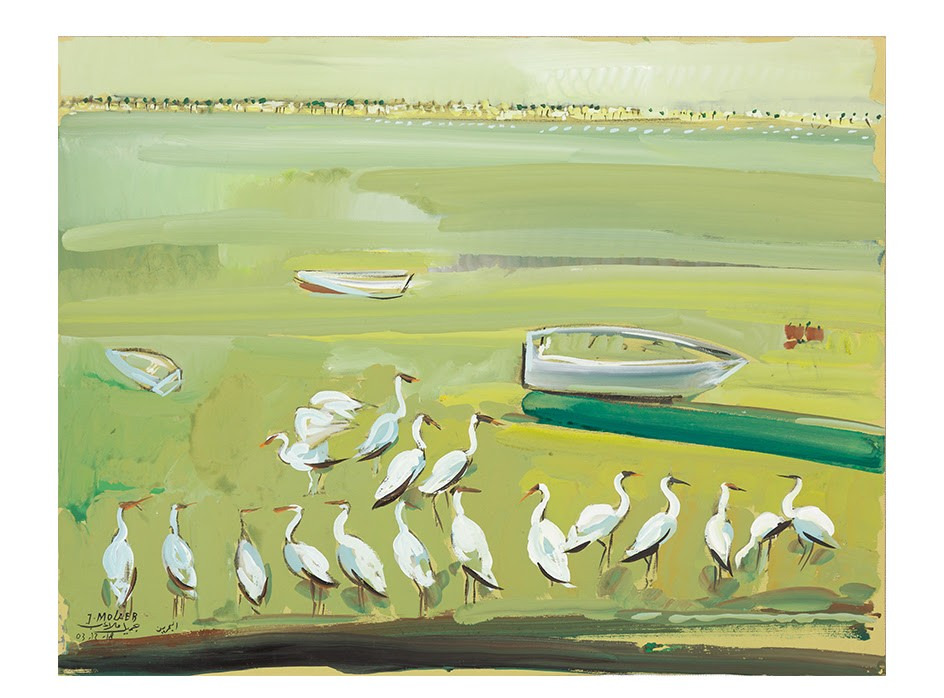
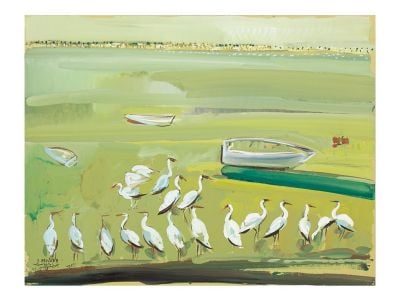
"Bahrain" by Jamil Molaeb. (Courtesy of the Janine Rubeiz gallery)






Roger Moukarzel, the sacred breath of sand in your eyes
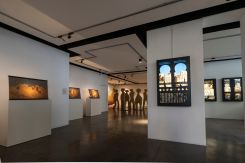
The effect of sand — its variations, texture, fluidity, and impermanence — is rendered in different works, all sharing a photographic base. The subject had been on Roger Moukarzel's mind for some time. He just needed to find the right tone, the original form, that whimsical spark that sets off this visual artist’s creative machine, an artist with an eye as striking as it is playful. An experimental photographer who, for thirty years, has worked tirelessly to push the limits of imagery, bringing to it substance, structure, even a framework.
Because creating landscapes of dunes and other sandy abstractions already seen was out of the question, he chose to turn instead to visual and sculptural installations to address what he calls a "personal journey through sand and its dust," he says.
The result of this long-term work — some of the pieces exhibited, such as the videos, date back several years — unfolds at the Mark Hachem Gallery in Beirut as an invitation to see, feel, and experience "this material, often seen as banal, but which is actually profoundly noble because it is linked to creation and time," he affirms.
Entitled "Sacred Thread," the exhibition follows this concept through five series of works "which establish a dialogue between the ancient and the contemporary, nature and human intervention, fragility and resilience," according to the curatorial text.
The scenography, developed with the help of Carl Gerges and Karen Stephan, "silently" guides the viewer through the different series, providing an immersive yet structured experience. From the sandy architectural landscapes opening the exhibition, to the two videos that close it, including wall or sculptural installations along the way, every element works together to create a contemplative and serene atmosphere.
It starts, for example, with photographs of Yemeni cities built in clay, set in black steel frames cut with mashrabiya patterns taken from the architecture itself. These works bear the timeless echo of sand in our contemporary world.
You find this echo again in another group depicting Yemeni architecture, this time directly incorporating sand and texturing mediums. In this series, the gesture becomes even more physical: through repeated, almost obsessive rubbing of the image, Roger Moukarzel erases, in a sense, the boundaries between photographic and pictorial media. The resulting prints, lit from behind, become unique works with a powerful poetic breath.
This breath of sand is also captured by Roger Moukarzel in "Sun Dust Photography," an installation made of five long strips — evoking strips of analog film — where silhouettes move across a landscape of particles floating in the amber light of dusk.
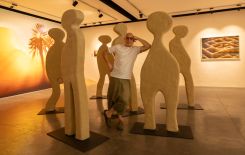
A cinematic and meditative atmosphere also extends to two videos, "Sundust" and "So Far, So Close," created by seamlessly blending photographs taken during his travels. The Maison Européenne de la Photographie (MEP) houses a copy of each. These moving images, of hypnotic beauty, stand in contrast to the stillness of a group of tall totemic figures. With monolithic, rounded contours, the sculptures evoke archaic idols shaped by sand and wind, the combined elements that return the human figure to its original — and sacred — essence. This is precisely why the artist insists that "the subject of this exhibition is neither architectural nor touristic." A must-see.
“Sacred Thread” by Roger Moukarzel, until Sept. 27 at the Mark Hachem Gallery in downtown Beirut.
'Itinerary' by Jamil Molaeb at Janine Rubeiz Gallery
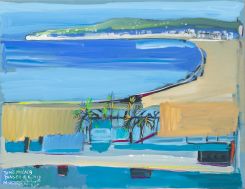
One might have thought Jamil Molaeb confined to his house-museum in Baysour, in the Lebanese mountains, completely absorbed in the wondrous representation of the spiritual breath of the surrounding nature. The 77-year-old painter seemed likely to have grown weary of city bustle and travel. But that would be to underestimate this artist, who, while deeply rooted in his native land, remains an insatiable traveler — always curious to see elsewhere, to discover other landscapes, countries, cultures, and atmospheres. To absorb them and incorporate them into his pictorial work.
"As soon as he arrives in a new country or city, he chooses a place or panorama and paints it on the spot, without referring to sketches or photos," says Nadine Begdache, his gallerist for thirty years.
In this way, over more than fifty years of travels, he has created a veritable anthology of paintings depicting the cities he’s traversed. Some, with strong symbolic charge, have even given rise to series that have marked his career, such as those dedicated to Beirut, Fez, New York — where he lived for five years — and Jerusalem. But there are also all the other cities of the wide world that Jamil Molaeb has visited and from which he brought back impressions in gouaches on paper, always painted on site.
It is these works, travel impressions, gathered in a collection of forty-five pieces — plus several large acrylics on canvas of Beirut and Baalbeck — that he displays at the Janine Rubeiz Gallery until Oct. 30 under the title "Itinerary."
The tour opens with a rare painting depicting Beirut in the 1970s, the geographic and temporal starting point of his journeys around the world, and ends with a recent representation of the Lebanese capital overflown by a MEA airliner. In between, visitors are taken on a true world tour in lines and colors. From Algeria in 1973 to Zurich, Switzerland, which he visited recently, the exhibition unfolds as a succession of fragments, captured on the spot: metropolises and small heritage towns, riverbanks and coastlines, contemporary architecture, and ancient ruins, cities of the East and the West. Destinations are portrayed in a pictorial language combining figurative, abstraction and pointillism, brought together in a luminous and intentionally open scenography.
Moscow, Paris, Rome, London, Zurich, Edinburgh, Cairo, Granada, Athens, Heraklion, Singapore, Vienna, Istanbul, Damascus, Aleppo, Palmyra, Fez, Tangier or Tetouan stand next to landscapes from Mexico, Croatia, India and Bahrain, as well as Deir al-Qamar, Tripoli, Sour or Baalbeck. So many countries and cities that may not be immediately recognizable, but to which Jamil Molaeb faithfully renders a distinctive atmosphere, light or feeling.
It is precisely this ability to convey a place's impressionistic imprint without resorting to cliches or postcard images that gives strength to his work. And it’s the charm of this travel-inspired exhibition, in which he invites you to follow him.
“Itinerary” by Jamil Molaeb, until Oct. 30, at the Janine Rubeiz Gallery, Raouche, Majdalani Building, ground floor.
From Cairo to Beirut, Difaf weaves the 'Fabric of Time'
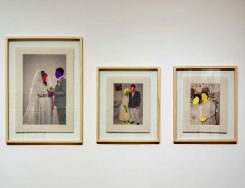
Sometimes a single old photograph is enough to make a whole world resurface. A face, a setting, a pose, a detail in clothing: behind the image, family stories, bygone habits, fragments of an era emerge. This memory, both intimate and collective, is what Difaf Gallery — "shores" in Arabic — puts on display in "Fabric of Time," an exhibition conceived from one shore of the Mediterranean to the other.
At the head of Difaf, Antoine Sfeir has made this circulation between Cairo and Beirut the very principle of his artistic programming. After a first edition in Egypt, curated by Loubna Tarek and featuring artists Fatma Abodoma, Sara al-Fazayry and Ahmed Lesi, the exhibition now continues in Beirut with "Fabric of Time II." Under the curation of Marie-Mathilde Jaber, founder of no/mad utopia, this second chapter invites Fadi al-Melhem, Yasmina Hilal, and Ieva Saudargaite Douaihi to explore the fabric of time as well. And this through the same question: what do we do with what has been passed down to us?
Because at a time when the present is on hold and the future is uncertain, the artists are less interested in preserving the past than in reactivating it. They draw from family albums, archives, found photographs, everyday objects, then relocate and transform them, sometimes even reinventing them.
At times, the intimate joins the collective, and family memory reveals a wider social history. Such is the case with Egyptian visual artist Ahmed Lesi, who inserts his silhouette and colors into photos of his parents' wedding, taken in a Cairo studio in the 1980s.
Beyond the personal story, his work brings to light the tradition of studio portrait photography, long established in countries throughout the eastern Mediterranean, as a ritual tied to major life events, especially weddings.
The same goes for Syrian artist Fadi al-Melhem, now in Lebanon, who, leafing through the family album, noticed the predominance of his own photos and those of his father. By transposing these portraits onto fabrics or prints, his gesture brings out, behind the images, the codes of an Eastern society with a strong patriarchal culture.
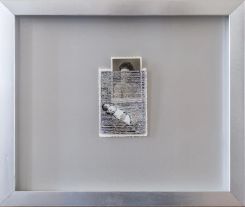
Instead of drawing from scattered family archives, Ieva Saudargaite Douaihi takes another approach: she gathers found photographs, everyday elements, and traces of lived experience to create new constellations of memory. It's a way of working with fragments, as if identity itself were built in this ever-shifting assembly.
Thus, "The Fabric of Time" does not recount the past: it shows what remains, and what artists do with it. Time appears less as a line separating yesterday from today than as a porous material, traversed by survivals, shifts, and reinventions. From one Mediterranean shore to another other, the stories may differ but their traces are recognizable. And it is in these echoes that Difaf, in turn, weaves its own thread between Cairo and Beirut.
"Fabric of Time II" at Difaf Gallery, Beirut, Mar Mikhael, Jacaranda Building, until Oct. 4.

 8 p.m. recap: Israel again threatens Beirut’s south suburbs; 2 ships hit near Hormuz; Riyadh football matches canceled