






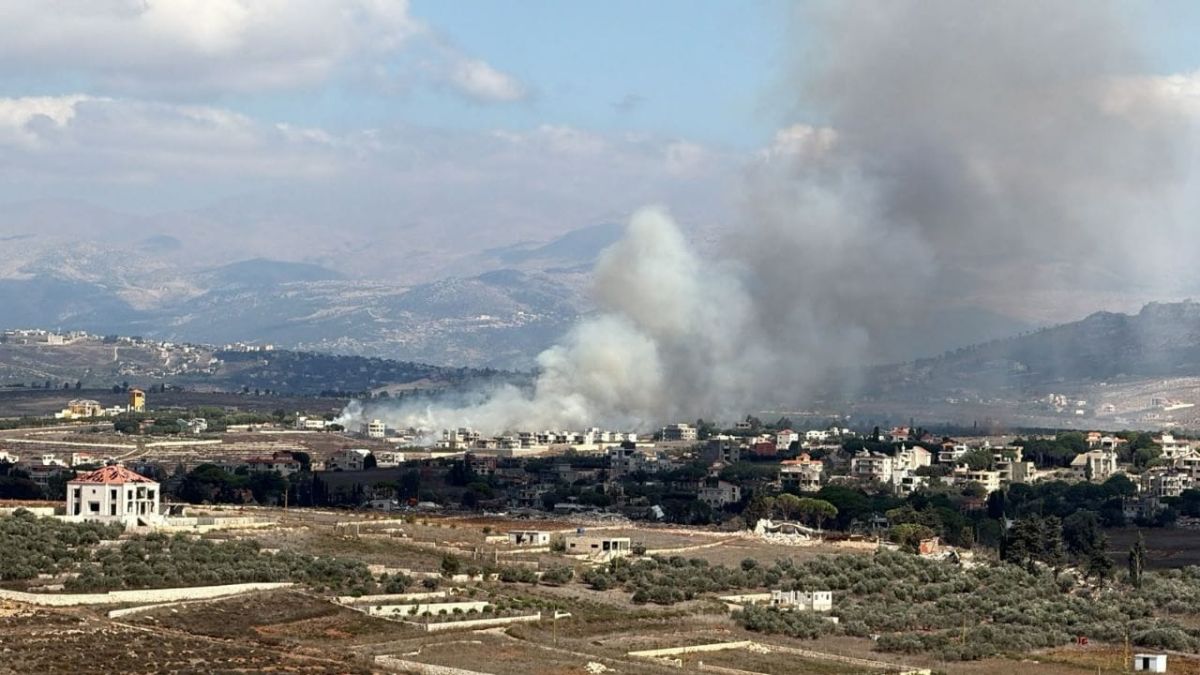
A fire broke out in Zawtar Sharqieh after the Israeli army dropped phosphorus bombs on its outskirts on Wednesday, Sept. 23, 2026. (Credit: Muntasser Abdallah)






BEIRUT — President Joseph Aoun accused Israel on Wednesday of failing to "implement the framework agreement" as negotiations between Beirut and Tel Aviv remain stalled since August and Israeli attacks continue on southern Lebanon.
"Israel is therefore not respecting the cease-fire, nor the commitment to refrain from destroying and razing homes, to resolve points of contention along the Blue Line, and to return Lebanese prisoners to Lebanon," Aoun said during a meeting with the British government’s senior defense adviser for the Middle East, Adm. Edward Ahlgren, according to a post on X by the Lebanese presidency.
Aoun also warned of a "security vacuum" in southern Lebanon following the end of UNIFIL’s mandate in December 2026 if no other force takes over. He highlighted the risk of such a situation "particularly if the Israeli occupation of southern villages and localities continues."
"Lebanon is open to any force capable of replacing UNIFIL," he reaffirmed, echoing Prime Minister Nawaf Salam's calls this week on the sidelines of the U.N. General Assembly in New York.
The topic was also central to the meeting between Ahlgren and Defense Minister Michel Menassah. "Ongoing efforts and discussions regarding the post-UNIFIL period, as well as proposed alternatives in this regard, were addressed" during the meeting, the state-run National News Agency (NNA) reported.
For his part, the British admiral reaffirmed "his country's commitment to continue supporting the Lebanese military institution and strengthening its capabilities."
'Security situation' in Nabatieh remains concerning
On Wednesday, Israeli phosphorus bombs were launched on the outskirts of Zawtar Sharqieh, causing a major fire. Israeli forces then targeted it again with automatic weapons at dawn.
Israeli artillery fire also targeted the outskirts of Mayfadoun, south of Nabatieh, and then Nabatieh Fawqa at mid-afternoon. An Israeli airstrike hit a building in the Deir neighborhood of Nabatieh Fawqa on Tuesday evening. The sound of explosions was heard throughout the region.
Following in the footsteps of Aoun and U.S. Ambassador Michel Issa, who visited Nabatieh in September, Justice Minister Adel Nassar (Kataeb) visited the city's courthouse on Tuesday.
In early September, amid concerns from local officials and residents as the Israeli army ramped up its offensive on Ali Taher and carried out deadly strikes in the city, the Lebanese Army deployed to the region, followed by personnel from General Security and State Security.
Israel damages public school
In the eastern sector, residents of Marjayoun contacted by our correspondent said a powerful Israeli explosion occurred Tuesday night at the northern entrance to Khiam, targeting several homes and damaging the public school in Jdeidet Marjayoun, several kilometers farther north. Classes were temporarily suspended there on Wednesday.
The Israeli demolition also damaged several homes in surrounding localities and caused a power outage in the area. The explosion was heard as far away as the western Bekaa, our correspondent reported.
Several attacks were also reported in the central sector. In the Bint Jbeil district, Israeli artillery fire targeted Braasheet, and machine-gun fire hit the same village as well as Haddatha, Beit Yahoun, and Aita al-Jabal.
From Tuesday night into Wednesday, Israeli attacks multiplied in Mansouri, which it has been systematically destroying for weeks. Three Israeli strikes hit several buildings, along with artillery fire several times throughout the night. After 2 a.m., Israeli forces triggered another large explosion.
In the Bint Jbeil district, Israeli forces blew up several homes on the outskirts of Braasheet. A Merkava tank stationed at Rshaf fired multiple shells toward Sarbine, and the Israeli army fired machine guns overnight at Beit Yahoun while flares were launched toward Wadi Slouqi (Marjayoun district).
Israel also targeted the hills of Halta (Hasbaya district) and an area near Mais al-Jabal (Marjayoun district) with artillery. Israeli military vehicles were also seen driving in residential areas of Houla (Marjayoun district).
European ambassadors in Saida
On Tuesday, Israel carried out a series of airstrikes on two southern Lebanese towns, and the outskirts and neighborhoods of 15 villages were subjected to intense artillery fire. It also carried out major explosions targeting homes, buildings and infrastructure in four towns.
On the diplomatic front, the ambassadors to Lebanon from Spain, Germany, Norway and Sweden, along with a representative from Belgium — all from countries supporting the international nongovernmental organization Action Against Hunger (ACF) — visited Saida. The diplomats made a field visit to a shelter center to observe aid distribution procedures, according to a statement.
Reporting by our southern Lebanon correspondent, Muntasser Abdallah
 8 p.m. recap: Israel again threatens Beirut’s south suburbs; 2 ships hit near Hormuz; Riyadh football matches canceled