






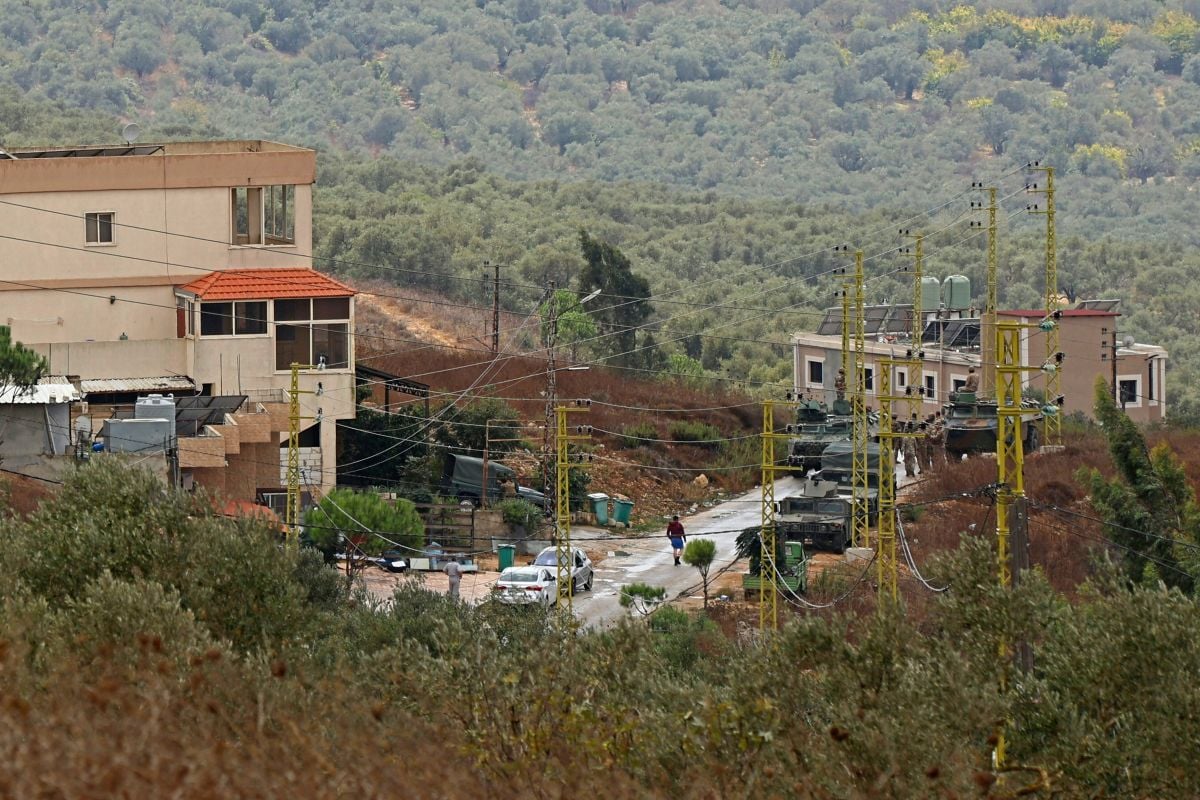
Lebanese soldiers deployed on the outskirts of Deir Mimas, in the eastern sector of South Lebanon, on Sept. 18, 2026. (Credit: AFP)






SOUTH LEBANON — A tense standoff erupted Friday between the Lebanese and Israeli armies near Deir Mimas in the eastern sector. The situation eventually de-escalated, but left residents of the village — still populated despite being in the “buffer zone” imposed by Israel — facing several hours of tension and panic.
The incident occurred a day after a meeting in Paris that brought together military officials from around 15 countries to mobilize international support for the Lebanese Army, which is tasked with deploying in the South and disarming Hezbollah. Israeli authorities have criticized the army’s slow progress on the issue.
The situation escalated, according to local sources cited by our correspondent in the South, Mountasser Abdallah, when the Lebanese Army set up a new checkpoint at the northern entrance to Deir Mimas, on a secondary road leading to the Morcos gas station, at the intersection linking Kfar Tibnit, Deir Mimas and Burj al-Mlouk.
The deployment, involving two Humvee-type vehicles, was reportedly not coordinated in advance with the Israeli army. According to some local media, the Israeli forces considered that the new post had been established beyond the “Yellow Line,” which de facto marks the Israeli-occupied zone but is not demarcated.
Lebanese and Israeli withdrawals from Deir Mimas
Israeli armored vehicles then advanced toward Deir Mimas, forcing the Lebanese Army to withdraw from the new position. The Lebanese soldiers fell back several dozen meters but remained face-to-face with the Israeli forces, while the army sent reinforcements.
The confrontation was accompanied by insults and threats from Israeli soldiers, who also threw stun grenades toward the Lebanese troops.
The Lebanese Army then withdrew from the outskirts of the village and repositioned along the main road leading to Burj al-Mlouk. Israeli forces searched several houses near the checkpoint before withdrawing toward Tell al-Nahas hill, where they maintain a position on occupied Lebanese territory.
Local sources said contacts were made to resolve the dispute and prevent further escalation. The Lebanese Army did not immediately respond to L’Orient-Le Jour’s requests for comment. Throughout the incident, villagers remained confined to their homes, unable to enter or leave the area. Some told our correspondent they felt as though Deir Mimas was “under siege.”
During the night, the Israeli air force carried out a series of airstrikes in the Marjayoun region, targeting Wadi Slouqi, Qantara, Bani Hayan and Tallousseh.
The Lebanese Army addressed the incident in Deir Mimas later Friday evening, saying in a statement that it had established “a temporary observation post on the outskirts of the town on Sept. 10, 2026, in coordination with the Military Coordination Group for Lebanon (MCG4L), to help residents inspect their agricultural land.”
The army said that “an Israeli force approached the newly established post in the so-called security zone on Friday and launched stun grenades. As a result, the army reinforced the post and both sides mobilized.”
“Following communications facilitated by the MCG4L, the Israeli occupying force withdrew from the area and the military personnel returned to their main base in the town,” the statement concluded. “Follow-up is ongoing in coordination with the Coordination Group.”
Ali Ammar defends Lebanese Army
Hezbollah MP Ali Ammar condemned the incident in Deir Mimas, describing it as a “blatant attack on Lebanon’s sovereignty and the dignity of its national institutions.” He also said it showed that Israel “does not want a strong army capable of fulfilling its national role of protecting the country’s territory and borders.”
“What happened in Deir Mimas is an attack on all of Lebanon,” he said, calling on the authorities to reconsider their choices, end their “futile negotiations” with Israel and stop making “repeated concessions” by relying on the United States and the international community.
According to Ammar, the incident was the result of the “wrong and humiliating path” taken by the authorities, which had allowed Israel to dictate where the Lebanese Army could deploy.
He called for giving the army “the means to fully carry out its role of protecting Lebanon, its sovereignty and its people,” as well as strengthening it politically and militarily and preserving its independence from any interference or tutelage.
Three wounded in Shaqra
Meanwhile, Israeli artillery fire targeted the Wadi Nahleh area on the outskirts of Shaqra (Bint Jbeil), injuring three civilians, one seriously, according to our correspondent.
Earlier in the day in the same area, eight Israeli military vehicles advanced and artillery fire was reported on the outskirts of Haris, also on the edge of the “buffer zone.” The armored vehicles later withdrew after “frightening” residents, according to local sources.
In neighboring Haddatha, intense artillery fire targeted several homes, causing a fire.
In the Sour district, the Israeli army continued its attacks on Mansouri, a coastal village where Israeli forces have conducted near-daily operations in recent weeks. The village, divided in two by the “Yellow Line” marking the Israeli-occupied zones in the South, had already been targeted overnight by hours of sustained artillery fire.
After midnight, an Israeli Apache helicopter strafed the village, with gunfire audible in nearby towns, while dozens of shells struck several of its neighborhoods.
Artillery fire also targeted the heights of Ali Taher and the outskirts of Kfar Tibnit (Nabatieh). Israeli forces also carried out a detonation in Mais al-Jabal (Bint Jbeil). Overnight, they had already blown up buildings near Kounine and Beit Yahoun in the same district.
Israeli attacks in the South, as well as discussions the previous day on international support for the Lebanese Army, were also raised during a meeting between President Joseph Aoun, who returned from Paris Thursday night, and Prime Minister Nawaf Salam.