





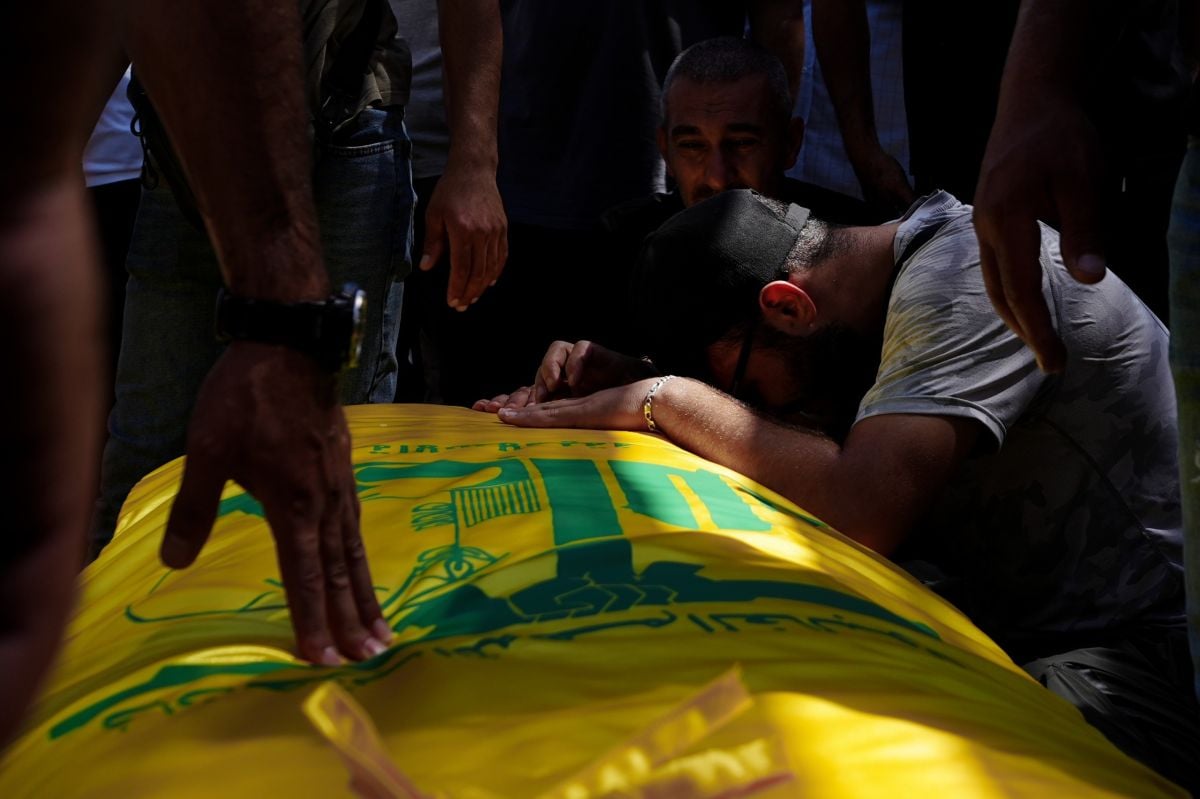
A grieving man pays his respects at a coffin draped with the Hezbollah flag during the funeral of 13 people killed by Israeli strikes the previous day in Kfar Roummane, southern Lebanon. (Credit: Mohammad Yassine/L'Orient-Le Jour)






Following a meeting with Supreme Islamic Shiite Council Vice President Sheikh Ali al-Khatib, a close associate of Hezbollah, U.S. Ambassador to Lebanon Michel Issa said Tuesday that Washington was “ready to negotiate” with the party “but through the intermediary of the Lebanese state, which is negotiating on behalf of Lebanon and its national interests.”
The U.S. said at the end of August that only the Lebanese government is authorized to negotiate with Israel, particularly to secure the withdrawal of Israeli forces from southern Lebanon and an end to its attacks. The statement followed several U.S. comments that had fueled speculation about possible direct talks between Washington and Hezbollah.
"The Shiite community is the most affected by the current situation," Issa said. "It is important for us to deliver the American message to this community and tell it that all we want is its best interests and for its sons to return to their villages and homes."
Issa said there was a difficulty in “achieving a result with part of this community,” which, he said, “does not realize that its interest lies in accepting its responsibilities,” referring to Hezbollah’s disarmament.
When reporters later asked him at a news conference about the ongoing Israeli attacks on southern Lebanon and Washington’s efforts to stop them, Issa explicitly placed responsibility on Hezbollah.
“For us, there is one who attacked and one who responded,” Issa said. “We cannot say that Israel is the one attacking without remembering who started first,” he said.
He said the U.S. had previously warned that Israel would respond if attacked, saying: “If you do not attack, Israel will not respond. If you attack, it will respond forcefully.”
“That is what I understood from the Israeli side,” Issa claimed.
No new round of negotiations before Paris
Regarding upcoming direct negotiations between Lebanon and Israel, Issa said discussions were ongoing but that it was “not necessary” to hold another round before the preliminary meeting for an international conference supporting the Lebanese Army, scheduled for Sept. 17 in Paris.
“What matters to us is to see at each stage whether there are advances, to what extent we can benefit from them and what the results are, so that we can integrate them in the next rounds of negotiation,” he said.
A few days after Israel released five people it had captured in southern Lebanon and detained for several months, Issa pledged to continue working to secure the release of the remaining prisoners. “I will not stop. I will do everything I can until the end. It is my responsibility,” he said.
Washington is sponsoring the framework agreement signed June 26 between Beirut and Israel. The agreement provides for the gradual withdrawal of Israeli forces from areas they occupy, alongside the deployment of the Lebanese Army, which is tasked with disarming Hezbollah.
Direct negotiations launched in April at the initiative of President Joseph Aoun led to the framework agreement, which circles close to Hezbollah and Amal have strongly denounced, along with the broader principle of direct talks between Lebanon and Israel.
Although hostilities subsided after a theoretical cease-fire took effect in mid-June, Israeli forces continue to occupy a “buffer zone” covering about 620 square kilometers in southern Lebanon and have carried out deadly strikes in recent days that have killed more than 20 people.
During the day, President Joseph Aoun reviewed the country’s security situation, particularly in southern Lebanon, with Army Commander Gen. Rodolph Haykal, as Israeli attacks continued to hit several villages and towns.
The discussions also covered the military institution’s situation and preparations for the preliminary meeting of the Paris conference.

 7 p.m. recap: Katz threatens Beirut south suburbs; London seeks to protect Riyadh; Netanyahu discusses ‘eliminating’ Iran’s regime