






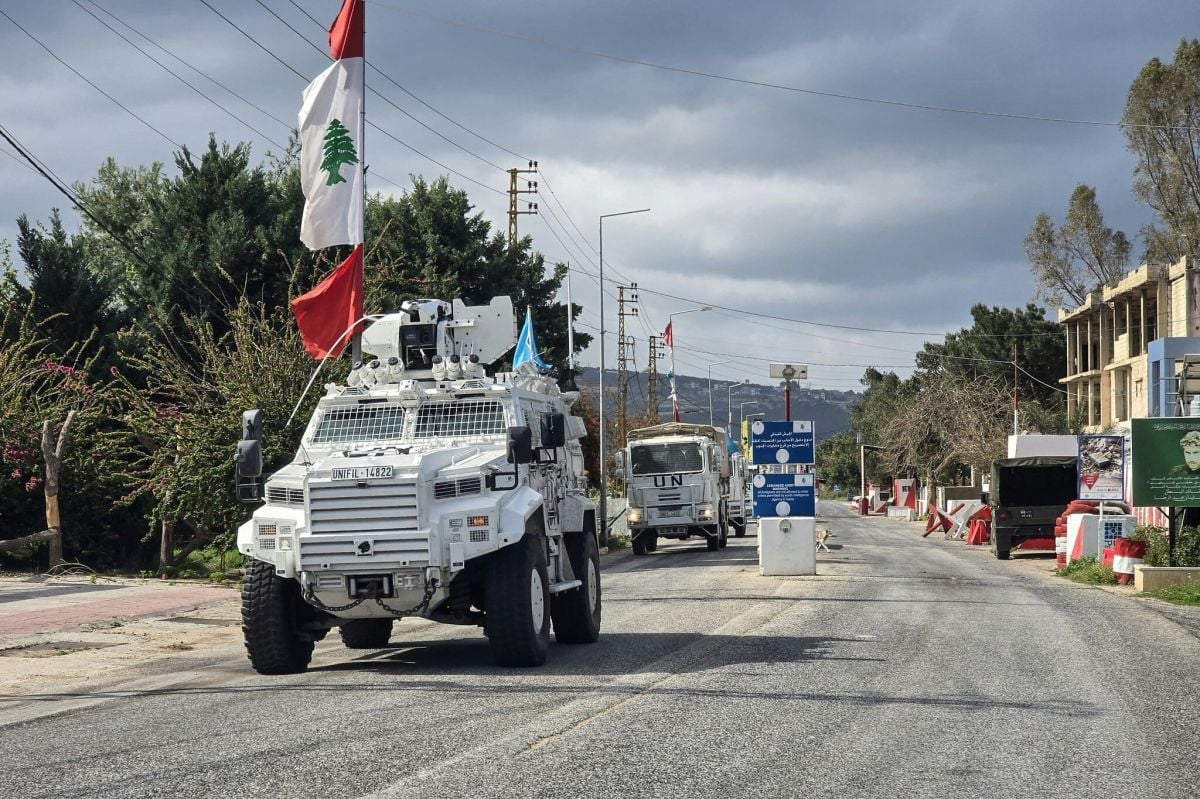
Soldiers of the United Nations Interim Force in Lebanon (UNIFIL) pass a Lebanese Army outpost in the Naqoura region, southern Lebanon, on March 27, 2026. (Credit: Kawnat Haju/AFP)






BEIRUT — President Joseph Aoun said Lebanon’s “first option” is to extend the mandate of the United Nations Interim Force in Lebanon (UNIFIL), which is due to expire at the end of the year, amid continued Israeli attacks in south Lebanon.
“If the mandate is not extended, the second option would be to adopt a formula ensuring the continued presence of international forces in the South, within an appropriate legal framework, alongside and in coordination with the Lebanese Army,” Aoun told a delegation of 20 lawmakers campaigning for the peacekeeping force’s renewal.
The comments came ahead of a closed-door UN Security Council consultation on Tuesday, where U.N. Assistant Secretary-General for the Middle East, Asia and the Pacific Mohammad Khaled Khiari is due to brief members on the situation.
Aoun stressed that UNIFIL’s presence in the South remains important for maintaining stability and helping residents remain in their villages, while strengthening cooperation with the Lebanese Army.
The president also backed a petition signed by 86 lawmakers, more than two-thirds of Parliament, calling on the Security Council to maintain and strengthen UNIFIL’s mandate. The petition argues that the force’s shortcomings should be addressed rather than its mission ended, particularly as Israeli violations continue.
UNIFIL said it had recorded a “marked increase” in Israeli military activity in southern Lebanon over the past two weeks. Between Aug. 5 and 16, the force recorded an average of 137 projectiles per day, including 208 on Saturday and 185 on Sunday.
Aoun said Israel had opposed UNIFIL’s presence and exerted pressure against it for nearly a year. He said the priority was to ensure the continued presence of an international force in the South, either through an extension of UNIFIL’s mandate or by establishing an international force to succeed or replace it.
Prime Minister Nawaf Salam also received the lawmakers at the Grand Serail and was handed a copy of the petition. Salam said he had personally informed UN Secretary-General Antonio Guterres of Lebanon’s position and that Guterres had expressed understanding of the need to maintain a UN force in southern Lebanon to succeed UNIFIL.
Aoun: Beirut 'committed to implementing the framework agreement'
Aoun also told a delegation from the American Task Force for Lebanon (ATFL) that Lebanon was “committed to fully implementing” the framework agreement signed on June 26 between Lebanon and Israel and brokered by Washington.
The agreement provides for Hezbollah’s disarmament and Israel’s withdrawal from “pilot zones” in southern Lebanon. Aoun said Lebanon was counting on the United States to help implement the deal, which has stalled amid tensions on the ground.
Washington “is serious, committed and supportive,” Aoun said, while stressing that “Israel will not be able to achieve its objectives through military force, destruction and the killing of innocent people alone.”
On relations with Tehran, Aoun said that “the relationship with Iran must be a state-to-state relationship, based on mutual respect and without interference in internal affairs.”
He also said Lebanese authorities were working on legislation to fight corruption, pursue reforms, introduce e-government and strengthen the judiciary.