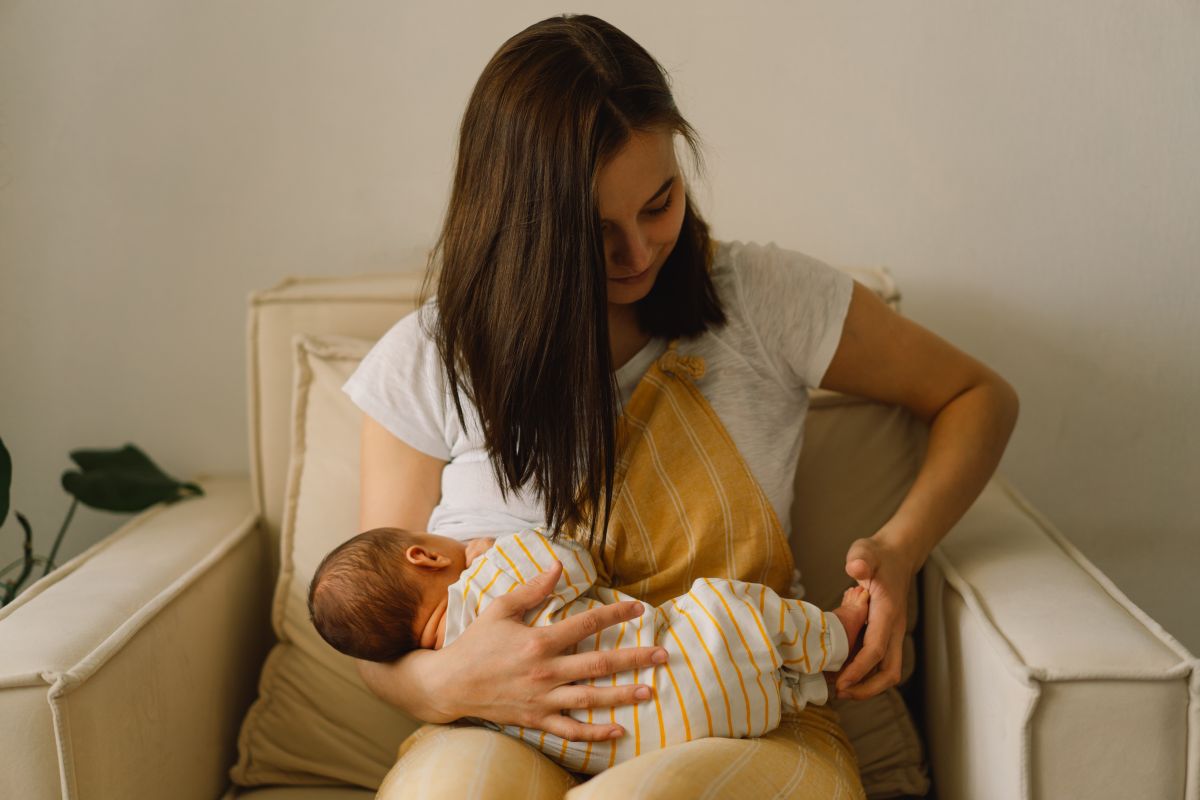
A young mother breastfeeding her newborn. Archival illustration photo/L'Orient-Le Jour






On Aug. 3, during the launch of a national breastfeeding program between the Health Ministry and UNICEF, MP Inaya Ezzeddine, president of Parliament’s Committee on Women and Children, took the opportunity to shed light on a bill she introduced in July 2023 that remains stalled in Parliament. The bill proposes extending maternity and paternity leave, as well as introducing measures to support parents returning to work during the first months of their child’s life. Ezzeddine explains to L’Orient-Le Jour why such legislation is essential not only for working women, but for society as a whole.
L'Orient-Le Jour: What does this bill entail?
Ezzeddine: The text stipulates extending the duration of maternity leave from 10 to 14 weeks, which is more in line with international standards. It also addresses paternity leave, recently introduced into Lebanese legislation but rarely implemented, extending it from three to 10 days.
Upon returning to work, during early childhood and the breastfeeding period, the proposal indicates that the mother should be able to benefit from one hour per day for breastfeeding or milk pumping, or have her work schedule shortened by an hour for the same reason, with no reduction in salary. The text also recommends that workplaces, both public and private, create nurseries within their facilities if the number of employees allows, or pay a childcare subsidy to enable parents to place their children in a nursery.
L'Orient-Le Jour: How important is this text for women in particular and society in general?
Ezzeddine: This proposal comes at an extremely important time for the child and the mother. For working women, maternity should no longer be seen as a punishment or a barrier in the workplace. A change in employers' mentality is also necessary: they should stop seeing maternity leave as a problem and instead view it as an investment by society as a whole in the care and education of future generations. The same applies to paternity leave: it sends an essential message to society—the father’s participation in raising children.
It is also important not to forget a fundamental truth: the time parents spend with their newborn is a right. However, today, women are far from enjoying all their rights regarding maternity. Given the precarious situation of households, they are often forced to work without a social safety net, knowing that 65% of them are in informal sectors. We are in discussions with the National Social Security Fund (NSSF) to better adapt conditions to women’s needs.
L'Orient-Le Jour: What is the status of this legislative text?
Ezzeddine: It was forwarded by Parliament Speaker Nabih Berri to joint committees in July 2023 and has never yet been placed on the agenda of their meetings by Deputy Speaker Elias Abou Saab. Issues concerning women and children are rarely considered a priority, which is why I brought this up again recently during the launch of the breastfeeding awareness campaign.
This interview was originally published in French in L'Orient-Le Jour.