







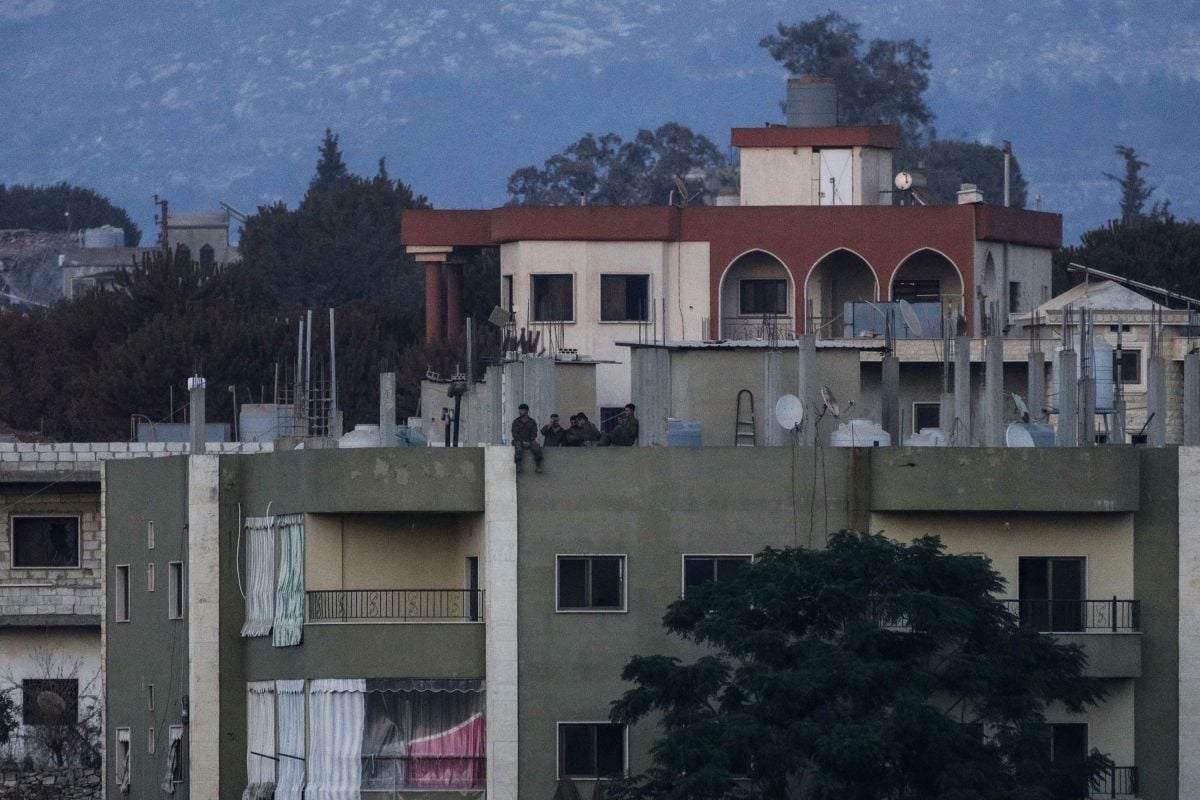
A photograph taken from the village of Zawtar Gharbieh shows Israeli soldiers on the roof of a residential building in the neighboring village of Zawtar Sharqieh, on Aug. 4, 2026. (Credit: Ammar Ammar / AFP)






BEIRUT — While Lebanese and Israeli delegations met Wednesday in Rome for the second day of a seventh round of talks aimed at ending the war and addressing the issue of Hezbollah’s disarmament, the Israeli army issued an evacuation order for residents of Mansouri (Sour district) before announcing that it had "begun carrying out targeted strikes in south Lebanon."
The order was the first issued by the Israeli army since the framework agreement between Beirut and Tel Aviv was reached in late June. Previous evacuation orders date back to June 14.
“Due to Hezbollah’s violation of the cease-fire agreement, the Israeli army is forced to act forcefully against it ... You must immediately evacuate your homes and head north, at least 1,000 meters away from the village, to open areas,” said a statement issued by the Israeli army’s Arabic-language spokesperson, Ella Waweya.
The Israeli army did not specify which violation it attributed to Hezbollah. However, media outlets, including Al Jazeera, reported that two Israeli soldiers had been killed in a booby-trapped building in Majdal Zoun. The Israeli army, which usually announces casualties among its ranks, had not confirmed the report at the time of publication.
Following the evacuation order, the few remaining families still present among the 120 that had fled Mansouri on June 20 were forced to leave. Mansouri lies on the border of the Israeli-declared "Yellow Line," which Israeli forces still occupy.
Earlier in the day, two strikes had already targeted communal land in the village, according to information gathered by our correspondent in the region. Shortly afterward, an Israeli strike targeted a prayer hall at the entrance to Tibnin cemetery (Bint Jbeil district), killing at least one person and injuring 12 others. The person killed was identified as Ali Mohammad Khatib, from the village of Lebbaya in the Bekaa, according to our correspondent.
Israeli artillery also shelled an area between Zibqine and Majdal Zoun (Sour district), both before and after the evacuation warning was issued.
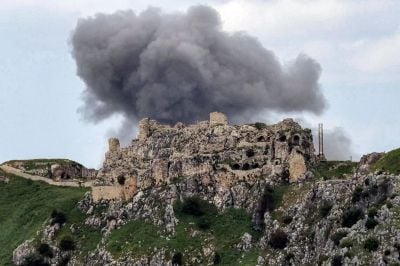
Phosphorus shells on Ali Taher Hill
The strikes came on top of other Israeli military operations carried out Wednesday. Israeli forces continue to occupy more than 60 localities in south Lebanon and destroy infrastructure there on a daily basis.
The Israeli army said it had destroyed a tunnel several dozen meters long in Sarbine (Bint Jbeil) and uncovered a Hezbollah weapons depot containing launchers, rockets and dozens of other military items. Israeli tanks and bulldozers also advanced toward the outskirts of Kfar Shuba (Hasbaya), while a well supplying Mais al-Jabal and Bint Jbeil was destroyed in Wadi Slouqi.
Israeli artillery also shelled the areas of Shaab al-Qaleb, in Shebaa locality (Hasbaya), Dohat Kfar Roummane (Nabatieh), and the strategic hill of Ali Taher, where phosphorus munitions were used, according to our correspondent. The Israeli army has been attempting to seize control of the height for several weeks.
Between Tuesday night and Wednesday, Israeli forces blew up several houses in Zawtar Sharqieh (Nabatieh), Haddatha and Aita al-Jabal (Bint Jbeil). From the early hours of Wednesday, Israeli machine-gun fire targeted the wooded area of Rabaa al-Tabn. Israeli forces later deployed to the Shammis area, northeast of Kfar Shuba, where they took up positions and sparked several fires.
Israeli forces also set fire to forests and orchards in the western neighborhoods of Houla (Marjayoun), a practice that has become increasingly frequent in recent days. Another fire broke out in the Zibqin valley (Sour) following an artillery bombardment.

Road repairs
On Wednesday, two ministers from Prime Minister Nawaf Salam’s government, which supports direct negotiations with Israel, visited the Nabatieh district.
Defense Minister Michel Menassah and Public Works and Transport Minister Fayez Rasamny inspected the destroyed bridge of Qaaqaaiyet al-Jisr, before heading to Zawtar Gharbieh, one of three sectors selected for the first phase of the “pilot zones” project outlined in the framework agreement.
Their visit aimed to assess infrastructure damage, observe from a distance the Israeli military presence in Zawtar Sharqieh — located in territory still occupied by Israel — and inspect ongoing rehabilitation work on roads and bridges.
"The land of the South will return to its people," Menassa said, as 360,000 displaced people remain unable to return home, according to United Nations figures.
At the same time, more than 800,000 people have already returned to their homes in south Lebanon, the Bekaa and Beirut’s southern suburbs after fleeing when fighting resumed on March 2.
On Sunday, Israeli Defense Minister Israel Katz said that the Israeli army had completely destroyed 24 border villages. Despite the nominal cease-fire in place since the beginning of the summer, the Israeli army continues its demolition operations.
“The army is in a permanent state of preparedness to recover our land ... Our only objective is to recover our territory. As for the outcome, it depends on the ongoing negotiations,” Menassa said.
Later Wednesday afternoon, the Lebanese Army announced that it had removed several unexploded munitions and missiles which the Israeli army had dropped on Majdal Selm, Qabrikha (Marjayoun), Braasheet and Deir Antar (Bint Jbeil), as well as Shoukin (Nabatieh).
The public works minister also announced the launch of a project to build a temporary crossing at the site of the Qaaqaaiyet al-Jisr bridge over the Litani River, restoring the connection between the Nabatieh and Bint Jbeil districts.
The municipality of Froun said work began later that day. Rassamny also announced the start of repairs to the damaged retaining wall along the Qaaqaaiyet al-Jisr public road.
He added that his ministry would begin rehabilitating roads in Ghandourieh, Zawtar Gharbieh, Burj Qalaway, Qalaway, Srifa and Froun, as well as the Sowaneh road connecting the village to Qaaqaaiyet.
Since fighting between Hezbollah and Israel resumed on March 2, Israeli attacks have killed at least 4,333 people in Lebanon and wounded at least 12,250.