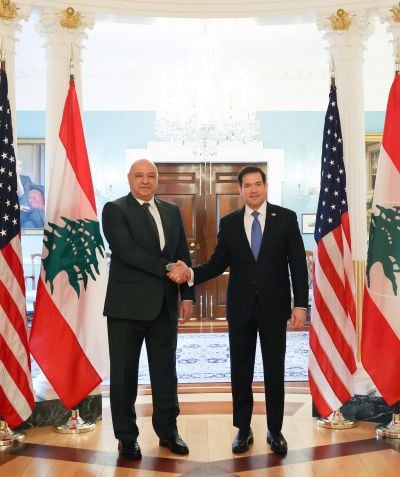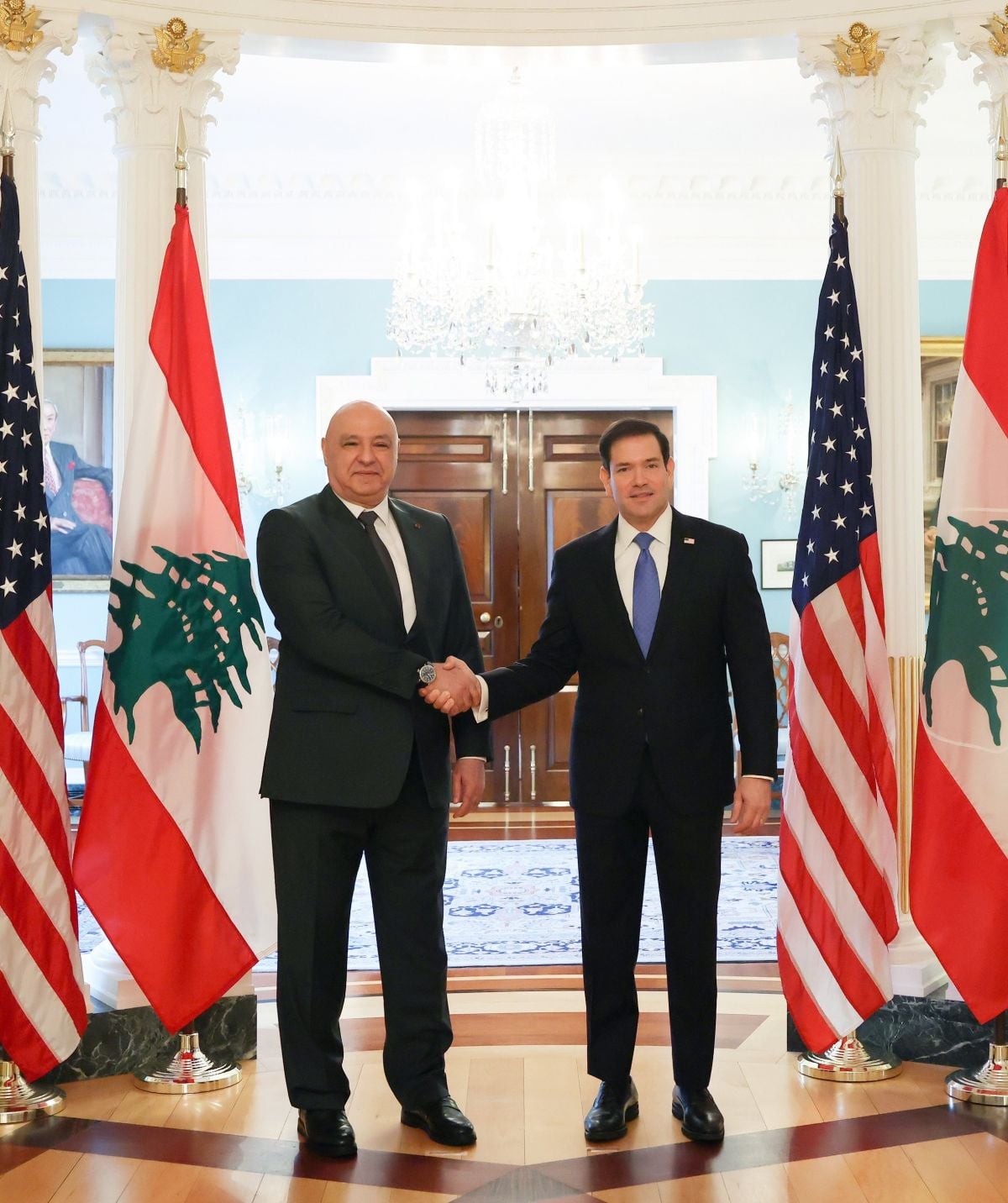
U.S. Secretary of State Marco Rubio shakes hands with Lebanese President Joseph Aoun during a meeting at the U.S. State Department in Washington on Sunday, July 19, 2026. (Photo shared by the Lebanese Presidency on X; Credit: @LBpresidency)






BEIRUT — President Joseph Aoun met U.S. Secretary of State Marco Rubio on Sunday at the State Department ahead of a scheduled meeting with U.S. President Donald Trump on Tuesday, as Washington reaffirmed its support for the Lebanese government while urging it to disarm Hezbollah and implement the framework agreement reached with Israel.
The visit marks the first trip by a Lebanese head of state to Washington since Michel Sleiman met then-U.S. President Barack Obama in 2009.
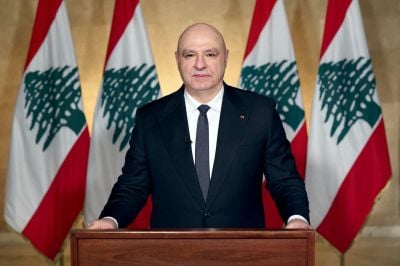
Rubio: Hezbollah remains Lebanon's biggest obstacle
Speaking to reporters after meeting Aoun, Rubio described the talks as "very positive" and reiterated that Hezbollah remains Lebanon's biggest obstacle to lasting peace.
"The best thing that could happen to Lebanon is to have a government, a legitimate government, his government, that controls the country," Rubio said.
"The biggest problem Lebanon has is that you have a political movement that also has an armed militia that is not just well armed and trained and equipped and financed by Iran, but they use that to conduct terrorism, particularly against northern Israel. And as long as that problem exists, Lebanon will never fully be at peace," he added.
Investment and direct flights
Rubio said Lebanon's security should ultimately rest solely with the Lebanese Army and stressed that strengthening state institutions would also help attract foreign investment.
"This is not just about military stuff," he said. "This is about how can we attract more U.S. and international investment into Lebanon. This is about things like how can we restart direct flights between the United States and Lebanon."
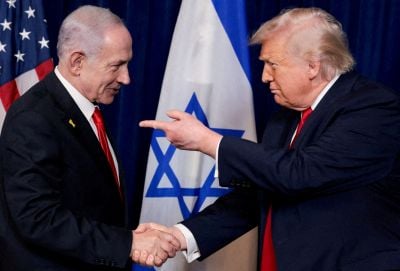
He also said he expected Tuesday's meeting between Aoun and Trump to be "very positive."
"I think President Aoun will be able to return to Lebanon and say to the people of Lebanon that he is the one that's getting positive results for the people ... He is the legitimate government, he is who we're going to work with, and that government is the government that should be in charge of that country," Rubio said.
In a statement issued after the meeting, the State Department praised the Lebanese government's "determined efforts to restore Lebanon's sovereignty, disarm Hezbollah and dismantle its terrorist infrastructure," while reaffirming U.S. support for the government's efforts toward peace, economic recovery and "a better future for the Lebanese people."
Talks with Israel ahead of Trump meeting
The meeting came days after the sixth round of U.S.-mediated Lebanon-Israel talks in Rome. The negotiations, launched in April, are aimed at reaching a peace agreement and permanently ending the Israel-Hezbollah war.
On June 26, the two sides reached a framework agreement providing for an Israeli military withdrawal from southern Lebanon and the deployment of the Lebanese Army, beginning with two pilot zones. Following last week's talks in Rome, the parties agreed on guidelines for implementing those zones, according to Washington.
The agreement remains contingent on the disarmament of the Iran-backed Hezbollah, which has rejected both the framework agreement and the negotiations.
Before departing for Washington, Aoun's office said his meetings would focus on strengthening the cease-fire, securing Israel's withdrawal from occupied Lebanese territory and discussing developments in southern Lebanon.
Lebanon fears a resumption of large-scale hostilities as Israel continues airstrikes and demolitions in the south despite the cease-fire. During his meeting with Trump, Aoun is expected to seek U.S. guarantees to help contain Israel and support a timetable for a full Israeli withdrawal from southern Lebanon.
Berri hopes for 'positive and concrete results'
Parliament Speaker Nabih Berri said he hoped Tuesday's meeting between Aoun and Trump would produce "positive and concrete results" that would help secure "the liberation of Lebanon and the guarantee of its established rights," according to remarks carried by local outlet Al-Afdal News.
Berri, who has opposed the June 26 framework agreement between Lebanon and Israel, said "the essential thing is to reach a genuine solution, regardless of where it comes from." He added that he had urged Aoun before his departure for Washington to focus on two priorities: consolidating the cease-fire and securing Israel's complete withdrawal from the remaining occupied Lebanese territory in the South.
Asked about the risk of a wider regional conflict amid escalating U.S.-Iran tensions, Berri replied: "What do you call what is happening now? It is already a form of war."
After meeting Aoun on Monday, Democratic Senator Elissa Slotkin, a member of the Senate Armed Services Committee, told LBCI that the committee had "requested a $36 million allocation for the Lebanese Army, particularly to support the special forces."
The U.S. defense appropriations bill for the coming fiscal year, which is still under discussion in the Senate, sets a ceiling of $36 million for Pentagon assistance to the Lebanese Army. However, only a limited portion of that funding — 5%, or $1.8 million — could be released immediately.