






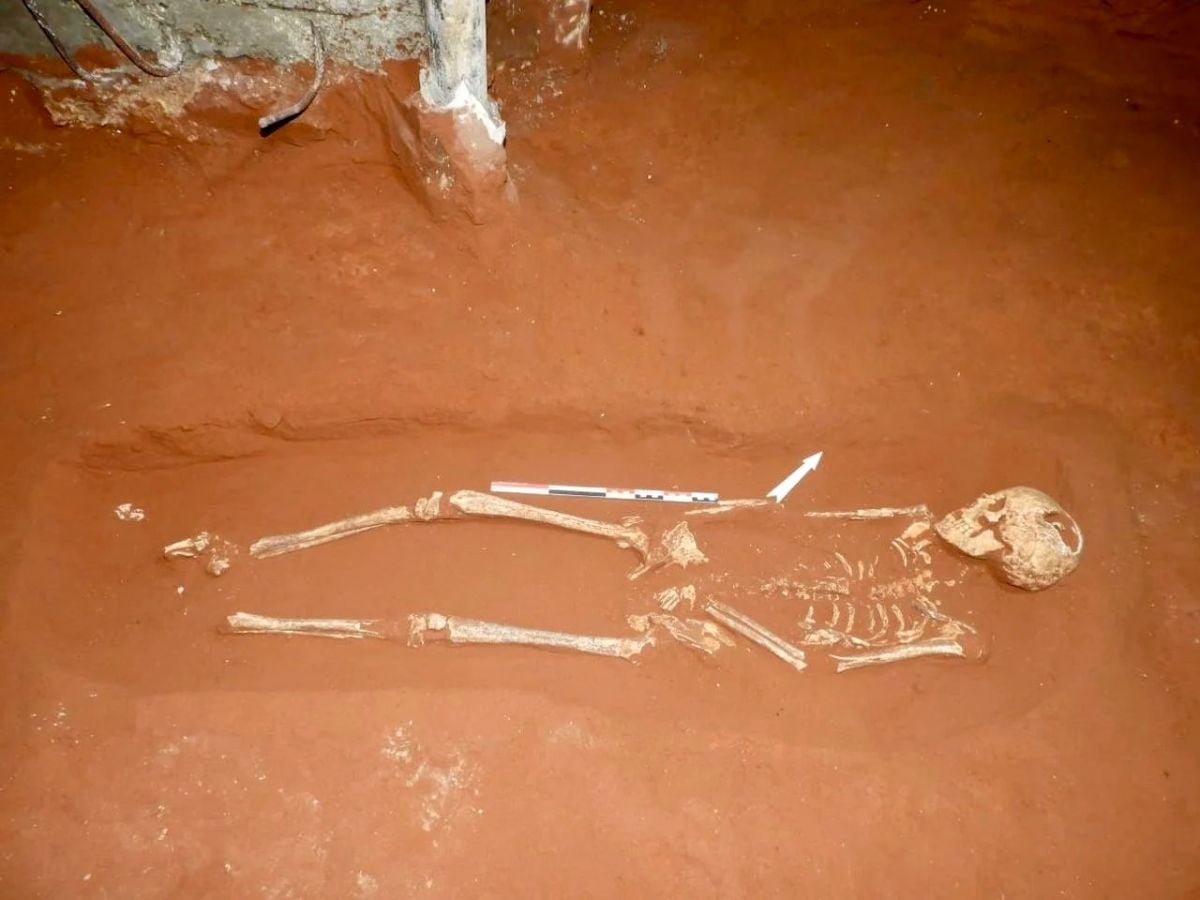
The archaeologist Laure Salloum reconstructed the skeleton unearthed at Rmeil to understand and document the initial position of the body. (Credit: Courtesy of the DGA)






No, the tomb of Alexander the Great was not discovered in Beirut, despite recent excitement on social media. The archaeological reality is quite different — though no less significant for the history of the Lebanese capital.
In front of the headquarters of Électricité du Liban (EDL), rescue excavations led by Laure Salloum, head of excavations for Beirut, Baalbeck and Hermel at the Directorate General of Antiquities (DGA), have uncovered modest burial sites. So far, preliminary findings include simple graves, some carved directly into the bedrock.
"These are collective graves, each containing the mortal remains of several individuals," says Salloum, noting that "these structures correspond to a section of the Roman necropolis that then extended outside the city walls." This emergency excavation was launched ahead of private construction work to consolidate and expand a traditional building across two adjacent plots.
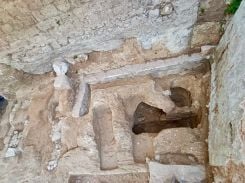
In Saint-Nicolas, just a few meters from Ward House, the dead were buried directly in the red sand. Near the skeletal remains, archaeologists have unearthed balsamaria — precious Roman flasks containing scented oils essential to funeral rites.
"This is not the first time Achrafieh's subsoil has revealed the secrets of the Roman necropolis. Historically, this area was located on the eastern outskirts of the city, an area traditionally reserved for 'cities of the dead' and artisanal activities, as Roman laws prohibited burials within the city walls."

A vast funerary landscape
Previous excavations have repeatedly confirmed the extent of Achrafieh’s Roman past. In 2007, digs carried out by the DGA on Ghandour al-Saad Street uncovered a Roman necropolis containing more than 200 sarcophagi dating from the 1st to the 3rd century AD. Made of stone, terracotta and lead, they contained human remains as well as balsamaria (ointment flasks). Iron nail traces also suggest the use of wooden coffins.
Beyond Ghandour al-Saad, similar discoveries have been made in Furn al-Hayek, SNA, Akkawi, Sagesse, the area between Mar Mitr and Rue du Liban (opposite the Church of Saydet al-Beshara), and on Maroun Naccache Street in Gemmayzeh. There, excavations revealed a Roman temple (unfortunately looted in antiquity) as well as around 30 tombs containing the skeletons of children, adults, and four dogs believed to have belonged to hunters or members of the Roman army.
Taken together, these findings have allowed specialists to reconstruct the historical layout of this extensive funerary zone covering the Achrafieh hill, and have significantly deepened understanding of Roman burial practices. From the 1st century BC to the 1st century AD, most coffins were made of wood. Burial traditions later evolved, with terracotta and stone becoming more common, followed by lead around the 3rd century.

 8 p.m. recap: Israel again threatens Beirut’s south suburbs; 2 ships hit near Hormuz; Riyadh football matches canceled