







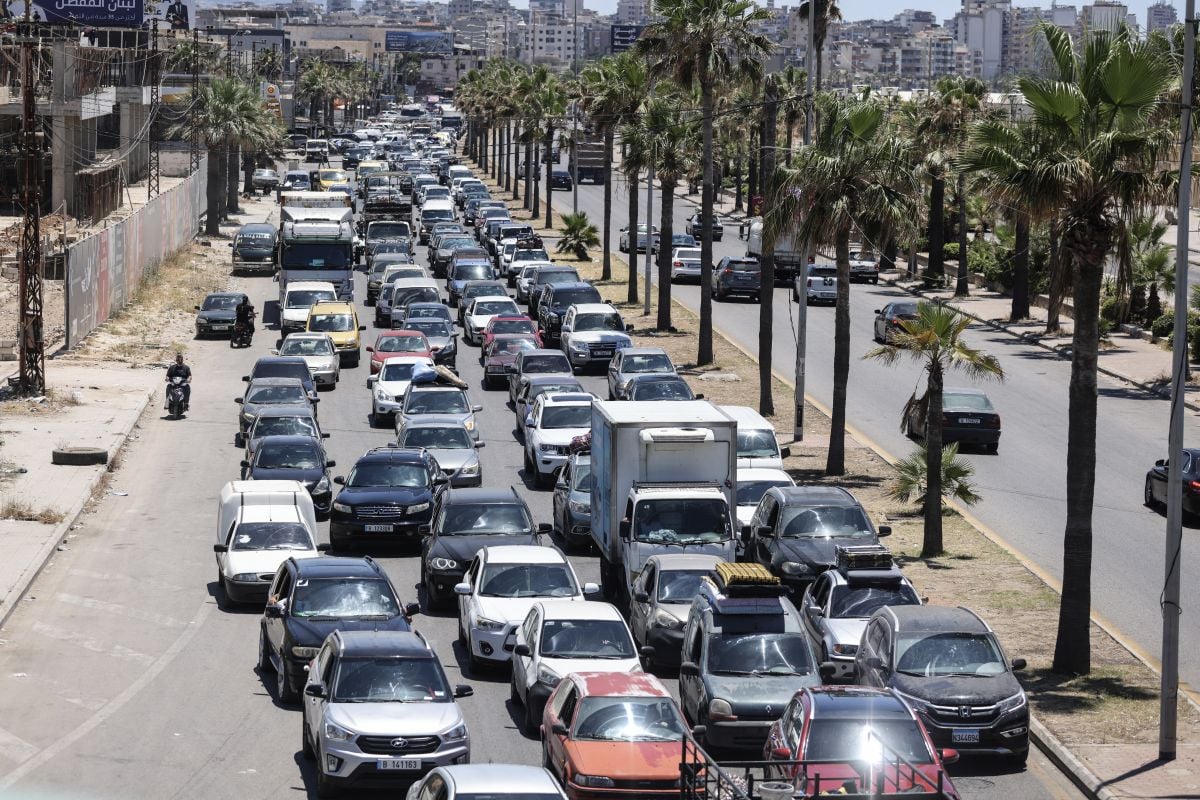
Vehicles line up in traffic at the entrance to Saida on June 19, 2026, as residents flee southern villages for the capital, Beirut, following Israeli airstrikes across the country's south. (Credit: Mahmoud Zayyat/AFP)






SOUTH LEBANON — Lebanon held its breath. On Friday, it experienced one of the deadliest days since the announcement on Monday of an Iranian-American memorandum of understanding calling for a cessation of hostilities.
The fear of the agreement collapsing grew particularly strong following the postponement of the negotiations scheduled in Switzerland between Washington and Tehran, apparently due to a disagreement over Lebanon.
On the ground, dozens of Israeli strikes pounded the south and the Bekaa, killing at least 50 and injuring 97, according to the health ministry.
Israel appears to want to take advantage of the stalled negotiations between the United States and Iran, it presented Friday’s attacks as retaliation for the death of four soldiers in the occupied area of southern Lebanon following a Hezbollah attack. The escalation was eventually contained in the afternoon, and a surprise cease-fire was announced.
Negotiated by U.S. and Qatari mediators, this cease-fire was announced to AFP in the afternoon by a senior American official on condition of anonymity. Set to take effect at 4 p.m., it was accepted by both sides, provided that neither is attacked by the other. But shortly after the announcement, the Israeli army stated it would maintain its "buffer zone" in southern Lebanon, about 10 kilometers deep, and continued its strikes.
At least three people were then killed, including a member of the Amal movement, Hussein Taleb Khodr, in Habboush (Nabatieh District), and two others in Kawthariyet al-Siyyad (Saida District).
According to Hezbollah’s MP Hassan Fadlallah, quoted by Reuters, Iran has also informed the party that discussions with the United States cannot resume before the entry into force of a comprehensive cease-fire. "We will respect the cease-fire if Israel does," his colleague Ibrahim Moussawi told the al-Arabiya channel. "We reserve the right to respond" to Israeli attacks, he added.
On the other side, a senior Israeli official confirmed to Reuters that Israel was under a "cease-fire." "If Hezbollah does not attack us, then we are no longer at war," he also said, before indicating that the Israeli army "will maintain its forces in southern Lebanon." This slight change in tone comes as Lebanon sits at the heart of the standoff between the United States and Iran.
After the announcement of the deaths of four Israeli soldiers in southern Lebanon, including the commander of the 52nd Battalion, Lt. Col. Dor Gedalia Ben Simhon, Israeli Prime Minister Benjamin Netanyahu said Israel would remain in Lebanon “as long as necessary” and would make Hezbollah “pay a very heavy price.”
According to the Israeli daily Haaretz, these soldiers were killed in a Hezbollah attack on a tank. Israeli National Security Minister Itamar Ben Gvir, a prominent figure of the far right, immediately declared that “all of Lebanon must burn.” Finance Minister Bezalel Smotrich, for his part, called on X to "open the gates of hell." The Israeli army also announced that an officer had been seriously wounded and three reservists slightly injured in a drone attack.
150 targets
The Israeli escalation began as soon as night fell on Thursday and continued relentlessly until Friday afternoon. In the morning, it was accompanied by an attempt to advance toward the strategic heights of Ali Taher, overlooking Nabatieh and the villages of Iqlim al-Touffah.
The strikes triggered a new wave of displacement from the targeted areas, mainly in the Nabatieh and Zahrani regions, toward Saida and Beirut, according to our correspondent in southern Lebanon. By 9 a.m. Friday, the death toll had already reached 25, including many civilians and children. In Harouf, six members of the same family — parents and their four children — were killed.
In Sharqieh, Mahmoud Choueib, his wife Batoul, their six-year-old daughter Zahra, and Hanadi Jaradi, 40, were killed. In Kfar Sir, Israeli attacks killed a mother and her daughter.
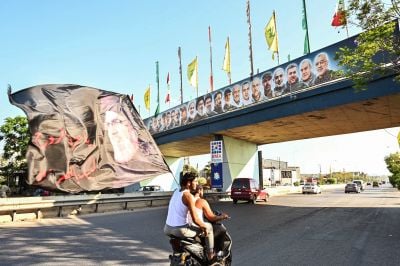
By 10 a.m., more than 50 strikes had pounded Nabatieh and its surroundings, including Doueir, Jibsheet, Bfaroueh and Harouf. Emergency services had to send many ambulances to evacuate residents trapped in the bombed areas. In the afternoon, two rescuers from the al-Rissala association affiliated with the Amal movement, Kassem Roumani and Ali Obeid, were killed in Habboush while carrying out “their humanitarian mission,” our correspondent reported.
The Bekaa was not spared. Strikes hit Ain Bourday, Douris, Zelaya and the heights of Abou Rached, according to our correspondent. The Israeli army claimed to have targeted a “Hezbollah infrastructure” in the Bekaa in retaliation for what it called “repeated cease-fire violations.” In the early afternoon, it said it had carried out more than 80 strikes in Lebanon “in the past few hours” and had killed “dozens of Hezbollah fighters.”
Israeli Prime Minister Benjamin Netanyahu said, that according to his orders, the Israeli army had “forcefully struck 150 Hezbollah targets.”
During the day, President Joseph Aoun denounced “a dangerous and reprehensible escalation that struck dozens of innocents, including women and children.” He nevertheless asserted that this escalation would not prevent work toward achieving a comprehensive cease-fire as soon as possible, which he said he had “recommended to Lebanese negotiators for the next session in Washington.”
The issue cannot be avoided, as “the comprehensive cease-fire is the gateway to addressing other issues, the most important being the Israeli withdrawal, the deployment of the army, and the return of prisoners,” he said.
Reporting contributed by our regional correspondents Sarah Abdallah and Muntasser Abdallah.

 8 p.m. recap: Israel again threatens Beirut’s south suburbs; 2 ships hit near Hormuz; Riyadh football matches canceled