







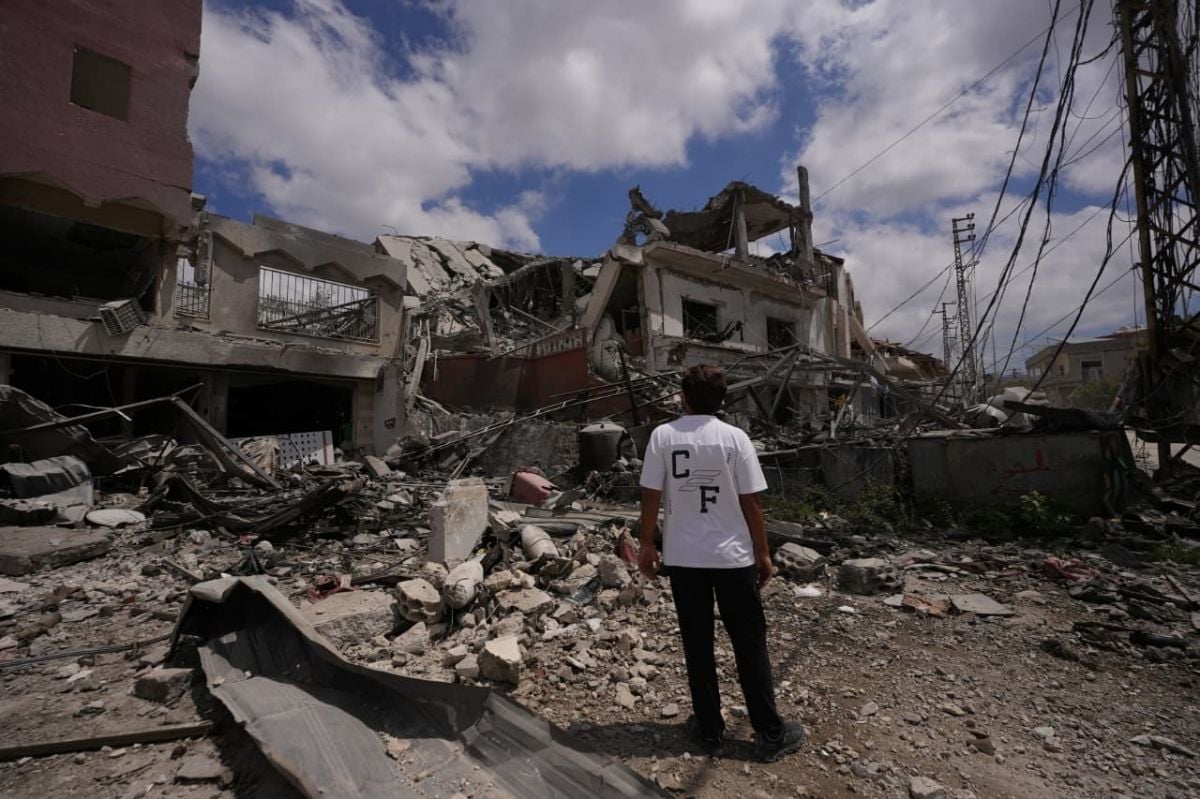
A man observes a ruined building in the city of Nabatiyeh, in southern Lebanon, on June 15, 2026. (Credit: Mohammad Yassine/L'Orient-Le Jour)






SOUTH LEBANON — A fragile calm held Monday morning across several towns in south Lebanon and the West Bekaa following the U.S.–Iran peace agreement, which includes de-escalation measures in Lebanon.
Displaced persons began to head back to their villages to inspect their homes and belongings, despite warnings from the Lebanese Army and several municipalities. The Israeli army, however, did not hesitate to open fire toward residents returning to certain villages in the south, in order to prevent them from accessing certain areas. Hezbollah, for its part, expressed thanks to Iran and its supreme leader.
After several days of escalation, Israeli warplanes and drones were absent from the skies of south Lebanon from midnight to the early morning hours, our correspondent in the region, reported.
This respite was brief. Early in the morning, the Israeli army fired artillery at the outskirts of Nabatieh al-Fawqa and Kfar Tibnit (Nabatieh district), as a warning to residents returning to the area.
Other strikes targeted the Ksar neighborhood in Yater (Bint Jbeil) as residents entered this area.
Around noon, Israeli artillery again struck the hills of Ali al-Taher, in the Nabatieh district. Explosions caused by the Israeli army were also reported in several localities in the south. In addition, two deaths were recorded in south Lebanon following the announcement of the agreement: Ismail Allam was killed in Yater (Bint Jbeil) after an explosion whose origin remains unknown at this stage. An Israeli drone also targeted a vehicle at the Kfart Tibnit roundabout (Nabatieh district), killing one person.
Journalist Hadi Hoteit was injured after an Israeli drone launched a grenade in his direction in the village of Kfar Tibnit (Sour) while he was working. From the al-Najda al-Shaabiya hospital, he recounted what happened, stating that the grenade exploded less than a meter from him. He also accused Israel of deliberately targeting him.
In this context, the Lebanese Army command called on residents to "wait before returning to the border villages and towns of the south." It also urged them to "follow the instructions of the deployed military units to ensure their safety against the risk of Israeli violations and aggressions, in light of recent developments in the region."
The army also emphasized the need for "caution and vigilance" in areas that have been targeted by Israeli attacks, inviting residents to report any unexploded ordnance or suspicious objects to the army or security forces. Likewise, many municipalities in south Lebanon asked their citizens to wait for official orders before returning to their villages.
Returns to south Lebanon thus remained limited and cautious. In West Bekaa as well, a few people began to return to their towns, notably in Mashghara, a village with a Shiite and Christian majority, according to our correspondent in the region.
Displaced persons from several Shiite villages also returned briefly to check on their homes before leaving again. In fact, Hezbollah and the Amal Movement have called on their supporters to wait for the outcome of the Iran-U.S. agreement signing ceremony, scheduled for Friday in Geneva.
Hezbollah does not intend to bring down the Salam government
Contacted by L'Orient-Le Jour, a Hezbollah source expressed thanks to Iran "which managed to reach a solid agreement, knowing that the return to calm in Lebanon was a necessary condition for this agreement."
"The Lebanese authorities are therefore called upon to learn the lessons of a process that has borne fruit and to take advantage of Speaker Nabih Berri's presence on the political scene to achieve concrete results," the source added.
The source also assured our publication that the militia does not intend to bring down the Salam government. "We have more important issues to address, like unifying the Lebanese position to move towards indirect negotiations," the source said, accusing the authorities of "yielding to American pressure and making gratuitous concessions to the Israelis." "It may be necessary to consider modifying the composition of the Lebanese negotiating delegation to Washington," the source suggested.
In a statement published in the afternoon, Hezbollah addressed "its greetings to the supreme leader of the Islamic Revolution, Mojtaba Khamenei, as well as to the president of the republic and the Iranian government, and to the valiant armed forces of the Islamic Revolutionary Guard Corps."
The party also called for the adoption of "a unified national position," while reaffirming the importance of its "resistance." It also called for "reviewing all calculations and paths taken by the authorities, learning from this experience and those that preceded it, and abandoning illusions and lost bets," while a new round of direct talks in Washington is scheduled for next week.
In statements to Reuters, a Hezbollah official assured that his party has not carried out any operations since the announcement of the agreement. He also said that the group rejects "Israeli freedom of movement" in Lebanon, and revealed that Iran postponed the signing of the agreement to monitor Israel's compliance with the cease-fire in Lebanon.
Reporting contributed by our regional correspondents, Muntasser Abdallah and Sarah Abdallah.

 8 p.m. recap: Israel again threatens Beirut’s south suburbs; 2 ships hit near Hormuz; Riyadh football matches canceled