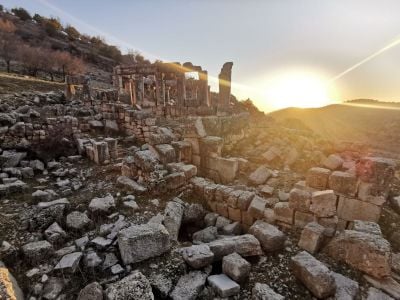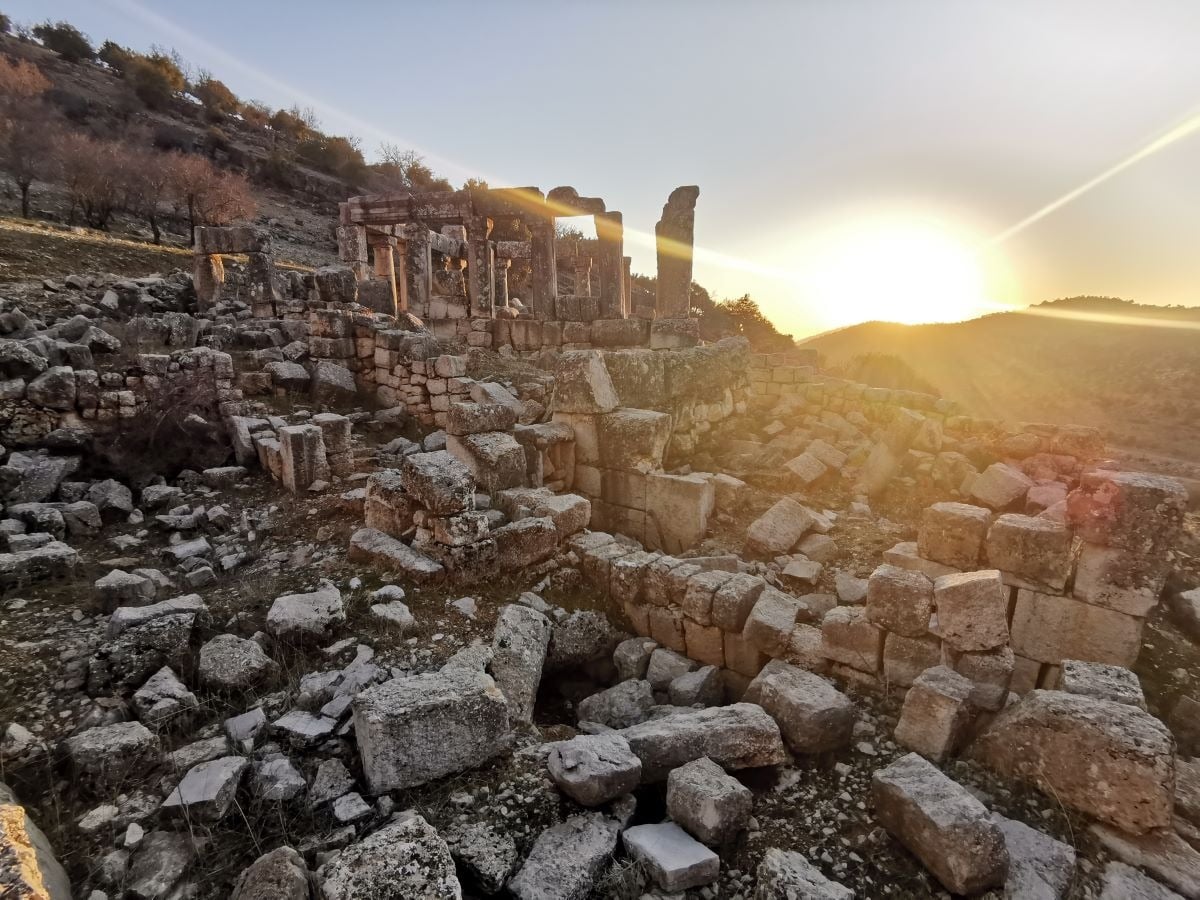
In Hammara, the stones tell 15 centuries of history in the heart of Mount Hermon. (Credit: Wikicommons)






In April 2026, UNESCO granted provisional reinforced protection status to 39 cultural sites in Lebanon, including the ruins of Hammara on the slopes of Mount Hermon. Rising to 2,814 meters above sea level and often called Jabal al-Sheikh ("mountain of the Sheikh") in reference to its snow-capped peaks, reminiscent of an elder's white hair, the massif hosts more than 30 ancient sanctuaries and temples, most clustered in its northern section.
A village erased from maps
Hammara, located on the slopes of the Anti-Lebanon range about 10 kilometers south of the Masnaa border crossing, no longer exists on Lebanon's map. Because its Arabic spelling matched the word for "she-donkey," the town was renamed al-Manara in 1968.
The village's historical ruins are documented by the HAL open archives platform and in the scholarly journal Ktèma (available through the Persée portal under the title Les Monuments de Hammara, Béqa'-Sud, Liban). These include an enclosure tomb, a unique funerary complex and the remains of Qasr Hammara, also known as Qasr al-Manara.
The site's material remains have been extensively studied by two specialists in archaeology and epigraphy: Shaker Ghadban, Lebanon's former director general of antiquities, and French historian Julien Aliquot.
A paleochristian masterpiece carved in stone
Discovered and described by Ghadban, the funerary complex is a square hypogeum carved entirely into the rock. Access to the tomb was through a narrow passageway — a dromos — leading to a basalt door weighing more than two tons.

The door is decorated with reliefs depicting the sculpted faces of a couple, geometric motifs including medallions, diamonds and rosettes, and two crosses beneath semicircular arches. It also bears an inscription: "The year 513. Nasios made it."
As Ghadban notes, the door, a "true paleochristian masterpiece," was transferred to the Anjar excavation site for safekeeping.
Exploration of the burial chamber also revealed niches, known as arcosolia, topped by arches and carved into the walls. Three troughs contained the bones of five individuals. Excavations uncovered modest grave goods that predate the door itself: terracotta lamps dating to the fourth or fifth century A.D., an iron ring and bronze bracelets with snake-head motifs that belonged to children. All of these artifacts were added to the collections of the National Museum of Beirut.
Farther downslope, during the construction of a house, Ghadban discovered another tomb. Located at the center of a rectangular stone enclosure, it was carved into the rock and protected by a massive lid. One face of the lid bears a carved, raised-image bust of a figure wearing a broad cloak, arms raised in the orant, or praying, posture.
The beardless face features pellet-like eyes, large ears and no visible forehead.
"This work is clearly by a local craftsman in the Semitic tradition, departing from classical Greco-Roman aesthetic standards," Ghadban observes, adding that a chi-rho, a Christian monogram, carved near the head identifies it as a Christian burial.
The tomb has been dated to the Theodosian era, between A.D. 430 and 450. Deemed "exceptional," the lid was transferred to the Anjar site for preservation.
A challenge to the codes of ancient Rome?
For his part, Aliquot, a researcher at the French Institute of the Near East and author of several publications on the region's religious organization and Greek inscriptions under the Roman Empire, notes that in 1938 French geographers Richard Thoumin and Étienne de Vaumas described Mount Hermon as a "sacred landscape" covering roughly 1,000 square kilometers.
Around the same time, German archaeologists Daniel Krencker and Willy Zschietzschmann identified distinctive features in the massif's sacred architecture that contrasted with the traditional Roman model: no columns on the facade, meaning the layout was not prostyle; abandonment of the Corinthian order on exterior structures; and a single entrance to the shrine, or cella, whereas temples in the Bekaa and Mount Lebanon typically featured triple doorways.
For modern archaeologists, this architecture reflected a deliberate choice.
"It sought to preserve local Semitic religious traditions under the Roman Empire," Aliquot explains.
With few exceptions, most of these sanctuaries are believed to date to the Roman period, between the second half of the second century and the end of the third century A.D.
The Qasr remains partly mysterious
But let us return to the main subject: Qasr Hammara — "qasr" meaning "castle" in Arabic — as introduced by Aliquot.
Here, stone blocks "from one or more Roman buildings" were reused during the proto-Byzantine period to construct a building whose exact function remains debated.
Krencker and Zschietzschmann, who produced what Aliquot describes as "the most comprehensive study of these monuments," identified Qasr Hammara as a basilica with a Christian apse and a house within the same enclosure, a hypothesis shared by British researcher George Francis Taylor and Ghadban.
However, archaeologist Lévon Nordiguian, founder of the Museum of Lebanese Prehistory and author of "Les Temples de l'époque romaine au Liban," identified the remains of an olive press inside the building believed to be a church. According to him, these remains suggest that the structure and the dwelling below may have formed part of a monastery.
Although specialists disagree about the building's precise function, they do agree in attributing the oldest blocks found near the site to a Roman sanctuary.
According to Aliquot, the strongest clues are architectural: a small votive altar dedicated to a deity; bases of columns and half-columns left unfinished; an Ionic capital; and two fragments decorated with shell and vegetal motifs.
Finally, architrave blocks complete the assemblage. Two bear a pagan Greek inscription that Aliquot dates to between the mid-third and early fourth centuries A.D. It commemorates the construction of a large four-sided portico funded by the rural community of Ainkania, an ancient site on a plateau overlooking Qasr Hammara about five kilometers to the east.
"The text is addressed to the god Zeus, imploring, 'Increase, Fortune of Ainkania.'"
Mount Hermon, or Jabal al-Sheikh, is currently under the control of Israeli forces, which seized the Syrian side of the massif as well as its strategic summits. This control gives Israel a major forward observation post overlooking Damascus, the Bekaa Valley and southern Lebanon.
This article was translated from L'Orient-Le Jour.