






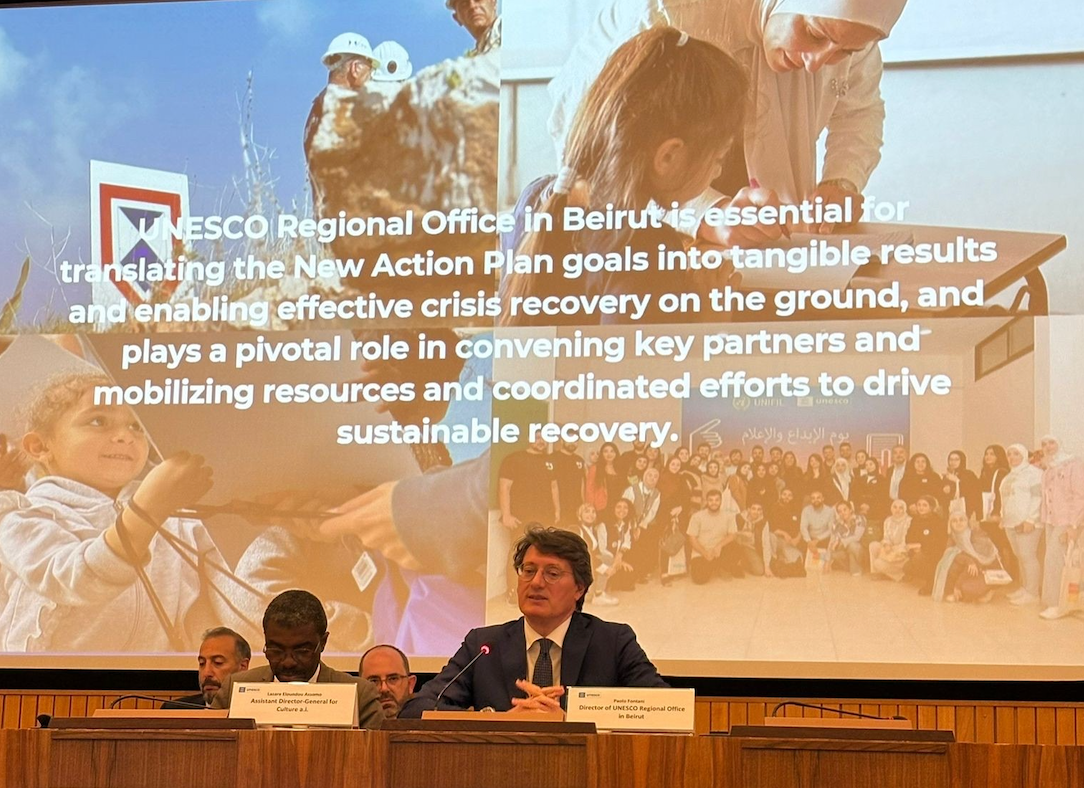
Lazare Eloundou Assomo, Acting Deputy Director-General for Culture and Direcor of the World Heritage Centre, alongside Paolo Fontani, Director of UNESCO’s Regional Office in Beirut, during the presentation of the organization’s emergency action plan in support of Lebanon. (Credit: UNESCO)






BEIRUT — At the initiative of Lebanon’s permanent delegation to UNESCO, an information meeting on the country’s situation was held on Monday, June 8, in Paris, attended by the president of the General Conference and representatives of member states.
This meeting allowed for the presentation of the emergency plan developed by UNESCO in support of Lebanon within the areas under its mandate: education, the protection of journalists and media, safeguarding cultural heritage and archaeological sites, as well as the preservation of the city of Sour, which is listed as a World Heritage site.
The discussions centered on four priorities: ensuring continuity of education, protecting cultural heritage, supporting cultural institutions and industries, and strengthening a media sector capable of providing reliable and independent information.
The session was opened by Lazare Eloundou Assomo, acting deputy director general for culture and director of the World Heritage Center, who presented the organization’s emergency action plan.
Paolo Fontani, director of UNESCO’s regional office in Beirut, then outlined the programs and projects implemented on the ground in response to the consequences of recent attacks.
A documentary produced jointly by the UNESCO secretariat and the Beirut office illustrated the cooperation carried out with Lebanese authorities, notably the culture and information ministries.
The film highlighted actions undertaken for the protection of heritage, support for media, and continuity in education. Testimonies from Culture Minister Ghassan Salameh and Information Minister Paul Morcos underscored the essential nature of this cooperation in the current context.
Lebanon calls to turn commitments into action
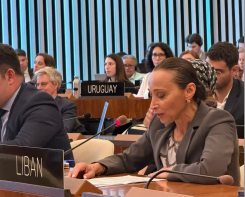
Taking the floor, Ambassador Hind Darwish, Lebanon’s permanent delegate to UNESCO, expressed her country’s gratitude to the organization, its director-general and all member states. She called for a shift from the planning phase to concrete implementation, mobilizing the necessary resources to ensure the continuity and sustainability of the country’s vital sectors.
The ambassador also appealed to friends of Lebanon to support its recovery and help restore its cultural, intellectual and civilizational role in the region and the world.
A cultural heritage under pressure
Jad Tabet, adviser to the culture minister and an expert in architectural heritage, presented a worrying overview of the damage sustained by several major cultural and archaeological sites. He specifically mentioned the site of Shamaa, Beaufort Castle (Kalaat al-Shqif), the public library and the Great Mosque of Bint Jbeil, as well as the city of Sour, whose integrity as a World Heritage site is now seriously threatened.
For his part, Ayman Mhanna, executive director of the Samir Kassir Foundation and a specialist in media freedom, warned of the risks journalists face during periods of conflict. He stressed the need to protect journalists on the ground, defend press freedom and support independent media, in order to ensure the public’s access to quality information.
2025 UNESCO Prize for Girls’ Education laureate Maya Moussa presented the unique challenges facing girls’ education in Lebanon, as well as the initiatives developed to preserve access to knowledge for the most vulnerable populations.
Renewed international solidarity
Several member states spoke during the meeting to reaffirm their solidarity with Lebanon and their support for the actions taken by UNESCO.
In closing the session, Ambassador Darwish thanked all the delegations for their commitment. She hailed this collective mobilization as a message of hope and confidence in Lebanon’s ability to recover and ensure continuity in its education, media and cultural sectors.