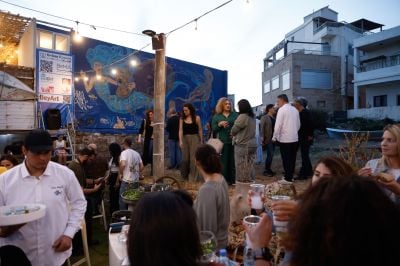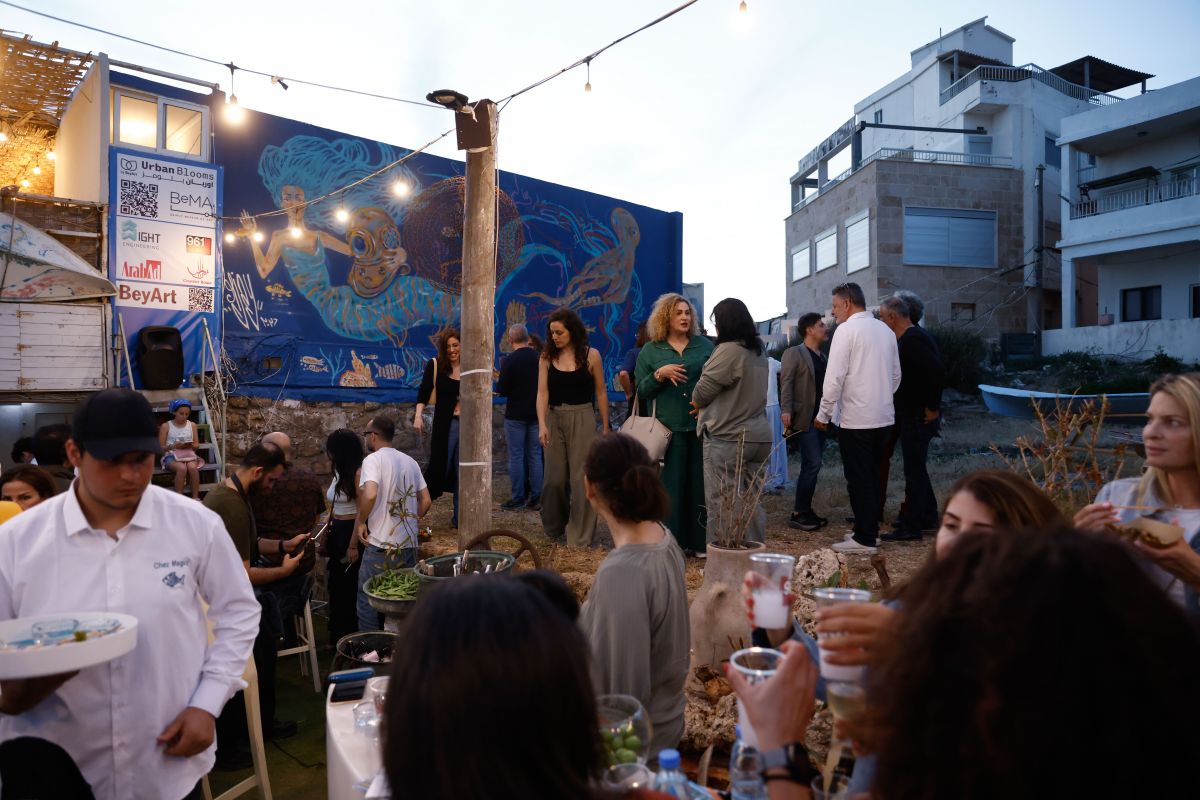
A view of the launch party for Bey Art's Urban Blooms initiative. (Credit: BeyArt)






A week after its inauguration in Batroun, Mare Nostrum by Marie-Joe Ayoub continues to overlook the sea. The launch lights have faded, the crowds have dispersed, and the videos shared that evening have disappeared from social media.
What remains is a blue mural filled with fish, sea sponges, and a floating mermaid — and a broader question about what public art can still offer in a city increasingly shaped by tourism and spectacle.
In Batroun, cafés spill onto the seafront every weekend, terraces fill before sunset, and façades increasingly blend into the same carefully curated coastal image. Against this backdrop, the Urban Blooms initiative seeks to introduce a different rhythm.
Launched by the BeyArt platform, the project aims to reclaim the city’s walls through murals that connect contemporary art, local memory, and public space.
Project founder Ranine al-Homsi said the initiative grew out of frustration with seeing Lebanese art circulate mainly inside galleries, institutions, and limited cultural circles. The goal, she said, is not simply urban beautification, but bringing art into everyday life.
“Art shapes society and society shapes art,” she said.
That approach carries particular resonance in Batroun. Beyond its image as a festive seaside destination, the city also holds a maritime history and local heritage that often remain overshadowed. Urban Blooms seeks to turn walls into spaces of storytelling rather than simple decorative backdrops.
The project’s first mural, Mare Nostrum, stands near the waterfront and draws on Ayoub’s personal connection to Batroun and the Mediterranean. Fish, marine plants, disappearing sea sponges, and a central mermaid create an image that appears bright and accessible at first glance before revealing a quieter reflection on the fragility of marine ecosystems.
“We have already lost the sea sponges once harvested by divers,” Ayoub said.
The project extends beyond the mural itself. QR codes installed nearby provide access to archives, texts, and historical material related to Batroun, while workshops, mainly with schoolchildren, accompany the artistic interventions. Developed with support from BeMA, the initiative aims to establish a longer-term presence beyond the opening event.
The project’s broader challenge may now lie in what remains after the inauguration. During the launch, the mural competed with music, conversation, and the bustle of the seafront, reflecting how art itself now struggles to stand out amid the constant flow of images and distractions.
A week later, the atmosphere has changed. The crowd is gone, but the wall remains a quiet fragment of blue facing the Mediterranean in a city where images often disappear as quickly as they appear.