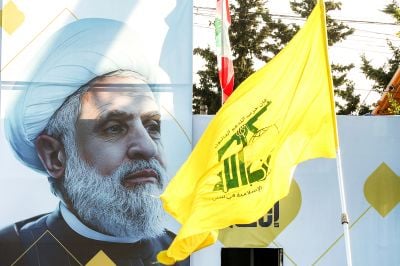
A portrait of Naim Qassem, the leader of Hezbollah, during a ceremony in Deir Qanoun al-Nahr, near Sour in southern Lebanon, on Sept. 27, 2025. (Credit: Mahmoud Zayyat/AFP)






BEIRUT — Hezbollah Secretary-General Naim Qassem on Monday reiterated his preference for indirect negotiations with Israel, as authorities are set to soon launch direct talks, stating that there is no Israeli "buffer zone" in southern Lebanon.
The Israeli army has de facto established this "buffer zone" along the southern Lebanese border, occupying territory and destroying homes and entire neighborhoods in dozens of villages in the region. It also continues to carry out massive strikes and daily artillery fire there, as well as north of the demarcated "yellow line" and across the South, facing daily Hezbollah attacks on the positions it occupies.
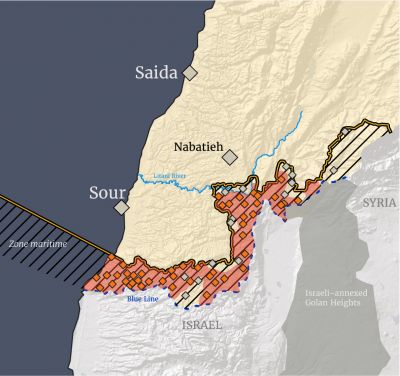
In a message read by a presenter on the party’s Al-Manar channel, Naim Qassem nevertheless declared that 'there is no such thing as a yellow line or buffer zone, and there never will be." Regarding the presence of Hezbollah fighters and weapons south of the Litani, an area the Lebanese Army had previously claimed to have demilitarized under the November 2024 cease-fire, Qassem stressed that the party's fighters “are not deployed in any specific geographic area" but act according to “lightning attack tactics" or "strike and retreat," in order, he said, "to inflict maximum losses and prevent the Israeli army from establishing itself on the occupied territories."
A 'free concession that will have no result'
Qassem also stated that "there is no cease-fire in Lebanon, but rather a continuing Israeli-American aggression," condemning the “targeting of civilians and the destruction of villages and towns," as more than 100 people have been killed in Israeli attacks over the past three days.
In the face of these ongoing attacks and demolitions, he reaffirmed his “support for diplomacy leading to an end to the offensive,” but opposed direct negotiations. “We are in favor of indirect negotiations, which bore fruit during the maritime border talks” in 2022, he said. He insisted that direct negotiations “are a free concession that will have no result and serve the interests of Netanyahu, who seeks a symbolic image of victory, and Trump ahead of the [U.S.] midterm elections.”

In a speech from Bkirki on Monday, U.S. Ambassador to Lebanon Michel Issa criticized this view of the situation, saying that direct negotiations and a possible meeting between President Joseph Aoun and Israeli Prime Minister Benjamin Netanyahu “would not neither be a concession nor a defeat,” but rather would allow Lebanon “to put its claims on the table.”
“The world must understand that capitulation is not the solution. The solution is not to reshape Lebanon politically and militarily into a weak, protectorate state, nor through forced diplomacy under continuous aggression and pressure without implementation of agreements,” Qassem warned, stating that there is no country “whose authority aligns with the enemy against its own resistance fighting an occupation.”
“We call on the authorities to strengthen national unity and sovereignty, and to energize the army’s role while settling the crises according to the Constitution,” he continued, as security and sectarian incidents have multiplied in recent weeks. He said that internal agreement would be one of the factors to overcome the “critical phase” Lebanon is going through, as well as “the continuation of the resistance and the possibility of benefiting from a U.S.-Iranian agreement, and any international or regional dynamic exerting pressure on the enemy.”