



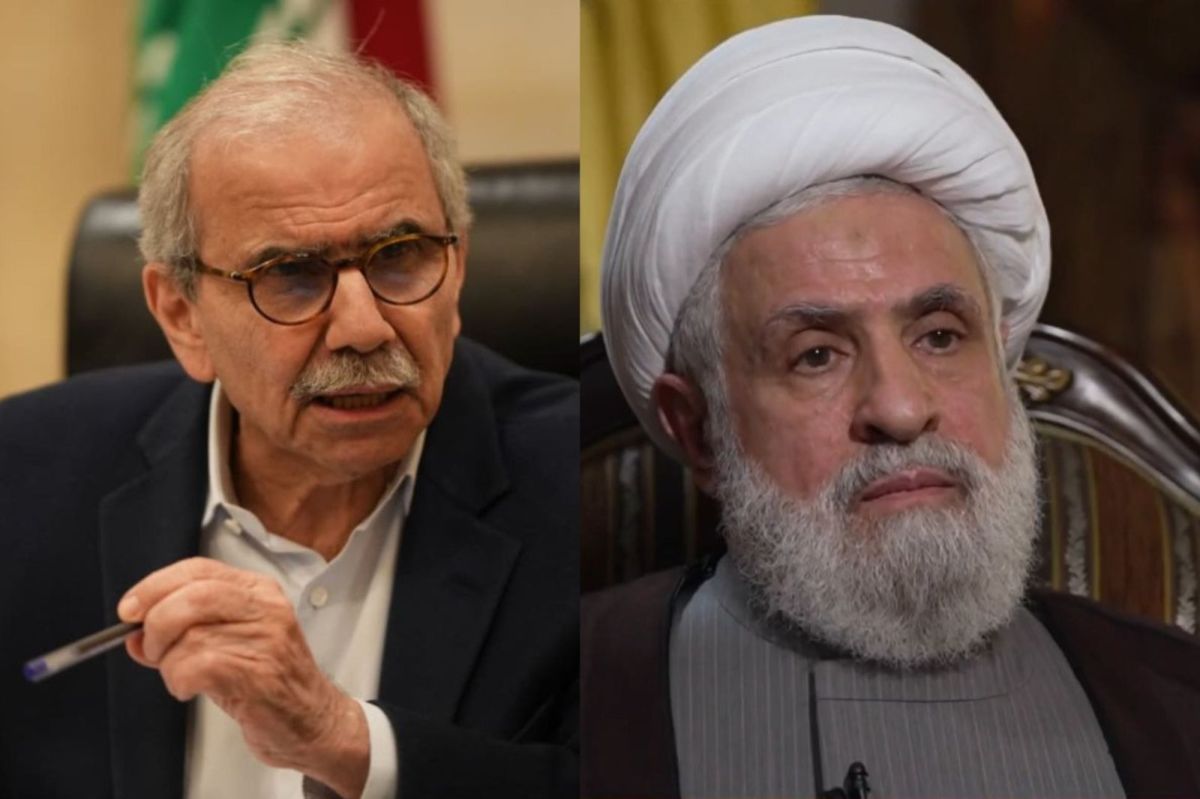
PM Nawaf Salam (left) during an interview with L’Orient-Le Jour on March 8, 2026, and Hezbollah Secretary-General Naim Qassem (right) during an interview with NBC on April 18, 2024.(Credit: Mohammad Yassine/L’Orient-Le Jour and NBC)






SOUTH LEBANON/BEIRUT — In an unusual move, Prime Minister Nawaf Salam on Tuesday lashed out at Hezbollah Secretary-General Naim Qassem, who earlier in a speech criticized the Lebanese state, accusing it of “serving Israel” rather than “Lebanon’s sovereignty.”
The remarks came just hours before the opening of the seventh round of direct talks between Lebanon and Israel, under U.S. auspices, aimed at ending the war.
“The truth, however, is that the greatest service rendered to Israel has been provided by those who unilaterally dragged Lebanon into the absurd wartime adventures of the ‘support front,’ giving Israel pretexts to attack our country, violate its sovereignty, destroy its cities and villages, kill its residents and displace hundreds of thousands,” Salam wrote on X.
Hezbollah unilaterally opened a “support front” against Israel from southern Lebanon the day after its ally Hamas attacked Israel on Oct. 7, 2023. Despite a cease-fire that took effect in November 2024 and has been violated daily by the Israeli army, Hezbollah resumed attacks against Israel on March 2, 2026, two days after Iranian Supreme Leader Ali Khamenei was assassinated in a U.S.-Israeli offensive against Tehran.
A fragile truce took effect in mid-June, but Israel still occupies nearly 700 square kilometers of southern Lebanon.
Hezbollah 'still seeks to seize the state’s decision'
“Those who monopolized the decision to go to war and still seek to seize the state’s decision, tying Lebanon to external calculations and axes while disregarding the interests of their own community as well as those of Lebanese as a whole, are in no position to hand out certificates of patriotism, let alone sovereignty,” Salam wrote.
“The Lebanese have not forgotten,” he added.
Earlier Tuesday, Qassem called on the state to “stop making free concessions” to Israel and “open the door to dialogue with the resistance.”
Reacting to the remarks, Salam said that “dialogue and unity can only be built through the courage to acknowledge the facts, however bitter they may be, and to take responsibility for the reckless choices whose heavy price the Lebanese continue to pay.”
“Abandoning the language of accusations of treason and showing sincerity in calls for dialogue and national solidarity are the most effective way to strengthen Lebanon’s ability to confront all these immense challenges,” the prime minister said.
In a reference to his government’s decision, in office since February 2025, to disarm Hezbollah, Salam said there “can be no sovereignty in Lebanon except through a single and independent decision, carried by a state with one army, exercising its authority over its entire territory exclusively through its own means.”
The state “remains the refuge of all Lebanese, particularly our fellow citizens who have suffered heavy losses,” the prime minister concluded.
He recalled that the objectives of direct negotiations with Israel are an Israeli withdrawal from the south, the release of prisoners and the reconstruction of southern Lebanon.
Joseph Aoun accused of being 'biased and divisive'
In his speech, delivered during a religious holiday, Qassem said Lebanese President Joseph Aoun, who met U.S. President Donald Trump in Washington on July 21 and reiterated the state’s intention to disarm Hezbollah, “did not act as an arbiter or unifier, but had become biased and divisive, which is incompatible with his role and with Lebanon’s strength.”
More broadly, the Hezbollah chief reiterated that direct negotiations between Lebanon and Israel would bring Lebanese people “only shame, humiliation and successive compromises.”
According to Qassem, “the path of the memorandum of understanding” signed in mid-June between Iran and the United States “is what will lead to the Israeli withdrawal. The Islamic Republic of Iran has triumphed,” he said.
The first article of the memorandum provides for a cease-fire in Lebanon. The truce is regularly violated by the Israeli army, which carries out daily devastating demolitions in occupied villages.
But Qassem’s willingness to engage with Syria’s new leadership under Ahmad al-Sharaa was particularly notable.
The Hezbollah chief said he was open to a meeting with the new Syrian authorities, a first for the group, which fought alongside ousted Syrian President Bashar al-Assad.
The statement came after Trump called for Damascus to become involved in the war against Hezbollah.
“Nothing prevents a public meeting between Hezbollah and the Syrian leadership when both sides deem it appropriate,” Qassem said, calling for “fraternal and positive relations” between the two countries.
Despite repeated calls from Trump, his Syrian counterpart, Sharaa, has repeatedly ruled out any intention of intervening in Lebanon.
“We reaffirm the importance of cooperation between the Lebanese and Syrian states, as well as the success of Syria in protecting itself against the enemy [Israel, which also occupies part of Syrian territory following the fall of the Assad regime] while remaining united,” the Hezbollah secretary-general said.
“We hope that refugees will return to Syria with dignity and with all their rights. A stable Syria is a support for Lebanon, just as a stable Lebanon is a support for Syria,” he added.
Israeli attacks continue in south Lebanon
Tuesday also saw several Israeli military movements deep into Lebanese territory. Three military vehicles advanced from Haddatha toward the outskirts of Haris, in the same district, which lies outside the “buffer zone” unilaterally declared by Israel in southern Lebanon.
Later, Israeli tanks accompanied by a D9 bulldozer advanced toward the outskirts of Haddatha and Aita al-Jabal. One of the tanks fired a shell toward a house in the area, according to our correspondent.
Military vehicles were also seen advancing from Houla toward Wadi Slouki, in the Marjayoun district, around 10 kilometers from the border.
Meanwhile, the Israeli army set fire to olive trees and other fruit trees Tuesday morning in Adsheet Qsair and opened fire toward a shepherd in a field in Wazzani, in the Marjayoun district, without causing injuries.
In the same area, medium-caliber machine-gun fire targeted the outskirts of Khiam.
On Monday evening and overnight into Tuesday, the Israeli army also shelled the Ali Taher hill in the Nabatieh district and carried out demolitions in Kounin, in the Bint Jbeil district.
Reporting contributed by our regional correspondent Muntasser Abdallah.

