







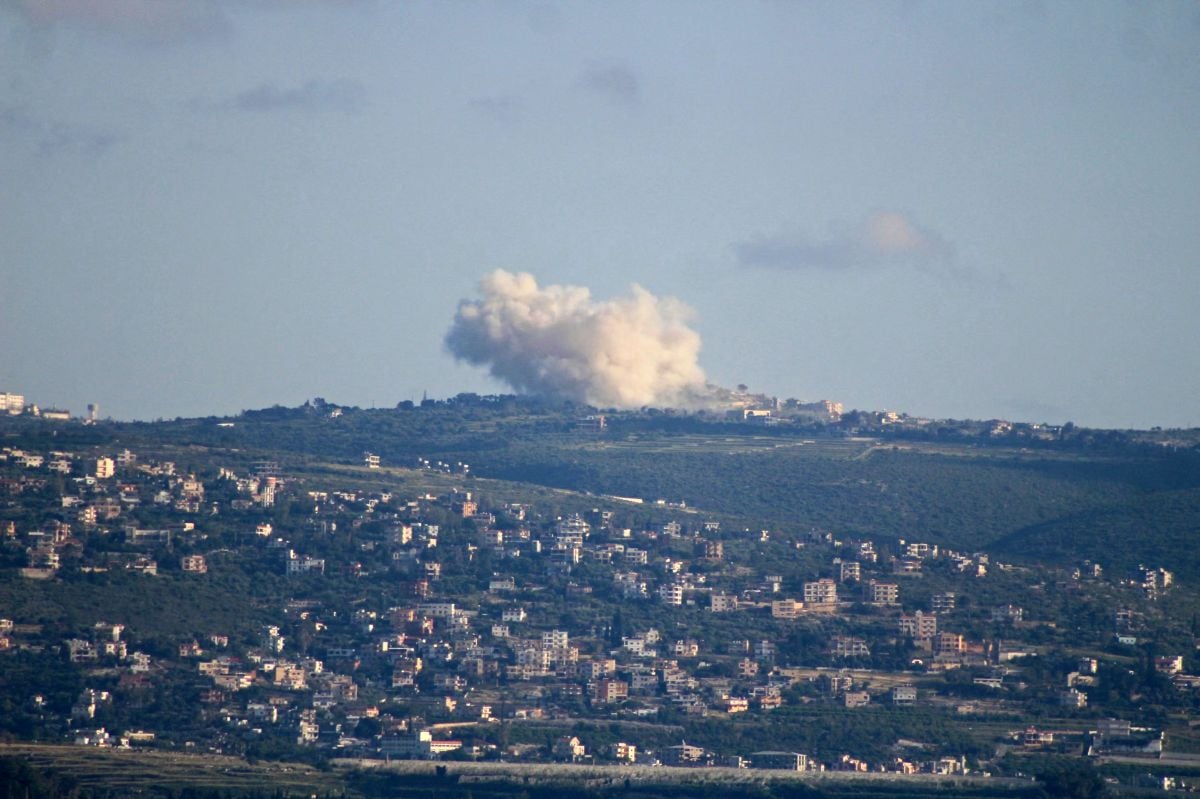
This photograph taken from the southern Lebanese area of Sour shows smoke rising from an Israeli controlled explosion in the village of Chamaa on May 1, 2026. (Credit: Kawnat Haju/AFP)






BEIRUT — Since Friday, Israeli strikes have repeatedly targeted the Nabatieh area, highlighting a fragile and increasingly strained truce.
Signs of rising tension included the daily death toll published by the health ministry, which recorded 2,576 killed on Thursday, climbing to 2,679 by Sunday afternoon. The Israeli army, for its part, claims it has destroyed dozens of Hezbollah infrastructures.
On Sunday morning, the Israeli army ordered the evacuation of about a dozen villages in south Lebanon, all located outside the de facto buffer zone it has established along the border. The 11 villages affected by these forced evacuations are: Doueir, Arab Salim, Sharqieh, Jibsheet, Breiqeh, Qaaqaaiyet al-Jisr, Qsaybeh and Kfar Sir in the Nabatieh district, as well as Kfar Dounine and Braasheet in the Bint Jbeil district, and Srifa in the Sour district.
Doueir and Jibsheet had already been targeted in threats published by the army the previous day. Residents of these villages, which had already been bombed several times in recent days even before the evacuation orders were issued, were ordered to move at least one kilometer away. A few hours later, heavy artillery fire hit Sharqieh, Qsaybeh and Srifa, the latter reportedly struck at least four times, according to our correspondent.
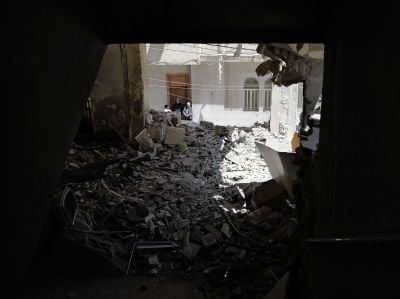
Intense strikes also targeted Jibsheet, Doueir and Arab Salim. In the latter village, airstrikes completely destroyed a restaurant and a nearby pharmacy, killing two people. Due to the presence of gas canisters and fuel tanks at the site, an explosion and fire followed the strikes.
In Breiqeh, a strike killed two people. Also in the same district, drone strikes targeted the city of Nabatieh and its surroundings on Saturday, according to our correspondent. Additional strikes hit Zebdine, Zawtar Sharqieh and Adsheet Shaqif.
Shells also fell on Zawtar Sharqieh and Mayfadoun, followed by heavy machine-gun fire in the valley between Zawtar Sharqieh and Zawtar Gharbieh, after several other bombardments in these areas. In addition to Nabatieh, strikes also hit Kounin (Bint Jbeil), Majdal Zoun (Sour), as well as artillery fire on Froun and Ghandourieh (Bint Jbeil).
Also on Saturday, one person was killed in a drone strike targeting a motorcycle in Shaaitiyeh (Sour). Three people were killed in two separate attacks targeting motorcycles in Semmaiyeh (Sour). In Zawtar Sharqieh (Nabatieh), two people were injured in a strike on a pickup truck. Injuries were also reported in Qana (Sour) after a strike on a utility vehicle. On Friday, the Israelis targeted the village of Habboush in the Nabatieh district. An apartment building, a supermarket and several homes were bombed.
Religious buildings damaged
In this context, the Israeli army admitted Saturday that its forces had "damaged a religious building" in Yaroun, in the Bint Jbeil district, after an outcry over the confirmed demolition of a convent of nuns in the village and an adjoining school.
The destruction in Yaroun, of what remained of the convent that had already been heavily destroyed in 2024 and the adjoining school, was confirmed Friday by our correspondent's sources in south Lebanon.
However, the Israeli foreign ministry denied that the building, described as a "monastery," had been "destroyed," sharing a photo of a two-story house with the message. The Yaroun municipality also condemned, in a statement, the destruction of a husseiniyah (Shiite place of worship) by the Israeli army.
For its part, Hezbollah claimed between Friday and Sunday morning several new attacks with artillery shells and exploding drones on Israeli vehicles and soldiers in south Lebanon.
Haykal-Clearfield meeting
In this context, Lebanese Army Commander Rodolph Haykal and the head of the cease-fire monitoring committee for November 2024 (the 'mechanism'), U.S. Gen. Joseph Clearfield, held an "exceptional meeting" at Beirut air base on Saturday, the army announced.
"The exceptional meeting followed a brief visit by Gen. Clearfield. The talks focused on the security situation in Lebanon, regional developments, as well as ways to strengthen the role of the mechanism and further develop its work."
The statement also stressed "the importance of the army's role and the need to support it in the current phase." Gen. Clearfield left Lebanese territory after the meeting. The meeting took place as part of a fragile cease-fire, negotiated by the United States between Hezbollah and Israel and aimed at ending the major war that broke out on March 2.